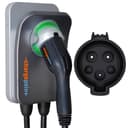
Amp & Adapter

ChargePoint Home Flex Review

The adjustable 16-50A charger that fits almost any panel — what the amperage dial actually buys you, and who should look at a cheaper 40A box instead.

By Stephen V.Last updated How we rank

The ChargePoint Home Flex is the charger we point most people to first, and the reason is boring in the best way: its amperage is dial-adjustable from 16A up to 50A, so a single unit fits almost any circuit an electrician can give you. You don’t have to know your panel perfectly before you buy, and if you move house or upgrade your service later, the charger comes with you. It costs a little more than a bare 40A box — here’s what that premium does and doesn’t buy.

How this is funded:we earn a commission if you buy through our links, at no extra cost to you. It never changes which product we recommend, and we’ll tell you plainly when we’d skip one. Full disclosure.

Quick picks

Ranked on published specs, install flexibility and buyer fit. Select a row to jump to the full write-up. We have not bench-tested these units — here is exactly what we do instead.

#ProductBest forPrice
1
ChargePoint Home Flex

ChargePoint Home Flex

The default recommendation for most homes: an adjustable amperage from 16A up to 50A means one unit fits almost any panel, and the app is the most mature in the category. You pay a little for the polish, but it's the safe pick.

Our pick — most homes
$494.00 · View on Amazon

Price as of July 19, 2026. #ad How we’re funded

The picks in full

#1Our pick — most homes

ChargePoint Home Flex

The default recommendation for most homes: an adjustable amperage from 16A up to 50A means one unit fits almost any panel, and the app is the most mature in the category. You pay a little for the polish, but it's the safe pick.

Strengths

  • Amperage is dial-set from 16A to 50A, so it matches whatever circuit your electrician can give you
  • Plug-in (NEMA 14-50) or hardwired from the same box
  • Mature app with scheduling, energy tracking and utility rate integration

Trade-offs

  • Costs more than a bare-bones 40A unit that does the same core job
  • App-forward design is more than a set-and-forget owner needs
ConnectorJ1772
Max output50 A
Max power12 kW
Cable length23 ft
InstallPlug-in (NEMA 14-50) or hardwired
Outdoor ratingNEMA 3R (indoor/outdoor)
Warranty3 years

Spec note. The 50A model needs a 60A breaker if hardwired at full output (the continuous-load 80% rule). On a NEMA 14-50 plug it's capped at 40A / 9.6 kW, which is plenty for overnight charging.

Specs read from the product listing, on July 19, 2026. “Not published” means the manufacturer does not state that figure.

Who it’s for

The Home Flex suits the buyer who wants to make one confident decision and be done. Because the amperage is set at install time, you don’t have to match the charger to your circuit at the checkout — the electrician simply dials it to whatever your panel supports, whether that’s a modest 32A or the full 50A. It also suits anyone who values a mature app: ChargePoint has been in this business a long time, and scheduling, energy tracking and utility-rate integration all work without fuss.

The amperage dial, and why it matters

Most chargers are a fixed amperage; the Home Flex is a range. That flexibility is worth real money if you’re not sure what circuit you’ll end up with, or if you might upgrade your panel down the line. Hardwired on a 60A circuit it delivers its full 50A (12 kW); on a NEMA 14-50 plug it’s capped at 40A (9.6 kW), which is still more than enough for overnight charging. If you already know you only have a 40A circuit and never plan to change it, a fixed 40A charger like the Grizzl-E Classic does the same everyday job for less.

Install and build

It installs plug-in or hardwired from the same box, and it’s rated NEMA 3R for indoor or outdoor mounting. As always, the circuit is a licensed electrician’s job — and if you’re plugging into a NEMA 14-50, spend the few extra dollars on an industrial-grade outlet; the charger is only as safe as the receptacle it plugs into. The cable is a usable 23 feet.

The app

Connectivity is the Home Flex’s selling point and its one caveat. The app is genuinely useful for scheduling around cheap overnight rates, but it’s also a feature you can live without — a “dumb” charger has one less thing to fail. If you know you’ll never open an app, you’re paying for something you won’t use, and a simpler unit is the smarter buy.

Alternatives

If you want 48A on a budget and have a 60A circuit, the Emporia gives you more amps per dollar. If you want the same features with a different build, the Autel MaxiCharger is the closest rival worth comparing on price. And if you drive a Tesla and also want to charge a non-Tesla, see our Tesla Wall Connector comparison.

Verdict

The Home Flex is the safe default: the adjustable amperage removes the one decision most buyers get wrong, and the app is mature if you want it. Pay the small premium for the flexibility if you value it; if you know your circuit and don’t want an app, a fixed 40A charger saves you money without costing you any real charging speed.

Frequently asked questions

What amperage should I set the ChargePoint Home Flex to?

As high as your circuit safely supports, up to 50A. The 80% rule means a 50A charger needs a 60A breaker and a 40A setting needs a 50A breaker. Your electrician sets it during install to match your panel — that's the whole advantage of the adjustable dial.

Can the Home Flex be hardwired?

Yes. Plug-in (NEMA 14-50, capped at 40A) and hardwired (up to the full 50A on a 60A circuit) are both supported from the same unit. Hardwiring is the way to get the maximum output and removes the outlet as a failure point.

Is the ChargePoint Home Flex worth it over a cheaper charger?

It's worth the premium if you value the adjustable amperage and a mature app, or if you're unsure what circuit you'll get. If you already know you have a 40A circuit and don't want an app, a fixed 40A charger does the same daily job for less.

Does it work with non-Tesla and Tesla cars?

It has a J1772 connector, so it works directly with any non-Tesla EV and with a Tesla using a cheap J1772-to-Tesla adapter. For a home unit built around Tesla's plug, compare it against the Tesla Universal Wall Connector.

Sources

Keep reading