Tesla Wall Connector vs ChargePoint Home Flex
Connector, amperage, install and cross-brand compatibility, side by side — which home charger wins for a Tesla, and which for everyone else.
These are two of the most common home chargers people cross-shop, and they answer slightly different questions. The Tesla Wall Connector is the factory option for a Tesla: a native NACS handle, 48A, hardwired to the wall and run from the Tesla app. The ChargePoint Home Flexis a J1772 charger from the company with the most established charging app — and the version sold on Amazon as of 20 September 2026 is the NEMA 14-50 plug-in model, a 40A unit; ChargePoint’s hardwired 16–50A Home Flex is a separate product that is not listed there. The short answer: the Tesla unit wins in a Tesla-only garage that already has the circuit, and the ChargePoint wins for a mixed-brand household or anyone who wants to plug in rather than hardwire.
How this is funded: we earn a commission if you buy through our links, at no extra cost to you. It never changes which product we recommend, and we’ll tell you plainly when we’d skip one. Full disclosure.
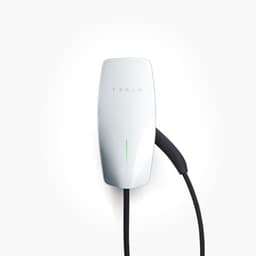 Tesla Wall Connector Tesla Wall Connector | 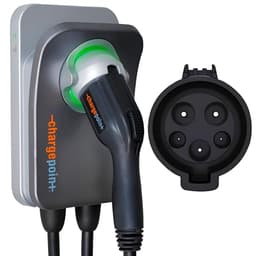 ChargePoint Home Flex (NEMA 14-50 plug) ChargePoint Home Flex (NEMA 14-50 plug) | |
|---|---|---|
| Connector | NACS (Tesla) | J1772 |
| Max output | 48 A | 40 A |
| Max power | 11.5 kW | 9.6 kW |
| Cable length | 24 ft | 23 ft |
| Install | Hardwired (60A circuit for full output) | Plug-in (NEMA 14-50); hardwired 50A and NEMA 6-50 sold as separate models |
| Outdoor rating | Indoor/outdoor rated | NEMA 3R (indoor/outdoor) |
| Warranty | 4 years (residential) | 3 years |
| Price | $883.99 · View on Amazon Price as of October 18, 2026. #ad How we’re funded |
Connector and compatibility
This is the real dividing line. The Tesla Wall Connector has a NACS plug and nothing else: a Tesla plugs straight in, and any J1772 car needs a NACS-to-J1772 adapter that Tesla does not supply. The ChargePoint has a J1772 plug, so it charges any non-Tesla directly and a Tesla with a cheap J1772-to-Tesla adapter you keep on the cable. If every car you own is a Tesla, the native NACS handle is the tidier answer; in any mixed-brand garage the ChargePoint is the one that needs fewer parts.
Tesla also builds a Universal Wall Connector with a J1772 adapter built into the handle, which would settle this section on its own — at a higher price than the standard unit, and still hardwired only. We compare it with the standard unit in Tesla Wall Connector vs Universal Wall Connector.
Amperage and speed
The Tesla unit delivers up to 48A (11.5 kW) hardwired. The plug-in ChargePoint linked here delivers 40A (9.6 kW) on a 50A circuit, or 32A on a 40A circuit — ChargePoint’s hardwired Home Flex reaches 50A, but it is not on Amazon as we write this. In practice the gap between 40A and 48A is about eight miles of range per hour: both add well over 300 miles in a night, and both are limited by your car’s onboard charger anyway. The Tesla is the faster unit on paper; you will only notice if you routinely arrive near empty and leave early.
Install
Here the two are opposites. The Tesla Wall Connector is hardwired only, so you commit to a permanent install on a 60A circuit. The ChargePoint we link is plug-in only: it goes on a NEMA 14-50 outlet, which is the cheaper install and the one you can take with you if you move. ChargePoint sells a hardwired Home Flex as a separate model, so that choice is made at purchase, not at install — and today it means buying from somewhere other than Amazon. If you rent, or might move, the plug wins. Read our plug-in vs hardwired guide for the trade-offs.
Availability and the app
The ChargePoint is widely stocked and has a mature app for scheduling and energy tracking. The Tesla Wall Connector is also sold direct from Tesla, so retail stock and pricing move around — check the current price before you count on it. Both are Wi-Fi-connected; ChargePoint’s app is the more established of the two, while Tesla’s integrates tightly if you drive a Tesla.
Which should you buy?
Buy the Tesla Wall Connector if every car in the household is a Tesla, an electrician has confirmed a 60A circuit, and you want the factory unit that lives in the same app as the car. Buy the ChargePoint Home Flexif you drive non-Tesla EVs, want to plug in rather than hardwire, or simply want the safe default — a certified 40A unit on a 14-50 outlet with the most mature app in the category. For a mixed-brand household, that makes the ChargePoint the easier recommendation; the Tesla unit is the specialist pick for a Tesla-only garage that wants 48A. See how both compare against the value and 48A options in our best home chargers roundup, or, if you only ever charge Teslas, our roundup of home chargers with a factory NACS plug.
Frequently asked questions
Can the ChargePoint Home Flex charge a Tesla?
Yes, with an inexpensive J1772-to-Tesla adapter. The ChargePoint has a J1772 plug, and the adapter bridges it to a Tesla's NACS port for normal Level 2 charging. Many Tesla owners keep one on the charger cable permanently.
Can the Tesla Wall Connector charge a non-Tesla EV?
Only with a NACS-to-J1772 adapter, which is not included. Tesla's Universal Wall Connector has one built into the handle, at a higher price and still hardwired only — so for a mixed-brand garage, a J1772 charger like the ChargePoint is often the simpler answer.
Is one faster than the other?
The Tesla, slightly. It does up to 48A hardwired; the plug-in ChargePoint Home Flex sold on Amazon runs at 40A on a 50A circuit (ChargePoint's hardwired Home Flex reaches 50A but is not currently listed there). Both add well over 300 miles overnight and both are capped by your car's onboard charger, so choose on connector and install type first.
Which is easier to install?
The ChargePoint, for most people, because the model we link plugs into a NEMA 14-50 outlet on a 50A circuit. The Tesla Wall Connector is hardwired only, which means a permanent install on a 60A circuit. Both require a licensed electrician to install the circuit.
Sources
- U.S. DOE Alternative Fuels Data Center — Charging Electric Vehicles at Home — DOE guidance on Level 1 vs Level 2 home charging, 120V/240V service and installation (accessed July 19, 2026)
- U.S. DOE Alternative Fuels Data Center — Electric Vehicle Charging Stations — DOE overview of charging levels, power output and connector types (J1772, CCS, NACS) (accessed July 19, 2026)
- SAE International — J3400 North American Charging System (NACS) for Electric Vehicles — The SAE standard for the NACS connector (Tesla's plug), alongside the J1772 AC standard (accessed July 19, 2026)
Keep reading
Best home chargers for a Tesla
Every Level 2 wall charger that ships with a factory NACS plug, so nothing dangles off the handle.
See the Tesla roundupChargePoint Home Flex review
The full review of the cross-brand option here — the 40A plug-in model sold now, and where it is beaten.
Read the ChargePoint reviewBest J1772-to-Tesla adapters
The cheap part that lets a Tesla charge from any J1772 charger — including the ChargePoint on this page.
Compare the adaptersBest Tesla charging accessories
The holsters, adapters and cable organizers that make living with a NACS car easier.
See the accessoriesTesla Wall Connector vs Emporia Level 2
The same Tesla unit against the 48A charger that starts on a plug and converts to hardwired later.
See that comparisonTesla Wall Connector vs Grizzl-E Classic
The same Tesla unit against a deliberately dumb cast-aluminum box, and the install cost that settles it.
See that comparisonTesla Wall Connector vs a NEMA 14-50 outlet
Skip the wall unit entirely — what an outlet and a portable actually cost and deliver instead.
Compare the installs