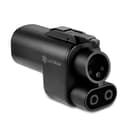
Amp & Adapter

Are EV Charging Adapters Safe?

The good ones are, because an adapter cannot override the handshake between the car and the charger. What separates a good one from a bad one is a named safety standard, the vehicle's own supported list, and whether the thing is hanging off your charge port under its own weight.

By Stephen V.Last updated How we rank

How this is funded: we earn a commission if you buy through our links, at no extra cost to you. It never changes which product we recommend, and we’ll tell you plainly when we’d skip one. Full disclosure.

A well-made adapter is safe, and the reason is structural rather than reassuring: an adapter sits inside a safety system it cannot overrule. The car and the charger negotiate before anything is energized, and they keep monitoring throughout. What an adapter cando badly is add resistance, add weight and add a failure point — which is why the useful question is not “are adapters safe” but “what separates a good one from a bad one”.

Why the car, not the adapter, is in charge

Three mechanisms do the work, and none of them is in the adapter.

The pilot handshake. Plug in and a dedicated low-voltage conductor carries a signal between the charger and the car before any power moves. The charger confirms the connector is fully seated and the ground path is intact; the car states the maximum current it will accept; the charger states what it can supply. Only then do the high-current contacts energize. Pull the plug and the pilot drops first, so the contacts de-energize before they separate.

Ground-fault protection.The charging equipment continuously compares current out against current back. Any leakage path opens the circuit in a fraction of a second. An adapter does not disable this — it is part of the path being monitored.

On DC, considerably more.A DC fast charger does not simply apply voltage. It negotiates a target voltage and current with the car’s battery management system over a digital link, runs an insulation-resistance check before closing its contactors, and the car commands the current throughout the session. If an adapter degraded that communication, the session would not start.

Our connector guide covers what each pin does, and our AC versus DC guide explains why the two cases are so different in what they demand of a part in the middle.

The standards layer, which did not used to exist

Adapters used to be aftermarket improvisation. That changed when SAE published J3400, standardizing the NACS connector that had been Tesla’s own design. A standardized connector on both sides means an adapter is now a defined part bridging two specifications rather than a hack bridging a specification and a proprietary plug.

The part that matters when you are shopping is the testing standard, and for adapters specifically that is UL 2252— the safety standard for electric vehicle coupler adapters. One of the picks below names it on its own listing — our review of the LENZ CCS-to-NACS adapter goes through what its listing publishes — and that is the single most useful thing printed on any adapter box, especially on a DC part carrying hundreds of volts.

What we will not do is treat silence as compliance. Where a listing names no testing body, our product card says the certification is not published rather than assuming it exists. Our certification guide sets out how UL 2594, UL 2231 and UL 2252 relate to each other.

What Tesla itself says, and why it is worth reading carefully

This is the most-cited and least-understood document in the category, so here it is plainly.

Tesla’s Gen 3 Wall Connector installation manual (part number 1457768) carries a safety caution: “No adapters or conversion adapters are allowed to be used”. Tesla’s charging-equipment limited warranty separately excludes damage arising from the “use of non-genuine Tesla accessories or parts”.

Note what that is and is not. It is a manufacturer’s instruction about its own home charger— do not put a third-party adapter on the end of a Tesla Wall Connector to charge a J1772 car. It is not a statement about adapters generally, and it is certainly not a statement about the J1772 adapter Tesla itself supplies with its cars for use at public stations. Tesla’s own Universal Wall Connector datasheet lists both NACS and J1772 connectors, because that unit docks Tesla’s adapter as part of the product.

The practical reading: use the manufacturer’s own adapter where there is one, and where you are adapting someone else’s hardware, understand that you are outside their support. If your household has both a Tesla and a J1772 car, buy a J1772 charger and adapt at the Tesla end — our Wallbox versus Tesla Wall Connector comparison works that decision through.

The four things that actually go wrong

1. Heat at the interface

Every connection is a resistance and resistance makes heat. An adapter inserts two more contact interfaces into a path that may be carrying 40 amps for six hours, or far more on DC. Undersized or poorly plated contacts get warm, warm contacts oxidise, and oxidised contacts get warmer. That feedback loop is the documented failure mode in this category.

What to do about it: buy an adapter whose rating is at or above the current you will actually pass through it, and put your hand on it after the first long session. Warm is a warning, hot is a stop.

2. Mechanical load on the charge port

This is the risk most people underestimate. An adapter lengthens the assembly and moves the cable’s weight further out, turning a heavy station cable into a lever against your car’s port. DC cables are heavy. Support the assembly — rest the cable on something, loop it so the weight is taken by the cable rather than the port — and never leave it hanging.

3. Using one where the combination is not supported

On DC in particular, whether an adapter works is a property of your specific vehicle and the specific station, not of the adapter alone. Manufacturers publish supported vehicle lists; check yours before buying, and expect some stations to refuse the session even where the car is listed. That is the system declining to proceed, which is the safety mechanism working.

4. Leaving it on a public charger

Mundane, extremely common, and not an electrical risk at all: adapters get left clipped to station handles and walk away. The small ones cost under fifty dollars and the DC ones cost several hundred. A locking ring or lock is the cheap fix — our adapter locks page covers them.

When we would not use an adapter

  • No named safety standard on the listing. Especially on DC. This is the one hard rule.
  • A cracked, loose or discoloured housing. Retire it. A charge port is more expensive than an adapter.
  • As a permanent part of a home installation.An adapter is a travel item. If you need one every night, you bought the wrong charger — buy the connector your car actually has. Our native-NACS charger roundup and main roundup cover both sides.
  • Stacked on another adapter. Two adapters in series doubles the added interfaces and the lever arm, for no good reason.

The short answer

Adapters are safe because they cannot overrule the handshake, the ground-fault monitoring or the car’s own battery management. Buy one that names UL 2252 on the listing, match its rating to the current you will pass, check your vehicle is on the manufacturer’s supported list for DC use, support the weight so nothing hangs off the port, and keep it as a travel item rather than a permanent fixture of your home charging. On that basis the J1772 adapter in a Tesla’s frunk is one of the most useful forty dollars in EV ownership.
Quick picks

Ranked on published specs, install flexibility and buyer fit. Select a row to jump to the full write-up. We have not bench-tested these units — here is exactly what we do instead.

#ProductBest forPrice
1
Lectron J1772 to Tesla Adapter

Lectron J1772 to Tesla Adapter

The adapter every Tesla owner should keep in the frunk: it lets a Tesla (or any NACS car) charge from the millions of public and home J1772 stations. Cheap, compact, and the single most useful $40 a Tesla owner can spend.

The AC adapter worth owning
$39.99 · View on Amazon

Price as of October 10, 2026. #ad How we’re funded

2
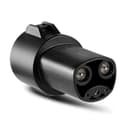
LENZ CCS1 to NACS Adapter

LENZ CCS1 to NACS Adapter

The one we would buy. It is the only CCS-to-Tesla adapter here whose listing names an actual safety standard — UL 2252 — which on a part carrying hundreds of volts of DC is the difference that matters far more than the price gap.

The DC adapter with a named standard
$69.99 · View on Amazon

Price as of October 10, 2026. #ad How we’re funded

3
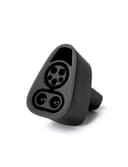
Lectron Vortex NACS to CCS1 Adapter

Lectron Vortex NACS to CCS1 Adapter

Lectron's take on the NACS-to-CCS DC adapter, generally a step cheaper than the A2Z while covering the same core job — Supercharging a CCS car. A sensible value option if your vehicle is on the supported list.

The DC adapter for a CCS car at a Supercharger
$199.99 · View on Amazon

Price as of October 10, 2026. #ad How we’re funded

The three adapters, in full

#1The AC adapter worth owning

Lectron J1772 to Tesla Adapter

The adapter every Tesla owner should keep in the frunk: it lets a Tesla (or any NACS car) charge from the millions of public and home J1772 stations. Cheap, compact, and the single most useful $40 a Tesla owner can spend.

Strengths

  • Opens up every J1772 Level 2 station to a NACS car
  • Rated for full 48A / Level 2 AC charging
  • Small enough to live in the glovebox

Trade-offs

  • AC charging only — this is not a Supercharger or DC-fast adapter
  • Locking behavior varies by station; some public units grip it loosely
ConnectorJ1772 → NACS (Tesla)
Max output48 A
Max power11.5 kW
Cable lengthNot published
InstallPlug-on adapter
Outdoor ratingNot published
Warranty1 year

Spec note. For AC (Level 2) charging only. It does not enable DC fast charging and is unrelated to the NACS-to-CCS DC adapters non-Tesla cars use at Superchargers.

Specs read from the product listing, on July 19, 2026. “Not published” means the manufacturer does not state that figure.

#2The DC adapter with a named standard

LENZ CCS1 to NACS Adapter

The one we would buy. It is the only CCS-to-Tesla adapter here whose listing names an actual safety standard — UL 2252 — which on a part carrying hundreds of volts of DC is the difference that matters far more than the price gap.

Strengths

  • Listing cites UL 2252, the safety standard for EV coupler adapters
  • 500V published rating covers the CCS stations a Tesla will realistically use
  • LENZ is an established adapter brand rather than a marketplace nameplate

Trade-offs

  • Costs more than the unbranded CCS adapters, which is the point
  • Your Tesla still has to support CCS charging — older cars may need Tesla's retrofit
  • Not every CCS station handshakes cleanly with every adapter
ConnectorCCS1 → NACS (Tesla)
Max outputNot published
Max powerNot published
Cable lengthNot published
InstallPlug-on adapter
Outdoor ratingNot published
WarrantyNot published

Spec note. The listing publishes a 500V rating and UL 2252 testing for DC fast charging into NACS vehicles. It does not publish a peak kW or amp figure, so those read as not published — the real ceiling is set by the station and the car.

Specs read from the product listing, on August 11, 2026. “Not published” means the manufacturer does not state that figure.

#3The DC adapter for a CCS car at a Supercharger

Lectron Vortex NACS to CCS1 Adapter

Lectron's take on the NACS-to-CCS DC adapter, generally a step cheaper than the A2Z while covering the same core job — Supercharging a CCS car. A sensible value option if your vehicle is on the supported list.

Strengths

  • Cheaper route to Tesla Supercharger access for a CCS car
  • Compact, from a brand that specializes in adapters
  • Covers the common DC-fast use case

Trade-offs

  • Sustained-current ceiling is generally below the priciest options
  • Same vehicle/site compatibility caveats as any NACS-to-CCS adapter
ConnectorNACS (Tesla) → CCS1
Max outputNot published
Max powerNot published
Cable lengthNot published
InstallPlug-on DC adapter
Outdoor ratingNot published
Warranty1 year

Spec note. A DC fast-charging adapter, not an AC one. As with every NACS-to-CCS adapter, whether it works depends on your specific EV and the Supercharger — check the supported-vehicle list first.

Specs read from the product listing, on July 19, 2026. “Not published” means the manufacturer does not state that figure.

General guidance, not electrical advice. Amp & Adapter is written by an EV-charging enthusiast, not a licensed electrician. Circuit sizing, breakers and hardwired installs must be done by a qualified electrician to local code — the figures here are for planning a purchase, not a wiring job.

Frequently asked questions

Are EV charging adapters safe to use?

A properly made one is, because it cannot override the safety system. Before any current flows, the car and the charger exchange a pilot signal, confirm the connection is seated and grounded, and agree the current — and on DC that handshake also negotiates voltage and runs isolation checks. An adapter passes those signals through; it does not get a vote. What makes an adapter unsafe is poor construction: undersized contacts, no named safety standard, or a housing that lets the assembly hang off your charge port.

What is the difference between an AC and a DC charging adapter?

How much they are being asked to do. An AC adapter (J1772 to NACS, or NACS to J1772) handles Level 2 charging at up to about 48 amps and is essentially a pin remap in a housing. A DC adapter (NACS to CCS, or CCS to NACS) sits in a path carrying several hundred volts and hundreds of amps, with the station's own isolation monitoring and thermal management on the other side. The DC case is where a named safety standard stops being optional.

What safety standard should an EV adapter have?

Look for UL 2252, which is the standard for electric-vehicle coupler adapters, named on the listing rather than implied. For the charging equipment itself the relevant standards are UL 2594 and UL 2231. An adapter whose listing names no testing body at all is one we would not buy at any price, and we say so on the product cards.

Does Tesla allow adapters on a Wall Connector?

Tesla's own Gen 3 Wall Connector installation manual states in its safety section: 'No adapters or conversion adapters are allowed to be used.' Tesla's charging-equipment warranty also excludes damage from the use of non-genuine Tesla accessories or parts. For a mixed-car household Tesla sells the Universal Wall Connector instead, which docks Tesla's own J1772 adapter on the side of the unit — a supported arrangement rather than a workaround.

Can an adapter damage my car's charge port?

Mechanically, yes — and that is the realistic risk rather than an electrical one. An adapter plus a heavy station cable creates a cantilever load on the port, and DC cables are the heaviest. Support the weight so the assembly is not hanging on the port, do not let the connector dangle, and stop using an adapter whose housing has cracked or whose fit has gone loose.

Will an adapter slow down charging?

On AC, effectively no — a 48-amp-rated adapter on a 40-amp charger is not the constraint. On DC it depends on the vehicle, the station and the adapter's own rating, and the honest answer is that the ceiling is set by whichever of the three is lowest. We cover that specifically in our guide to NACS-to-CCS adapter charging speed.

Sources

Keep reading