Lectron vs A2Z NACS-to-CCS Adapter
The two best-known DC adapters, side by side — ratings, interlocks and brand track record, on the part that carries the most current you will ever hold.
These are the two names that come up whenever a CCS owner asks what to buy for Supercharging, and the comparison is genuinely close. Both are rated for the full envelope of a Supercharger stall. Both are made by companies that specialize in this rather than by anonymous marketplace sellers. Neither will charge your car faster than the other, because no adapter does— the session speed is negotiated between the station and your car.
So the decision comes down to two things: which published specification you weight more heavily, and how much a longer consumer track record is worth to you.
The short answer: the A2Z Typhoon Pro publishes the higher voltage ceiling and is the one we would buy for a car that Superchargers often, particularly an 800V one. The Lectron publishes an interlock and comes from the most established brand in consumer EV adapters, which is a reasonable thing to weight heavily on a part you handle in the rain.
Before either: an adapter alone is not enough. Your vehicle must be enabled for non-Tesla Supercharger access and the site must support it. Our Supercharger access guide covers all three conditions.
How this is funded: we earn a commission if you buy through our links, at no extra cost to you. It never changes which product we recommend, and we’ll tell you plainly when we’d skip one. Full disclosure.
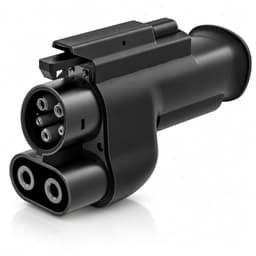 A2Z NACS to CCS1 Adapter (Typhoon Pro) A2Z NACS to CCS1 Adapter (Typhoon Pro) | 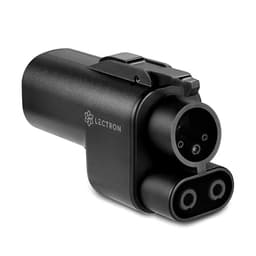 Lectron Vortex NACS to CCS1 Adapter Lectron Vortex NACS to CCS1 Adapter | |
|---|---|---|
| Connector | NACS (Tesla) → CCS1 | NACS (Tesla) → CCS1 |
| Max output | Not published | Not published |
| Max power | 500 kW | Not published |
| Cable length | Not published | Not published |
| Install | Plug-on DC adapter | Plug-on DC adapter |
| Outdoor rating | Not published | Not published |
| Warranty | 1 year | 1 year |
| Price | $169.99 · View on Amazon Price as of October 18, 2026. #ad How we’re funded | $199.99 · View on Amazon Price as of October 18, 2026. #ad How we’re funded |
The ratings: what 1000V buys you
Both publish a 500A current ceiling, which comfortably exceeds anything a Supercharger stall delivers. On current, treat them as equivalent.
The difference is voltage. The A2Z publishes 1000V; the Lectron publishes a lower figure. For a conventional 400V car this is academic — neither is anywhere near its limit and both have enormous margin. It becomes relevant if you drive an 800V vehicle: an Ioniq 5, an EV6, an EV9, a Taycan, and an increasing share of new models. Those cars are the ones whose sessions push closest to a part’s voltage envelope, and headroom is what keeps a component from being the constraint.
Two honest caveats. First, an 800V car at a 400V-native Supercharger stall is usually limited by the architecture mismatch long before any adapter is the issue — our Kia EV6 and Ioniq 5 pages explain that in detail. Second, a higher published ceiling is a design margin, not a promise of better real-world behavior. It is a reasonable tiebreaker, not a decisive one.
The interlock: the Lectron’s clearest argument
The Lectron listing publishes an interlock, and it is the specification we would most want on a DC adapter.
An interlock is a mechanism that prevents the adapter being separated from the connector while current is flowing. That matters because breaking a several-hundred-amp DC connection under load is exactly the event you want made impossible rather than merely unlikely — it can arc, and arcing damages contacts on both the adapter and, potentially, the station. On an AC adapter this is a non-issue. On DC it is the safety feature that separates a properly engineered part from a cheap one.
If you weight this above the voltage headroom — and there is a good argument for doing so, particularly with a 400V car where the extra volts are irrelevant — the Lectron is your adapter. The full NACS-to-CCS roundup also covers the FOCSPROD, which publishes an interlock at a lower price.
Brand track record
Lectron is the most established name in consumer EV adapters. It makes the J1772-to-Tesla adapter that sits in an enormous number of gloveboxes, plus portable chargers and AC adapters in both directions. Long product lines with wide distribution generate a lot of field data, and companies that stay in a category tend to have fixed things quietly along the way. If you want the DC part looked at on its own terms rather than as half of a head-to-head, this Lectron NACS adapter review goes through the build and the everyday handling in more detail.
A2Z is the specialist. Its focus is high-current EV connectors rather than a broad accessory catalog, and its published specifications are the most aggressive here. Specialists often build the better part; generalists often have the better support.
Neither answer is wrong. If you buy a lot of EV accessories and value one brand you can go back to, Lectron. If you want the part whose entire reason for existing is this one job, A2Z — our A2Z Typhoon Pro review goes into it properly.
What neither publishes
Both listings are quiet on warranty terms and operating temperature ranges, which read as “Not published” in the table above rather than being filled in with plausible figures. On a part in this price bracket we would like to see both, and if one of them starts publishing a warranty it would move our recommendation.
Which should you buy?
Buy the A2Z Typhoon Pro if you drive an 800V car, if you Supercharge frequently rather than occasionally, or if you simply want the part with the most margin on paper.
Buy the Lectron if you drive a 400V car (where the voltage difference is irrelevant), if the interlock is the specification you care about, or if you would rather buy from the brand with the longest consumer track record.
Buy neither until you have confirmed three things: that your car actually has a CCS1 port rather than a native NACS one, that your vehicle is enabled for non-Tesla Supercharger access, and that your automaker is not already supplying an adapter for your car. Ford, Rivian, Hyundai, Kia and others have run adapter programs on their own timelines, and a manufacturer-supplied unit is validated against your specific vehicle. Our per-vehicle pages for Ford, Rivian and BMW cover what to check.
And if what you actually want is AC
Both of these are DC parts for Supercharging. If you want to use a Tesla Wall Connector or a hotel Destination Charger with a non-Tesla EV, that is AC and needs a Tesla-to-J1772 adapter costing a fraction as much. Our AC vs DC guide explains why the two can never be the same part.
Frequently asked questions
Does the A2Z or Lectron adapter charge faster?
Neither. Charging speed is negotiated between the station and your car's battery management system, bounded by the station's output, your car's maximum DC rate and charge curve, and battery temperature. Both adapters are rated well beyond what a Supercharger stall delivers — their job is to pass the session without becoming the weak link.
What is an interlock and do I need one?
An interlock prevents the adapter being separated from the connector while current is flowing, which stops a several-hundred-amp DC connection being broken under load. That event can arc and damage contacts. It is the safety feature that most distinguishes a properly engineered DC adapter from a cheap one, and the Lectron publishes it.
Does the 1000V rating matter for my car?
Only if you drive an 800V vehicle — an Ioniq 5, EV6, EV9, Taycan or similar. For a conventional 400V car, both adapters have enormous voltage margin and the difference is academic. Even on an 800V car, the architecture mismatch with a 400V-native Supercharger stall usually limits the session before the adapter does.
Should I buy either if my automaker supplies an adapter?
No — use the automaker's. It has been validated against your vehicle's specific charging hardware and keeps warranty questions simple. Third-party adapters are for owners whose manufacturer route is unavailable, or who want a spare for a second vehicle.
Will either work at a Tesla Destination Charger?
No. Both are DC adapters for Superchargers. Destination Chargers and Wall Connectors are AC, and need a Tesla-to-J1772 adapter — a different and much cheaper part.
Sources
- SAE International — J3400 North American Charging System (NACS) for Electric Vehicles — The SAE standard for the NACS connector (Tesla's plug), alongside the J1772 AC standard (accessed July 19, 2026)
- U.S. DOE Alternative Fuels Data Center — Charging Electric Vehicles in Public — DOE guidance on public AC and DC fast charging (accessed July 19, 2026)
- U.S. DOE Alternative Fuels Data Center — Electric Vehicle Charging Stations — DOE overview of charging levels, power output and connector types (J1772, CCS, NACS) (accessed July 19, 2026)
- U.S. DOE Alternative Fuels Data Center — Electric Vehicles for Consumers — DOE consumer overview of EV ownership, range and charging (accessed July 19, 2026)
Keep reading
Best NACS-to-CCS adapters
The full DC adapter field, including the mid-price options that also publish an interlock.
See the roundupA2Z EV Typhoon Pro review
What the 500A / 1000V rating actually buys you, and how to live with a DC adapter.
Read the reviewSupercharger access for non-Tesla EVs
The three conditions that must all be true — and why buying the adapter first is the expensive mistake.
Check the conditionsJ1772, NACS and CCS explained
Which plug your car has, which adapter bridges which gap, and where the NACS transition leaves you.
Untangle the connectors