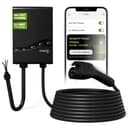

Amp & Adapter

Emporia Pro vs Wallbox Pulsar Plus

Two 48-amp hardwired chargers on the same 60-amp circuit, with the same 25 ft cable and the same three-year warranty. They diverge on how each one solves a panel that is already full — and on how much wall they need.

By Stephen V.Last updated How we rank

Buy the Emporia Pro. It is the cheaper of the two, it publishes a NEMA 4 outdoor rating against the Wallbox’s NEMA 3R, and its PowerSmart load management ships with the panel monitor it needs in the box — which is the one feature here that changes what your house is capable of. Buy the Wallbox Pulsar Plus instead if wall space is genuinely tight, or if you are charging two cars and want two chargers sharing one circuit rather than one charger throttling itself.

On paper these two are close enough to be annoying. Both are 48 amps / 11.5 kW hardwired on a 60-amp circuit. Both carry a J1772 connector on a 25 ft cable. Both have a 40-amp plug-in variant for buyers who do not want to hardwire. Both have app scheduling and energy metering. Both carry a three-year warranty.

So the comparison comes down to three things, and only three: how each one copes with a panel that cannot spare 60 amps, the enclosure rating, and physical size. The first one is where most buyers should make the decision, because it is the thing most likely to stop the install.

We own neither unit and we do not bench-test chargers — here is exactly what we do instead. Specifications below are each manufacturer’s published figures as read from the listings our registry cites, on the dates recorded there; both prices are live from our daily check.

How this is funded: we earn a commission if you buy through our links, at no extra cost to you. It never changes which product we recommend, and we’ll tell you plainly when we’d skip one. Full disclosure.

Quick picks

Ranked on published specs, install flexibility and buyer fit. Select a row to jump to the full write-up. We have not bench-tested these units — here is exactly what we do instead.

#ProductBest forPrice
1
Emporia Pro (48A, hardwired, J1772)

Emporia Pro (48A, hardwired, J1772)

Not a faster charger than the Emporia Classic — Emporia's own comparison puts both at 48A — but a charger you can install where 48A would not otherwise fit. The premium buys PowerSmart load management and the Vue 3 panel monitor it depends on, which throttles charging to whatever headroom your service has left. On a 100A panel that is the difference between charging fast and rewiring the house; on a roomy 200A panel it is a feature you are paying for and will not use.

Better buy for most people
$599.00 · View on Amazon

Price as of October 18, 2026. #ad How we’re funded

2
Wallbox Pulsar Plus

Wallbox Pulsar Plus

The compact one. It's the smallest 48A charger here by a wide margin, so it suits a tight garage wall or a design-conscious install — with power sharing if you end up charging two cars.

Better for a tight wall or two cars
$699.00 · View on Amazon

$799.9913% off

Price as of October 18, 2026. #ad How we’re funded

The picks in full

#1Better buy for most people

Emporia Pro (48A, hardwired, J1772)

Not a faster charger than the Emporia Classic — Emporia's own comparison puts both at 48A — but a charger you can install where 48A would not otherwise fit. The premium buys PowerSmart load management and the Vue 3 panel monitor it depends on, which throttles charging to whatever headroom your service has left. On a 100A panel that is the difference between charging fast and rewiring the house; on a roomy 200A panel it is a feature you are paying for and will not use.

Strengths

  • PowerSmart load management is bundled, not an upsell — the Vue 3 panel monitor it needs is in the box
  • 48A / 11.5 kW hardwired, or 40A on a NEMA 14-50 outlet, from the same unit
  • NEMA 4 rated for indoor or outdoor installation, with a 25 ft cable
  • Rear-entry hardwire option the Classic does not offer, which hides the conduit
  • Solar excess-charging and whole-home energy monitoring in the same app, with no subscription
  • 3-year warranty, and Emporia publishes UL Listed, NEMA rated and ENERGY STAR certification

Trade-offs

  • No faster than the cheaper Emporia Classic — both are 48A, so if you do not need load management you are paying for nothing
  • PowerSmart depends on the Vue 3 sending load data to Emporia's cloud, so the throttling that protects your panel is a connected service, not local hardware
  • The Vue 3 clamps onto your service mains, so an electrician still has to open the panel — 'no panel upgrade' does not mean 'no panel work'
  • Emporia's own “$3,000-$8,000 panel upgrade” saving is the manufacturer's marketing figure, not an independent estimate
  • Emporia does not publish the Pro's ENERGY STAR model number, which rebate forms usually ask for
ConnectorJ1772
Max output48 A
Max power11.5 kW
Cable length25 ft
InstallHardwired (48A); a NEMA 14-50 plug-in SKU runs at 40A
Outdoor ratingNEMA 4 (outdoor)
Warranty3 years

Spec note. Emporia publishes: up to 48A hardwired on a 60A circuit, up to 40A on a NEMA 14-50 outlet (50A circuit), a 25 ft cable, a NEMA 4 indoor/outdoor rating, a rear-entry hardwire option, a 3-year warranty, and UL Listed / NEMA Rated / ENERGY STAR Certified marks. Its own Classic-vs-Pro table lists BOTH models at up to 48A, 25 ft and 3 years — the Pro's differences are PowerSmart load management, the bundled Vue 3 energy monitor, solar and peak-demand features, the square case and rear entry. EPA's ENERGY STAR certified-EVSE database holds one Emporia Corp. family record (EMEVSE1, 48A, 25 ft output cord, 6 AWG, network capability 'Yes', qualified May 2022) covering fifteen further model numbers; Emporia does not publish which one the Pro carries, so confirm the model number with Emporia before filing a rebate that requires it.

Specs read from the product listing, on September 2, 2026. “Not published” means the manufacturer does not state that figure.

#2Better for a tight wall or two cars

Wallbox Pulsar Plus

The compact one. It's the smallest 48A charger here by a wide margin, so it suits a tight garage wall or a design-conscious install — with power sharing if you end up charging two cars.

Strengths

  • Up to 48A / 11.5 kW in the smallest housing in its class
  • Power Boost and Power Sharing for multi-car or limited-panel homes
  • App scheduling and energy metering

Trade-offs

  • Hardwired only for the 48A version — no plug option at full output
  • The compact body runs the cable management tighter than a bigger box
ConnectorJ1772
Max output48 A
Max power11.5 kW
Cable length25 ft
InstallHardwired (48A) or plug-in (40A)
Outdoor ratingNEMA 3R (indoor/outdoor)
Warranty3 years

Spec note. The 40A plug-in variant exists, but the 48A model is hardwired on a 60A circuit. Power Sharing lets two Pulsar Plus units split one circuit — the cleanest answer to charging two EVs without a panel upgrade.

Specs read from the product listing, on July 19, 2026. “Not published” means the manufacturer does not state that figure.

The published specifications, side by side

SpecificationEmporia ProWallbox Pulsar Plus
Max output48 A / 11.5 kW48 A / 11.5 kW
Circuit at full output60 A60 A
InstallHardwired at 48 A; NEMA 14-50 plug-in SKU runs at 40 AHardwired at 48 A; plug-in variant at 40 A
Cable25 ft25 ft
EnclosureNEMA 4 (outdoor)NEMA 3R (indoor/outdoor)
Full-panel answerPowerSmart load management; Vue 3 panel monitor in the boxPower Boost and Power Sharing across two units
SizeSquare case, rear-entry hardwire optionThe smallest 48 A housing in its class
Certification publishedUL Listed, NEMA rated, ENERGY STAR certified (model number not published)Not published on the listing we cite
Warranty3 years3 years
ExtrasSolar excess charging, whole-home energy monitoring, no subscriptionApp scheduling and energy metering

“Not published” in that last-but-two row means exactly that: we read the listing our registry cites for the Pulsar Plus and it does not carry a certification line. That is not a claim the charger is uncertified — it is a gap in what is published, and we would rather say so than fill it in. Our certification guide explains what UL 2594, UL 2251 and ENERGY STAR each actually mean, and our ENERGY STAR rounduponly lists models we found in EPA’s own database by model number.

Two different answers to the same problem: a panel with no room

A 48-amp charger needs a 60-amp circuit, and on a 100- or 125-amp service that is frequently the thing an electrician says no to. Both of these chargers have an answer. They are not the same answer, and the difference is the most useful thing on this page.

Emporia: throttle one charger to the headroom you have

PowerSmart watches your service mains and reduces the charger’s current when the rest of the house is drawing power. The Vue 3 panel monitor that does the watching is bundled, not an upsell — which matters, because competing load management often means buying a sensor separately.

Two honest caveats. The clamps go on your service mains, so an electrician still opens the panel: “no panel upgrade” is not “no panel work”. And the throttling depends on the Vue 3 reporting load data to Emporia’s cloud, so the protection is a connected service rather than local hardware. Emporia also publishes a “$3,000–$8,000 panel upgrade” saving; that is the manufacturer’s own marketing figure, not an independent estimate, and we are not going to repeat it as fact. Our load management guide and 100-amp panel roundup cover this properly.

Wallbox: split one circuit between two chargers

Power Sharing lets two Pulsar Plus units sit on one circuit and divide it. That is a different problem being solved: not “my panel is too small for one charger” but “I have two EVs and one circuit”. If that is your household, it is the cleanest answer in the category and it is the reason the Wallbox appears on our two-EV roundup. Power Boost is the single-unit version, reducing output against household load.

So: one EV on a tight panel, Emporia. Two EVs on one circuit, Wallbox. Both on a roomy 200-amp service with one car, and you are paying for a feature you will never see work — which is worth saying out loud, because load management is the main reason both of these cost more than a plain 48-amp charger.

NEMA 4 against NEMA 3R, and why it decides outdoor installs

Emporia publishes NEMA 4; Wallbox publishes NEMA 3R. Both are genuine outdoor ratings and neither charger is going to dissolve in the rain. The difference: 3R is rated against falling rain, sleet and snow, while 4 adds windblown dust, splashing water and hose-directed water.

In a garage, forget it. On an exposed wall, under a gutter, next to a driveway you hose down, or anywhere a sprinkler reaches, NEMA 4 is the one to buy. Our outdoor charger roundup ranks on exactly these ratings, and charging an EV in the rain explains why the connection itself is safe either way.

Size, which sounds trivial until you are holding one

The Pulsar Plus is the smallest 48-amp charger in this registry by a wide margin. If your charger is going on a narrow strip of wall between a window and a door frame, or in a garage where the car door opens within inches of the unit, that is not a styling preference — it is whether the charger fits.

The Emporia goes the other way: a bigger square case, but with a rear-entry hardwire option that brings conduit in behind the unit instead of alongside it. On a finished wall that is a tidier install and one fewer visible run. Neither is better; they suit different walls.

If you do not need load management at all

Worth saying plainly, because it is the most money-saving sentence on this page. Emporia’s own Classic-versus-Pro table lists bothmodels at up to 48 amps, 25 ft and three years. The Pro is not a faster charger than the cheaper Emporia — the premium is PowerSmart, the bundled monitor, solar and peak-demand features and the case. If your panel has headroom and you have one car, buy down. Our 48-amp roundup has the whole tier, and best budget chargers has the floor.

The short answer

Identical output, identical circuit, identical cable, identical warranty. Emporia is cheaper, better rated for the weather and the right buy for one car on a panel with no room. Wallbox is the one to buy for a tight wall or for two cars sharing a circuit. If neither of those descriptions is you, buy a plain 48-amp charger and keep the difference.

Frequently asked questions

Is the Emporia Pro or the Wallbox Pulsar Plus better?

For most buyers, the Emporia Pro: it is cheaper, it publishes a NEMA 4 outdoor rating against the Wallbox's NEMA 3R, and its PowerSmart load management includes the Vue 3 panel monitor it depends on. The Wallbox is the better buy in two specific cases — a wall too tight for a full-size charger, and a household charging two EVs that wants two units sharing one circuit through Power Sharing.

Are the Emporia Pro and Wallbox Pulsar Plus the same speed?

Yes. Both publish up to 48 amps / 11.5 kW hardwired on a 60-amp circuit, both have a 40-amp plug-in variant, and both ship a 25 ft cable. Nothing on this comparison turns on charging speed — the real differences are the enclosure rating, the physical size and how each one handles a panel that cannot spare 60 amps.

What circuit does a 48-amp EV charger need?

A 60-amp circuit. A continuous load is sized at 125% of its draw, so 48 × 1.25 = 60 amps. Both of these chargers publish that requirement for full output, and both offer a 40-amp variant on a 50-amp circuit if 60 amps is more than your panel can spare. Our amps-and-circuits guide walks through reading your panel before you shop.

Does Emporia's PowerSmart mean I can skip a panel upgrade?

Often, but read the fine print. PowerSmart reduces the charger's current when the rest of the house is drawing power, which can let a 48-amp charger live on a service that could not otherwise carry it. Two caveats Emporia's marketing does not lead with: the Vue 3 clamps onto your service mains, so an electrician still opens the panel, and the throttling depends on the Vue 3 reporting to Emporia's cloud rather than on local hardware. Emporia's own '$3,000-$8,000 panel upgrade' saving is its figure, not an independent one.

What is Wallbox Power Sharing?

It lets two Pulsar Plus units sit on one circuit and divide the available current between them, so two EVs can charge from a single 60-amp feed instead of two. It solves a different problem from Emporia's load management: Power Sharing is for two cars and one circuit, where PowerSmart is for one car and a panel with no headroom. If you have two EVs, Power Sharing is the cleanest answer in this category.

Which one can go outside?

Both, and the Emporia has the better rating. Emporia publishes NEMA 4, which covers windblown dust, splashing and hose-directed water; Wallbox publishes NEMA 3R, which covers falling rain, sleet and snow. In a garage the distinction does not matter. On an exposed wall, under a gutter or within reach of a sprinkler, buy the NEMA 4 unit.

Sources

Keep reading