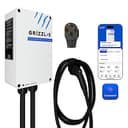
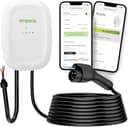
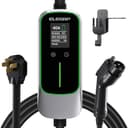
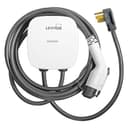
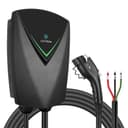
The five, side by side
Every cell comes from the same registry entries as the reviews above. Read the install column before the amperage column: whether a charger plugs in or hardwires determines what the electrician does, what it costs to fit, and whether you can take it with you when you move — and it is not something you can change after purchase on any of these units.
| Product | Connector | Max output | Max power | Cable | Install | Weather rating | Warranty | Price |
|---|
| Grizzl-E Classic Connect 40A (J1772) | J1772 | 40 A | 9.6 kW | 25 ft | Plug-in (NEMA 14-50) | UL Type 4 (indoor/outdoor) | 3 years | |
|---|
| Emporia Level 2 EV Charger | J1772 | 48 A | 11.5 kW | 25 ft | Hardwired (ships with whip) | NEMA 4 (outdoor) | 3 years | |
|---|
| ELEGRP Level 2 EV Charger (40A, NEMA 14-50) | J1772 | 40 A | 9.6 kW | 25 ft | Plug-in (NEMA 14-50) | Not published | Not published | |
|---|
| Leviton EV40P 40A (NEMA 14-50 plug, Wi-Fi) | J1772 | 40 A | 9.6 kW | 25 ft | Plug-in (NEMA 14-50P, 50A circuit) | NEMA Type 3R (indoor/outdoor) | 2 years (limited) | |
|---|
| Lectron Nexus Level 2 (48A, hardwired) | J1772 | 48 A | 11.5 kW | 23 ft | Hardwired only | IP66 (indoor/outdoor) | 3 years | |
|---|
Why a J1772 charger still makes sense in a NACS world
Almost every carmaker in the United States has announced or shipped a NACS charge port, which raises an obvious worry: is a J1772 charger a stranded asset? In practice, no, for three reasons.
First, the standard underneath has not changed.NACS, now standardised as SAE J3400, is a connector shape. The AC signalling it carries at a home charger is the same J1772 protocol, which is why a passive forty-dollar adapter is all that stands between a J1772 charger and a NACS car. That is not a workaround; it is the design. Connectors explained has the detail.
Second, the installed base is enormous and slow-moving.Public Level 2 stations, workplace chargers, hotel chargers and virtually every home charger fitted before 2024 hand out a J1772 plug. A household with a J1772 car and a J1772 charger needs no adapter at all today, and the car will be on the road for a decade.
Third, several manufacturers sell the same hardware both ways. Grizzl-E sells the Classic Connect in J1772 and NACS; Emporia sells the Level 2 in both. So the forward-looking move is not to guess the connector — it is to buy from a maker that offers both, so a future swap is a like-for-like replacement rather than a new install. If your household is already Tesla-first, start instead at best chargers for a Tesla, which ranks the native-NACS units.
How we ranked these five
The Grizzl-E Classic Connect 40A leads because of the adjustment range.It is a made-in-Canada metal box with a UL Type 4 indoor/outdoor rating, a 25-foot cable, a three-year warranty and 16–40 A adjustment set in the unit. That last figure is the upgrade worth paying for: one charger fits a 20-amp, 30-amp, 40-amp or 50-amp circuit, so the panel decides the setting rather than the purchase. It plugs into a NEMA 14-50, so it comes off the wall and moves house with you. The honest con is the one we would raise with any owner of the older Classic: this line’s reputation was built on having nothing to fail, and the Connect adds a Wi-Fi radio. Our Classic Connect review has the full trail.
The Emporia Level 2 is the 48-amp pick and the most output per dollar here.Forty-eight amps is 11.5 kW, the top of residential Level 2, with a NEMA 4 outdoor enclosure, a 25-foot cable, three years of warranty and an app that is genuinely useful rather than decorative. Two conditions attach to it, and both are real: it is hardwired and ships with a whip, so it is a permanent fixture rather than a plug-in, and 48 A needs a 60-amp circuit, which many older panels cannot spare without load management. If that describes your house, read chargers for a 100-amp panel before this page. Full detail in the Emporia Level 2 review.
The ELEGRP Level 2 40A is the budget pick, and it is a real certification rather than a cheap one.It is the least expensive route we have found to an ETL-certified 40-amp charger with a 25-foot cable: a plain plug-in box, no app, no scheduling, nothing to configure. What the listing does not publish is an enclosure rating or a warranty term, which is precisely why it undercuts the names above — so we would site it indoors, in a garage, rather than on an exposed wall. Our ELEGRP review sets out what it does and does not state.
The Leviton EV40P is the plug-in unit to buy if you want an app without hardwiring.It is 40 amps on a NEMA 14-50 plug with a 25-foot cable, Wi-Fi and the My Leviton app, a NEMA Type 3R shell and a two-year limited warranty — and when we checked it was the cheaper of Leviton’s two units despite being the better buy than the hardwired 32-amp EV320. The two-year term is the shortest on this page, and the shell is plastic rather than metal.
The Lectron Nexus 48A is the hardwired-value pick.Same box and same certification set as Lectron’s 40-amp plug-in model, hardwired at 48 A for 11.5 kW, with an IP66 indoor/outdoor rating, a 23-foot cable and three years of warranty. We are blunt about who it is wrong for: most households will pay for amps their car cannot draw and give up the ability to unplug and take it with them. It is right for a large-battery EV on a panel that can genuinely carry 60 amps. See the Nexus review.
What to ignore when buying a J1772 charger
Amperage you cannot use.If your car’s onboard charger is 7.2 or 11 kW, a 48-amp wall unit charges it at exactly the same speed as a 40-amp one. Check the car first; it is the cheapest decision on this page. “Universal” or “works with all EVs” as a differentiator. Every J1772 charger works with every J1772 car; that is what the standard is for, and a listing that treats it as a feature is padding. A listing that publishes no enclosure rating and no warranty term for an outdoor install.One pick here does neither, and the answer is to put it indoors rather than to assume the best — see best outdoor chargers if the wall is exposed.