Amp & Adapter

Best EV Charging Adapters Under $50

Fifty dollars covers every AC adapter most drivers will ever need — the connector adapters that open up other networks, and the outlet adapters that unlock 240 volts you already own.

By Stephen V.Last updated How we rank

The adapter we would buy first is the Lectron J1772-to-Tesla — for any Tesla or NACS-port driver who wants to use the millions of public and home J1772 Level 2 stations their car cannot otherwise plug into. It is rated for the full 48 A of Level 2 AC charging, it fits in a glovebox, and it is the single most useful forty dollars a Tesla owner can spend. The budget pick is the ELEGRP NEMA 10-30 adapter at around twenty dollars, which solves a different problem for the least money on this page: it turns the three-prong dryer receptacle in an older house into the NEMA 14-50 your charger has a plug for, and it is the only adapter here that publishes its conductor gauge (10 AWG STW).

There are two completely different kinds of adapter on this page and it is worth separating them before you buy. Connector adapters change the plug the station hands you into the one your caraccepts — J1772 to NACS, or NACS to J1772. Outlet adapters change the 240-volt receptacle on your own wall into the NEMA 14-50 your charger expects, which is how a dryer or welder circuit becomes a charging circuit. Both are cheap. Only one of them needs you to change a setting on the charger, and getting that wrong is the one real risk in this category.

Every pick was priced under $50 at our most recent automated price check — November 20, 2026, and we store no prices: each button reads the live figure on page load and reverts to “Check price on Amazon” rather than showing a number we cannot stand behind. One thing this page cannot give you at any price: a DC fast-charging adapter. The NACS-to-CCS adapters that let a non-Tesla use a Supercharger, and the CCS-to-NACS adapters that do the reverse, start well above $50 — see best NACS to CCS and best CCS to Tesla. No $25 part does DC, whatever a listing title implies.

How this is funded: we earn a commission if you buy through our links, at no extra cost to you. It never changes which product we recommend, and we’ll tell you plainly when we’d skip one. Full disclosure.

Quick picks

Ranked on published specs, install flexibility and buyer fit. Select a row to jump to the full write-up. We have not bench-tested these units — here is exactly what we do instead.

#ProductBest forPrice
1
Lectron J1772 to Tesla Adapter

Lectron J1772 to Tesla Adapter

The adapter every Tesla owner should keep in the frunk: it lets a Tesla (or any NACS car) charge from the millions of public and home J1772 stations. Cheap, compact, and the single most useful $40 a Tesla owner can spend.

Best overall
$39.99 · View on Amazon

Price as of November 20, 2026. #ad How we’re funded

2
EVDANCE Tesla to J1772 Adapter (80A)

EVDANCE Tesla to J1772 Adapter (80A)

The value pick for opening Tesla's AC network to a non-Tesla EV: the same job as Lectron's adapter at a noticeably lower price, with a higher published amp rating. If you want one adapter in the glovebox for Tesla Destination chargers, start here.

Best for a J1772 car
$49.99 · View on Amazon

Price as of November 20, 2026. #ad How we’re funded

3
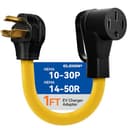
ELEGRP NEMA 10-30P to 14-50R Adapter (1 ft)

ELEGRP NEMA 10-30P to 14-50R Adapter (1 ft)

The one that unlocks the old three-prong dryer outlet in an older house — the most common 240V receptacle people already have and cannot use. Heavy 10-gauge STW cable, from a brand that makes electrical fixtures rather than a marketplace pop-up.

Budget pick
$19.99 · View on Amazon

$23.9917% off

Price as of November 20, 2026. #ad How we’re funded

4
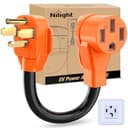
Nilight NEMA 14-30P to 14-50R Adapter

Nilight NEMA 14-30P to 14-50R Adapter

The modern-dryer version, and the one most people actually need. A 14-30 is the four-prong receptacle in essentially every house built or rewired in the last few decades, and this is a 10-gauge cord from an established automotive-electrical brand.

Best dryer-outlet adapter
$24.99 · View on Amazon

Price as of November 20, 2026. #ad How we’re funded

5
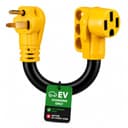
Suplevel NEMA 6-50P to 14-50R Adapter Cord (1 ft)

Suplevel NEMA 6-50P to 14-50R Adapter Cord (1 ft)

The welder-outlet adapter, and the one that starts from the best circuit: a 6-50 is fed by a 50A breaker, so the wall is not what limits you. The cord is, a little — the seller asks you to set the charger to 32A or less — but that is still well above what either dryer adapter here allows, and it publishes 6 AWG conductors and an ETL listing.

Best welder-outlet adapter
$23.99 · View on Amazon

Price as of November 20, 2026. #ad How we’re funded

The picks in full

#1Best overall

Lectron J1772 to Tesla Adapter

The adapter every Tesla owner should keep in the frunk: it lets a Tesla (or any NACS car) charge from the millions of public and home J1772 stations. Cheap, compact, and the single most useful $40 a Tesla owner can spend.

Strengths

  • Opens up every J1772 Level 2 station to a NACS car
  • Rated for full 48A / Level 2 AC charging
  • Small enough to live in the glovebox

Trade-offs

  • AC charging only — this is not a Supercharger or DC-fast adapter
  • Locking behavior varies by station; some public units grip it loosely
ConnectorJ1772 → NACS (Tesla)
Max output48 A
Max power11.5 kW
Cable lengthNot published
InstallPlug-on adapter
Outdoor ratingNot published
Warranty1 year

Spec note. For AC (Level 2) charging only. It does not enable DC fast charging and is unrelated to the NACS-to-CCS DC adapters non-Tesla cars use at Superchargers.

Specs read from the product listing, on July 19, 2026. “Not published” means the manufacturer does not state that figure.

#2Best for a J1772 car

EVDANCE Tesla to J1772 Adapter (80A)

The value pick for opening Tesla's AC network to a non-Tesla EV: the same job as Lectron's adapter at a noticeably lower price, with a higher published amp rating. If you want one adapter in the glovebox for Tesla Destination chargers, start here.

Strengths

  • Published 80A / 250V rating — more headroom than any Level 2 circuit will ask of it
  • Opens Tesla Destination chargers and a friend's Wall Connector to a J1772 car
  • Small enough to live in the glovebox permanently

Trade-offs

  • AC only — it will not let you Supercharge, and no adapter of this type can
  • Some Tesla Wall Connectors are configured to reject non-Tesla vehicles regardless of adapter
  • The listing does not publish a warranty term
ConnectorNACS (Tesla) → J1772
Max output80 A
Max powerNot published
Cable lengthNot published
InstallPlug-on adapter
Outdoor ratingNot published
WarrantyNot published

Spec note. The listing publishes a maximum 80A at 250V and compatibility with Tesla Destination Chargers. It does not publish a kW figure — the real ceiling is whatever the AC charger and your car's onboard charger allow — nor a warranty term.

Specs read from the product listing, on August 11, 2026. “Not published” means the manufacturer does not state that figure.

#3Budget pick

ELEGRP NEMA 10-30P to 14-50R Adapter (1 ft)

The one that unlocks the old three-prong dryer outlet in an older house — the most common 240V receptacle people already have and cannot use. Heavy 10-gauge STW cable, from a brand that makes electrical fixtures rather than a marketplace pop-up.

Strengths

  • Opens up the 10-30 dryer receptacle, which is otherwise useless to a 14-50 charger
  • 10 AWG STW cable — the gauge is published, which many competing adapters do not do
  • One foot long, so it hangs at the outlet instead of becoming a floor cable

Trade-offs

  • The circuit behind a 10-30 is 30A, so you MUST dial the charger down to 24A — the adapter cannot do it for you
  • 10-30 outlets have no ground conductor, only a bonded neutral; have an electrician confirm the outlet is sound first
  • No published warranty term
ConnectorNEMA 10-30P → NEMA 14-50R
Max output30 A
Max powerNot published
Cable length1 ft
InstallIn-line plug adapter
Outdoor ratingNot published
WarrantyNot published

Spec note. The listing publishes a NEMA 10-30P to 14-50R conversion, 30 amps, 10 AWG STW heavy-duty cable and a 1 ft length. It does not publish a certification body or warranty term. A 30A circuit permits a 24A continuous draw under the 80% rule — set the charger accordingly.

Specs read from the product listing, on August 11, 2026. “Not published” means the manufacturer does not state that figure.

#4Best dryer-outlet adapter

Nilight NEMA 14-30P to 14-50R Adapter

The modern-dryer version, and the one most people actually need. A 14-30 is the four-prong receptacle in essentially every house built or rewired in the last few decades, and this is a 10-gauge cord from an established automotive-electrical brand.

Strengths

  • 10-gauge conductor published in the listing — appropriate for a 30A circuit
  • 14-30 has a true ground, unlike the older 10-30 it replaced
  • Nilight is an established brand in automotive electrical rather than a one-listing seller

Trade-offs

  • Still a 30A circuit — the charger must be set to 24A maximum, which the adapter will not enforce
  • Sharing the dryer circuit means only one of the two can run at a time
  • No published warranty term or certification body
ConnectorNEMA 14-30P → NEMA 14-50R
Max output30 A
Max powerNot published
Cable lengthNot published
InstallIn-line plug adapter
Outdoor ratingNot published
WarrantyNot published

Spec note. The listing publishes a NEMA 14-30P to 14-50R conversion, 30 amp to 50 amp and a 10 gauge conductor. It does not publish a length, certification body or warranty term. A 30A circuit permits 24A continuous under the 80% rule.

Specs read from the product listing, on August 11, 2026. “Not published” means the manufacturer does not state that figure.

#5Best welder-outlet adapter

Suplevel NEMA 6-50P to 14-50R Adapter Cord (1 ft)

The welder-outlet adapter, and the one that starts from the best circuit: a 6-50 is fed by a 50A breaker, so the wall is not what limits you. The cord is, a little — the seller asks you to set the charger to 32A or less — but that is still well above what either dryer adapter here allows, and it publishes 6 AWG conductors and an ETL listing.

Strengths

  • Starts from a 50A circuit, so the 32A the seller asks for is a cord limit rather than the low ceiling a dryer outlet forces
  • 6 AWG conductors and an ETL listing are both published — the strongest spec sheet here
  • Molded plug, pure copper conductors and a flame-retardant, UV-resistant jacket, all stated

Trade-offs

  • The seller asks you to set the charger to no more than 32A, so you do not get the full 40A the circuit could give
  • 6-50 has no neutral; it works for EV charging but is not interchangeable with a 14-50 for other loads
  • Only useful if you already have a welder outlet — running a new one costs the same as running a 14-50
  • Warranty is published two different ways on the same listing, 2 years and 18 months
ConnectorNEMA 6-50P → NEMA 14-50R
Max output50 A
Max powerNot published
Cable length1 ft
InstallIn-line plug adapter
Outdoor ratingNot published
Warranty18 months

Spec note. The listing publishes a 3-prong NEMA 6-50P to 4-prong NEMA 14-50R conversion, 50 amps, 250 volts, 12,500 watts, STW 6 AWG / 3-conductor cable, an ETL listing and a 1 ft length — and instructs the buyer to set the charging current to no more than 32A before charging. The circuit behind a 6-50 outlet is a 50A one, so that 32A figure is the cord's limit rather than the wall's. Warranty is stated inconsistently on the same listing: Amazon's warranty field says 2 years, the listing's own bullets say 18 months, so confirm it with the seller before relying on either. Not for RV use and not for a 120V outlet, per the listing.

Specs read from the product listing, on September 23, 2026. “Not published” means the manufacturer does not state that figure.

The five, side by side

Read from the same registry entries as the reviews above. The connector column is the one to read first: it tells you which direction each adapter converts, and getting that backwards is the most common mistake buyers make here.

ProductConnectorMax outputCableWarrantyPrice
Lectron J1772 to Tesla AdapterJ1772 → NACS (Tesla)48 ANot published1 year
$39.99 · View on Amazon

Price as of November 20, 2026. #ad How we’re funded

EVDANCE Tesla to J1772 Adapter (80A)NACS (Tesla) → J177280 ANot publishedNot published
$49.99 · View on Amazon

Price as of November 20, 2026. #ad How we’re funded

ELEGRP NEMA 10-30P to 14-50R Adapter (1 ft)NEMA 10-30P → NEMA 14-50R30 A1 ftNot published
$19.99 · View on Amazon

$23.9917% off

Price as of November 20, 2026. #ad How we’re funded

Nilight NEMA 14-30P to 14-50R AdapterNEMA 14-30P → NEMA 14-50R30 ANot publishedNot published
$24.99 · View on Amazon

Price as of November 20, 2026. #ad How we’re funded

Suplevel NEMA 6-50P to 14-50R Adapter Cord (1 ft)NEMA 6-50P → NEMA 14-50R50 A1 ft18 months
$23.99 · View on Amazon

Price as of November 20, 2026. #ad How we’re funded

Which direction do you need?

You drive a Tesla, or any car with a NACS charge port. You want a J1772-to-NACSadapter — the Lectron here. Public Level 2 stations, workplace chargers, hotel chargers and almost every home charger installed before 2024 hand you a J1772 plug. Without the adapter, your car cannot take it. With it, you charge anywhere. This is AC only; it has nothing to do with Superchargers, which your car already uses natively.

You drive a J1772 car and want to use Tesla’s AC hardware. You want a NACS-to-J1772adapter — the EVDANCE here, or one of the second sources on our category page. That covers Tesla Destination Chargers at hotels and restaurants, a friend’s Wall Connector, and a Tesla Mobile Connector you borrow. One honest caveat the cheap listings do not advertise: some Wall Connectors are configured by their owner to reject non-Tesla vehicles, and no adapter overrides that. Our Tesla-to-J1772 roundup covers the category in full.

You have a 240-volt outlet that is not a 14-50.You want an outlet adapter. The four-prong NEMA 14-30 behind a modern dryer is the most common; the three-prong 10-30 in an older house and the NEMA 6-50 welder outlet in a workshop are the other two. A one-foot cord for twenty-odd dollars turns any of them into the 14-50 receptacle your charger has a plug for — see our NEMA adapter roundup for the whole set.

The rule that comes with an outlet adapter

An outlet adapter does not know what circuit it is plugged into, and it will not stop you overloading one. You must set the charger’s output yourself to no more than 80% of the circuit’s rating.Behind a 14-30 or 10-30 dryer receptacle that is a 30-amp circuit, so the charger goes to 24 A — not 32, not 40. Behind a 6-50 welder outlet the circuit is 50 A, so the wall is not the limit; the Suplevel cord’s own seller asks you to stay at or below 32 A, which is a cord limit rather than a circuit one and still far more than either dryer route allows. If your charger cannot be dialled down, you cannot use these adapters safely. Full working in charging from a dryer outlet and amps and circuits.

How we ranked these five

The Lectron J1772-to-Tesla leads because of how often it gets used. It is the adapter that converts a car which can only charge at Tesla hardware into one that can charge almost anywhere, it publishes a 48-amp rating that covers any Level 2 circuit, and it is from the best-established brand in this category. The honest con is mechanical rather than electrical: locking behavior varies by station and some public units grip it loosely, which is exactly why adapter locks exist. Full detail in our review.

The EVDANCE is the pick running the other way— an 80 A / 250 V published rating, which is more headroom than any Level 2 circuit will ever ask for, at a lower price than the brand-name equivalent. It publishes no warranty term. Our EVDANCE review has the figures.

The ELEGRP 10-30 is the budget pick, and the cheapest useful adapter on the page.It opens the old three-prong dryer receptacle — the most common 240-volt outlet in an older house, and useless to a 14-50 charger without it — and it is the one adapter here that publishes a conductor gauge, 10 AWG STW, from a company that makes electrical fixtures rather than a marketplace pop-up. Two conditions, both the buyer’s to meet: the 30-amp circuit behind it means the charger must be set to 24 A, and a 10-30 receptacle has no separate ground conductor, only a bonded neutral, so have an electrician confirm the outlet is sound before charging from it nightly.

The Nilight 14-30 is the outlet adapter most people actually need, because the four-prong 14-30 is the dryer receptacle in essentially every house built or rewired in the last few decades, and unlike the older 10-30 it has a true ground. Ten-gauge conductor published; no certification body or warranty published. Remember the 24-amp ceiling, and remember that sharing the circuit means the dryer and the car cannot run at once.

The Suplevel 6-50 has the strongest spec sheet on the page — 6 AWG conductors, a molded plug, an ETL listing, 50 A / 250 V / 12,500 W published — and it starts from a 50-amp circuit rather than a 30-amp one. It is only relevant if you already have a welder outlet, because running a new 6-50 costs the same as running a 14-50. Note the listing publishes its warranty two different ways, 2 years and 18 months, which is the kind of thing we would rather tell you than tidy up.

What to ignore in this category

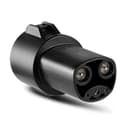
Any sub-$50 adapter described as working at a Supercharger or “DC fast” station.It does not. DC adapters are physically larger, carry hundreds of amps, and are tested to a different standard altogether — the Lectron Vortex Plus publishes UL 2252 certification, 500 A DC and 1,000 V DC, and prices accordingly. Our adapter safety guide explains the difference properly.

Any adapter that publishes no amp rating at all. A connector adapter carrying 32 or 48 amps continuously should state its rating in plain text. Every pick above does, and that is most of why they are the picks. Adapter chains.One adapter between the station and the car is the limit — stacking a connector adapter onto an outlet adapter onto an extension is how connectors melt.
Frequently asked questions

What EV charging adapter do I need?

If your car has a Tesla-style NACS port, you want a J1772-to-NACS adapter so you can use ordinary public and home Level 2 stations. If your car has a J1772 port, you want a NACS-to-J1772 adapter so you can use Tesla Destination Chargers and Wall Connectors. If the problem is the outlet on your own wall rather than the station, you want a NEMA adapter instead.

Can a $50 adapter be used at a Supercharger?

No. Every adapter on this page is for AC — Level 1 and Level 2 — charging. DC fast charging needs a different class of adapter entirely: physically larger, rated for hundreds of amps and hundreds of volts, and tested to UL 2252. Those start well above $50. Any cheap listing implying otherwise is misdescribing itself.

Are cheap EV charging adapters safe?

An AC connector adapter is a passive part with no electronics, and the ones here publish amp ratings far above what any Level 2 circuit delivers — which is why price buys build quality rather than capability. We would still insist on a published rating, we would not stack adapters, and we would check the housing for heat or discoloration occasionally. DC adapters are a different conversation.

Do I need to change a setting when I use a NEMA adapter?

Yes, and this is the one genuine hazard in the category. The adapter cannot tell what circuit it is on, so you must set the charger to 80% of that circuit's rating: 24 amps behind a 30-amp dryer outlet. If your charger has no amperage setting, do not use a dryer-outlet adapter with it.

Will a Tesla-to-J1772 adapter work on any Tesla charger?

It works mechanically and electrically on Tesla's AC hardware — Wall Connectors, Destination Chargers and the Mobile Connector. What it cannot do is override a Wall Connector whose owner has configured it to accept Tesla vehicles only, or work at a Supercharger. Neither is an adapter problem.

How many adapters should I own?

Most drivers need exactly one connector adapter, kept permanently in the car. A second one for the other vehicle in the household is well under fifty dollars. Outlet adapters are different: buy the one that matches the receptacle you actually have, and only after confirming the circuit behind it with an electrician.

Sources

  • SAE International — J3400 North American Charging System (NACS) for Electric Vehicles — The SAE standard for the NACS connector (Tesla's plug), alongside the J1772 AC standard (accessed July 19, 2026)
  • U.S. DOE Alternative Fuels Data Center — Charging Electric Vehicles in Public — DOE guidance on public AC and DC fast charging (accessed July 19, 2026)
  • U.S. DOE Alternative Fuels Data Center — Electric Vehicle Charging Stations — DOE overview of charging levels, power output and connector types (J1772, CCS, NACS) (accessed July 19, 2026)
  • Lectron — Vortex Plus NACS to CCS Adapter with Interlock (500A / 1,000V) — Lectron's own "Under the Hood" specification table: "Rated Current 500A DC", "Rated Voltage 1,000V DC", "Max. Power Up to 500 kW", "Charger Connector NACS (SAE J3400)", "Vehicle Connector CCS1", "Weatherproof Rating IP67", "Operating Temperature -22°F to 122°F", "Weight 2 lbs", "Materials PC / PA66 / Copper", "Safety Certification UL 2252" and "Warranty 2 Years". The FAQ states "Vortex Plus is certified to UL 2252 by SGS", that it "works with CCS1-equipped EVs whose manufacturers have approved access to the Tesla Supercharger network", that it "supports compatible Tesla V3 and V4 Superchargers" and "does not support V2 Superchargers or Tesla AC chargers such as Wall Connectors and Destination Chargers", and that it is for DC fast charging only. A "Dual Interlock" badge reads "Secures at both ends" with no mechanism described, and the page states "Built-in thermal protection monitors temperature while charging and can automatically reduce or pause power if required." Under "Automakers with Supercharger Access" it lists Acura, Audi, BMW, Cadillac, Chevrolet, Ford, GM, Genesis, GMC, Honda, Hyundai, JLR, Kia, Lucid, Mercedes-Benz, MINI, Nissan, Polestar, Porsche, Rivian, Stellantis, Subaru, Toyota, Volkswagen and Volvo. The page publishes NO dimensions, NO UL certificate number, NO storage temperature, NO interlock mechanism detail and NO statement about vehicle warranty (accessed November 2, 2026)
  • Qmerit — NEMA 14-50 and GFCI Protection for EV Chargers (May 1, 2026) — An installer network's explanation: NEC 210.8(A) requires GFCI protection for 125- through 250-volt garage receptacles, NEC 625.54 requires it for receptacles installed for EV charging, the charger's own ground-fault protection can conflict with an external GFCI, and hardwired chargers are not subject to the 625.54 receptacle requirement (accessed September 18, 2026)

Keep reading