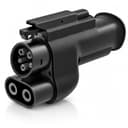
Why 800V matters at a 400V station
Power is voltage multiplied by current. An 800V car charging from a station built around 400V either needs the station to boost its output voltage, or needs the car to accept the lower voltage and draw more current to reach the same power — and current is limited by cable and connector thermal capacity, which is why liquid-cooled cables exist.
In practice, where the architectures do not match cleanly, the session settles at a power level well below what either device can do in isolation. An Ioniq 5 that peaks impressively on a high-power 800V-capable CCS charger may deliver a fraction of that on a Supercharger stall. This is a characteristic of the electrical architecture rather than a defect, and no adapter changes it — an adapter is a passive connector translator, not a converter.
Layer the normal DC taper on top — every EV slows steeply past roughly 50–60% state of charge to protect the battery — and the honest summary is that Supercharging an Ioniq 5 is a convenience feature rather than a speed feature. Our AC vs DC charging guide works through the taper and why DC charging behaves so differently from the AC charging you do at home.
Where to charge instead when speed matters
If you are on a trip and the clock matters, an Ioniq 5 is better served by a high-power CCS station that supports 800V natively. Save the Supercharger for the situations it is genuinely good at: areas with thin CCS coverage, sites where the CCS stalls are broken or occupied, and overnight or mealtime stops where the charging rate is irrelevant because you are not standing there watching it.
How to verify compatibility before you buy
1. Look at your charge port.The industry is midway through the transition to native NACS ports. If your car has one, you plug straight into a Supercharger and this adapter is not what you need — you would want the opposite direction for CCS stations.
2. Check Hyundai’s own adapter program.Where an automaker supplies or endorses an adapter for its vehicles, use it. It has been validated against your car’s charging hardware and avoids awkward warranty conversations. Third-party units are for owners without that option, or who want a spare.
3. Confirm account enrollment and site availability.Non-Tesla Supercharger access is account-based and site-by-site. The Tesla app, your automaker’s app and the DOE’s Alternative Fuels Data Center station finder all show which locations are open to non-Tesla vehicles.
4. Then buy the adapter, prioritizing one whose listing names UL 2252— the safety standard for EV coupler adapters. This part carries several hundred volts of DC in the weather while you hold it, which is why our main NACS-to-CCS roundup ranks the whole category on certification before price.
The parking problem
Supercharger stalls assume a charge port at the rear left of the vehicle, which is where Tesla puts it. The Ioniq 5’s port is on the rear right. Combined with short Supercharger cables, that frequently means reversing into the stall from an unusual angle or occupying two bays — genuinely awkward at a busy site, and worth planning for rather than discovering.
The adapter itself adds length and weight to the connector, and that weight hangs on your charge port. Support the assembly with a hand or rest it rather than letting it dangle, particularly on a long session.
What we would skip
Skip any adapter with no published voltage rating and no named safety standard. Skip buying before you have checked the port, the enrollment and the site. And skip the assumption that Supercharger access will improve your road-trip times — for this car specifically, it improves your coverage. If the connector naming has you turned around, our connector guide sorts out which plug is which.