What you are actually buying
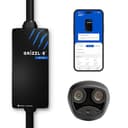
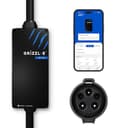
United Chargers publishes a short, unusually concrete spec sheet for the Mini: adjustable current 7A–40A, a NEMA 14-50 plug with four adapters included, a 25 ft cable, a J1772 or NACS connector option, an aluminum enclosure with a Type 4 indoor/outdoor rating, an operating range of −30 °C to +50 °C, Wi-Fi at 2.4 GHz with a mobile app, UL file E510712, and a 3-year warranty with a 5-year option.
The four adapters are the specification that does the most work and the one buyers notice last. The unit terminates in a NEMA 14-50 plug, and the box adds NEMA 5-15P, TT-30P, 14-30P and 6-50Padapters. In plain terms that is a standard household outlet, an RV park’s 30-amp pedestal, an electric dryer outlet and an older welder or range circuit. Most portables ship with one adapter or none, and the ones that cost less than this usually sell the rest as accessories.
Pair those adapters with the 7A–40A adjustment and you get a charger that can be legally and safely matched to whatever circuit is in front of it. That is the real argument for this product, and it is a different argument from “portable”. Our NEMA outlet guide decodes which of those plug numbers is which, and the amps and circuits guide covers the breaker arithmetic that decides what you are allowed to dial it up to.
The three figures that do not agree
This is the part of the review that matters, because all three gaps come from comparing the manufacturer against the retail listing against the certifying body’s own measurement — something no product page does for you.
One: the cable is probably 24 ft, not 25. United Chargers publishes 25 ft (7.6 m), and the NACS Amazon listing repeats “25 feet Cable” in its title. But the J1772 listing of the same hardware states “24 Feet Cable” in its own feature text, and EPA’s ENERGY STAR record for the Grizzl-E Mini family measures the output cord at 24 ft. Two of three sources say 24. If reach is tight, plan around 24 ft and measure from where the outlet will actually be to where the charge port sits when the car is parked the way you really park it.
Two: the cord is 10 AWG, where the wall Grizzl-E’s is 8 AWG. Nobody publishes this in marketing copy, but EPA’s dataset records cord gauge, and the numbers are striking side by side: the Grizzl-E Classic and Grizzl-E Smart records both read 24 ft of 8 AWG; the Mini record reads 24 ft of 10 AWG. Same 40A rating, thinner conductor. That is almost certainly deliberate — 10 AWG is what makes a 40A cable coilable enough to stuff in a bag, and it is a large part of why the J1772 Mini weighs 9.8 lb on Amazon’s own item-weight field. It is also the single clearest statement of what this product is: a cable engineered to be carried, not to hang on a wall for fifteen years.
Three: the weight you see published is the box, not the charger. United Chargers publishes 9.00 kg / 19.84 lb and a 445 × 445 × 200 mm dimension, which cannot be the same object as the 6.9 × 3.1 × 2.4 in enclosure it also publishes. Amazon’s item-weight field reads 9.8 lb for the J1772 unit and 19.4 lb for the NACS one, on identical enclosure dimensions. The charger is a couple of pounds of aluminum and a long cable; the ~20 lb figure is a shipped package with a case and four adapters in it. Do not let it talk you out of the product.
Certification, and what ENERGY STAR actually confirms
A portable charger holds its rated current for hours, outdoors, often off an outlet nobody inspected. Certification is the floor, not a feature — our certification guide explains what each mark covers.
United Chargers publishes UL file E510712, the same file the Classic Connect carries, and the NACS listing describes the unit as “UL Certified”. On top of that, EPA’s certified-EVSE database holds a Grizzl-E Mini family record— model GRM-070-W-14-25DJ40-A-GB, qualified 12 November 2024, with three further model numbers listed alongside it — at 40A / 9.6 kW, network capability “Yes”, and a measured idle draw of 2.64 W.
That 2.64 W is worth a sentence of its own. A charger that is plugged in but not charging draws power continuously, and ENERGY STAR’s allowance for a unit this size is 21 W. The Mini measured an eighth of that, and less than the Grizzl-E Classic’s 3.44 W or the Smart’s 5.2 W. It is a trivial amount of money either way, but it is a third-party measurement rather than a marketing claim, and there are very few of those in this category.
One honest limit on all of this. Amazon’s part-number field for both Mini listings reads simply “GRM” — the family prefix, not a model number. So while a certified Mini family plainly exists, we cannot tell you from the listing which of the four certified model numbers you would receive. If a utility rebate requiring ENERGY STAR certification is part of your plan, confirm the exact model number with United Chargers before you order. Rebate programs verify by model number, and this is the one place where the paperwork could cost you real money.
Wi-Fi, and the connector trap on Amazon
United Chargers sells the Mini as the “Mini Connect”, with Wi-Fi and the Grizzl-E Connect app, in either a J1772 or a NACS handle. Amazon today does not offer that full matrix, and the gap is the most practical thing in this review.
The NACS listing is the Connect: its own feature text describes “Wi-Fi connected. Smart Charger powered by Grizzl-E Connect software” with real-time monitoring, schedules, statistics and updates, and adds that charging “works with or without an online connection”. The J1772 listing is not: its equivalent bullet reads “Local Smart Features … Can connect within range of charger” — set maximum power, monitor, schedule, track consumption, all within radio range of the unit and not from indoors or from the road.
Both are listed at the same price. So on Amazon, your connector choice and your connectivity choice are welded together: a NACS car gets Wi-Fi, a J1772 car gets local control for the same money. If remote scheduling genuinely matters to you and your car is J1772, buy direct from the manufacturer, where the Connect is offered in both connectors, or buy a fixed smart charger for the garage and keep a cheaper portable for travel.
We would also say plainly that for a lot of buyers the local-only version is the better object. The whole Grizzl-E reputation was built on a box with nothing to fail, and a charger that already adjusts its own amperage and already recovers from a power outage does not need a cloud account to do its job. Where the charger really does have to be the smart component — a utility tariff your car cannot schedule around, or a panel that needs load management — our load management guide explains why, and the answer there is usually a wall unit, not this.
Can it really be your only charger?
Yes, with two conditions, and this is the question the product exists to answer.
The first condition is an outlet. At 40A it needs a 50A circuit, because code sizes a continuous load at 125% of its draw, and that is licensed work whether the charger is portable or not. The receptacle you choose matters more than people expect: ordinary 14-50 outlets are built for the intermittent loads of ranges and RVs, not 40A held for eight hours a night, and an industrial-grade one is the cheapest safety upgrade in the whole job. Our plug-in versus hardwired guide is blunt about the trade-off you are accepting by having a plug at all.
The second is honesty about the hardware. A portable gets coiled, dragged and unplugged daily; a wall charger does not. The Mini is better equipped for that life than any plastic portable, but it is still a plug and a cable doing a job that hardwiring was invented to avoid. If the car never leaves the house and you have no interest in charging anywhere else, a fixed 40A wall charger is cheaper, tidier and holds its 40A on thicker wire.
What tips it the other way is the second location. If you have a cabin, a workplace outlet, a parent’s driveway you visit monthly, or you camp, this is one purchase instead of two — and our road-trip charging kit guide explains how the adapter set turns an RV pedestal into a usable overnight charge.
Who should buy something else
- Anyone who only ever charges at home. You are paying a portability premium you will never use. The Grizzl-E Classic Connect is the same brand, the same Type 4 enclosure, thicker cord, and costs less.
- Anyone who needs 48A. This is a 40A unit, and 40A is the ceiling for anything that plugs into a 14-50 outlet. If your car can genuinely take 48A on AC and your panel can carry a 60A circuit, the 48A page is the right one.
- Anyone on a tight budget. There are 40A portables at a third of this price. They are plastic, their cords are not measured by anybody, and most publish no certification you can look up — but if the unit lives in a trunk for emergencies, that may be the correct purchase. Our Level 1 roundup covers the emergency-cable end of the market.
- Anyone who wants Wi-Fi on a J1772 car. Covered above: on Amazon that combination is not currently offered.
- Anyone whose rebate requires a named ENERGY STAR model. A certified Mini family exists, but the listing does not tell you which member you are getting. Confirm before ordering.
The verdict
The best-built portable Level 2 charger we can document, and the only one in the category whose cord gauge and standby draw we could verify against a third-party database rather than a product page. The 7A–40A adjustment plus four adapters is a genuinely rare combination, the cast-aluminum Type 4 enclosure is a real rating in a field full of vague “weather resistant” claims, and the manufacturer sells it on Amazon itself at the same price its own store shows, which removes the usual reseller markup question.
The honest caveats are the three disagreements above, and one more: it costs more than most fixed 40A wall chargers, including Grizzl-E’s own. You are paying for a case, four adapters and the ability to take your charger with you. If that second location is real, it is a good buy. If it is hypothetical, buy the wall unit and spend the difference on a better outlet.
One last buying note, which applies to everything on this site. United Chargers sells the Mini direct as well as on Amazon, and the two prices were the same when we checked. We earn a commission on the Amazon link and nothing on the direct one, and we would still rather you paid less — check both before you order.