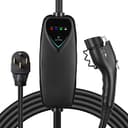
The number Honda publishes, and the number it does not
Almost every “best charger for your EV” decision starts with the vehicle’s onboard charger— the hardware inside the car that converts the wall’s alternating current into something the battery can take. It is the AC ceiling. No wall charger can push more than the car will accept, which is why buying a 48A charger for a car that accepts 32A is money spent on nothing.
Honda does not publish that figure for the Prologue. We looked for it in the 2026 specifications release and it is not there — the charging rows give a battery capacity, a 240-volt rate expressed in miles per hour, and DC fast-charge times, and that is all. We are not going to fill that gap with a number we remember reading somewhere, so here is the honest route to the same answer.
Three figures, all Honda’s own, from the same release:
- Battery capacity: 85 kWh.
- EPA range: 308 mileson the front-drive car — which works out to roughly 3.6 miles per kWh.
- 240-volt Level 2: 34.1 miles of range per hour of charging.
Divide 34.1 miles per hour by 3.6 miles per kWh and you get about 9.4 kW of power actually going into the car. At 240 volts that is roughly 39 amps. A 40A charger delivers 9.6 kW. A 48A charger delivers 11.5 kW.
The caveat matters, so read it before you act on it. Honda does not say which charger that 34.1 mi/hr figure was measured against. If it was measured on a 40A unit, then 9.4 kW is what that charger could give rather than what the car could take, and the Prologue might accept more. Treat the arithmetic as establishing a floor: a 40A charger is definitely enough to hit Honda’s published rate. Whether 48A would beat it is something Honda has not told anyone, and we are not going to pretend otherwise.
What that means for what you should buy
In practice it splits readers into two groups, and the split is about your electrical panel rather than your car.
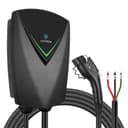
If an electrician is coming anyway, buy a 48A-capable charger. It costs a little more, it needs a 60A circuit, and on this car it may deliver nothing extra — but it is the last home charger you will need to buy, and the next EV in the household will almost certainly use all of it. That is pick two, or pick four if your panel is the thing standing in the way.
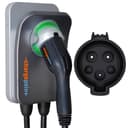
If there is already a NEMA 14-50 outlet on the wall, or your panel cannot spare a 60A circuit, buy a 40A plug-in charger and stop. It covers 34.1 miles per hour, which is Honda’s own published rate, and on an 85 kWh battery a 9.6 kW charger goes from near-empty to full in roughly nine hours — an overnight charge with time to spare. That is picks one, three and five. Our 40A versus 48A page makes the general case; the Prologue is a car where the cheaper answer is genuinely defensible.
The electrical constraint is the part people underestimate. Code sizes a continuous load at 125% of its draw, so a 48A charger needs a 60A circuit and a 40A charger needs a 50A one. That is a real difference in what an older panel can accommodate. Our amps and circuits guide walks through finding out what yours can spare, and installation cost covers what the answer tends to cost.
Which connector does a Prologue use?
Honda does not state the connector type in the specifications release either, and we are not going to assert one. Go and look at your own carbefore you buy anything — it is a thirty-second check that prevents the single most expensive mistake in this category.
A J1772 inlet is a round connector with five pins, and on a car with DC fast charging it sits as the top half of a larger CCS1 port with two big pins below. A NACS inlet is a small flattened oval with five contacts and no separate DC section. Our connector guide has the shapes side by side.
Every pick on this page is a J1772 charger, because that is what the overwhelming majority of non-Tesla cars on American driveways use for AC charging. If your Prologue has a NACS inlet, do not buy a J1772 charger plus an adapter as your permanent setup — buy a native-NACS unit, and our NACS charger roundup is the right page. If you already own a working J1772 charger and the car is NACS, a J1772-to-NACS adapter is a legitimate forty-dollar answer to a five-hundred-dollar problem.
How we chose
Four criteria, applied in this order, and we say on each pick where it fails one.
- Does it comfortably cover 34.1 miles per hour? That means 40A or more. Nothing below 40A is on this page, because on an 85 kWh battery a 32A unit starts to make overnight charging tight if you arrive home low.
- Is the enclosure rating published and named?A NEMA or UL Type number, not the words “weather resistant”. We say so on the picks whose listings do not publish one.
- Is the cable long enough for a real garage?25 ft on picks one and four, 23 ft on picks two and three, 21 ft on the portable. Measure the run from where the box will go to where the car’s port sits — around the car, not through it.
- Is it purchasable right now, from a seller you can identify? Every pick returned a real price and a stock state when we checked.
Why the Grizzl-E is first
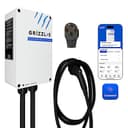
Because on this car the expensive answer buys you nothing Honda has published. The Classic Connect delivers 40A / 9.6 kW, which covers the 34.1 miles per hour on Honda’s own spec sheet; it plugs into a NEMA 14-50 outlet, so if one is already there you may need no electrical work at all; the cable is 25 ft, the longest on this page; and the enclosure is cast metal rated UL Type 4, the best weather rating of any pick here.
The honest costs. It is plug-in only, so you cannot convert it to a hardwired 48A unit later — if you think the next car in the household will want 48A, buy pick two now. It has no load management, so it needs its 50A circuit outright. And its output is adjustable down to 16A, which is useful on a weak circuit but is not a substitute for a charger that reads your panel. Our Grizzl-E Classic Connect review covers it in full, and our Emporia versus Grizzl-E comparison works through the metal-versus-software trade-off properly.
The outlet, and where the money actually goes
Whichever charger you choose, the install decides whether it is still working in ten years. Hardwiring is electrically the better answer: no receptacle to overheat, and it sidesteps the GFCI conflict that makes plug-in chargers trip breakers, because NEC 210.8(A) and 625.54 attach GFCI requirements to receptacles rather than to hardwired equipment.
If you go plug-in — which picks one, three and five all are — spend money on the receptacle itself. An ordinary NEMA 14-50 outlet is built for the intermittent loads of ranges and RVs, not 40 amps held for eight hours a night, and overheated outlets are a documented failure mode. Our NEMA 14-50 outlet roundup covers the industrial-grade ones, and plug-in versus hardwired makes the full case.
What we left out, and why
- 32A chargers. On an 85 kWh battery, 7.7 kW is about eleven hours from empty. That is fine if the car always sits overnight and tight if it does not. Our 32A roundup is the honest page if a 40A circuit is the most your panel can offer.
- Chargers with no published enclosure rating. Several cheaper 40A units advertise a price and a cable length and nothing verifiable about weather sealing. On hardware that lives outdoors for a decade, that is not a saving.
- 80A commercial units. The Prologue cannot use them, your panel almost certainly cannot feed them, and they are the wrong product for a driveway.
The short answer
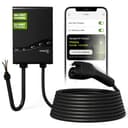
Honda publishes 34.1 miles of range per hour on 240 volts, and a 40A charger covers it. If you have a 14-50 outlet already, buy the Grizzl-E and spend the difference on nothing. If an electrician is coming, buy the Lectron Nexus and hardwire it at 48A so the next car in the household is covered too. If your panel is the obstacle, the Emporia Pro at pick four manages it rather than demanding more of it. Either way, measure the cable run first and put the money you save into a decent receptacle rather than a bigger charger.
One buying note. Several of these brands sell direct as well as on Amazon, and the prices are not always the same. We earn a commission on the links here and nothing on the direct ones, and we would still rather you paid less — check both. Our main home-charger roundup is the wider field if none of these suit.