Amp & Adapter

bokman Level 1 & 2 Portable Charger Review

The dual-plug travel charger that doubles its rate wherever a 240V outlet exists — and why that second plug is the entire reason to buy it.

By Stephen V.Last updated How we rank

The interesting thing about this charger is not its amperage. It is that it ships with two plugs.

A NEMA 5-15 is the ordinary three-pin household socket in every room of every building. A NEMA 6-20 is a 240V, 20A outlet found in workshops, garages, laundry areas, older window-air-conditioner installations and a surprising number of basements. The charger runs from either — and because power is voltage times current, running the same 16 amps at 240V instead of 120V doubles the charging rate.

In practical terms: from a household socket you are looking at roughly 4 to 5 miles of range per hour. From a 6-20, roughly 11 to 13. Over a twelve-hour overnight that is the difference between about 50 miles and about 140. Same charger, same cable, different plug.

That is a genuinely unusual amount of capability in a unit at this price and size, and it is why the bokman appears on both our Level 1 roundup and our budget home charger roundup. Everything below is read from the published listing on the date shown under the pick; we own no units and run no bench tests, and unpublished figures read “Not published”.

How this is funded: we earn a commission if you buy through our links, at no extra cost to you. It never changes which product we recommend, and we’ll tell you plainly when we’d skip one. Full disclosure.

Quick picks

Ranked on published specs, install flexibility and buyer fit. Select a row to jump to the full write-up. We have not bench-tested these units — here is exactly what we do instead.

#ProductBest forPrice
1
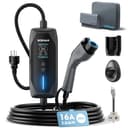
bokman Portable Level 1 & 2 Charger (16A)

bokman Portable Level 1 & 2 Charger (16A)

The dual-voltage answer at a Level 1 price: it runs from a standard 5-15 household outlet or a 6-20 240V outlet, which roughly doubles the charging rate wherever a 240V receptacle exists. That flexibility is what a travel charger is actually for.

Our pick — best dual-voltage travel charger
$99.99 · View on Amazon

$114.9913% off

Price as of September 2, 2026. #ad How we’re funded

The picks in full

#1Our pick — best dual-voltage travel charger

bokman Portable Level 1 & 2 Charger (16A)

The dual-voltage answer at a Level 1 price: it runs from a standard 5-15 household outlet or a 6-20 240V outlet, which roughly doubles the charging rate wherever a 240V receptacle exists. That flexibility is what a travel charger is actually for.

Strengths

  • Ships with both NEMA 5-15 (120V) and NEMA 6-20 (240V) plugs — one unit covers both
  • 16A rating is the practical maximum for this class of portable charger
  • 20 ft cable is longer than most units at this price

Trade-offs

  • The listing does not name a safety-certification body, unlike the Lectron
  • 16A is still a top-up rate, not a replacement for a Level 2 wall charger
  • Small brand with limited support history
ConnectorJ1772
Max output16 A
Max powerNot published
Cable length20 ft
InstallPlug-in (NEMA 6-20 or 5-15)
Outdoor ratingNot published
WarrantyNot published

Spec note. The listing publishes 16A, a 20 ft cable and both NEMA 6-20P and 5-15 plug options for Level 1 and Level 2 use. It does not publish a certification body, a kW figure or a warranty term.

Specs read from the product listing, on August 11, 2026. “Not published” means the manufacturer does not state that figure.

Go and look for a 6-20 outlet

This is worth five minutes before you buy anything, because most people have never had a reason to notice one.

A NEMA 6-20 receptacle has two flat blades — one horizontal, one vertical — plus a round ground pin. It looks subtly wrong compared to a normal socket, which is exactly how you spot it. Places to check:

  • The garage or workshop. Often installed for power tools, compressors or a bench welder.
  • Near where a window air conditioner was fitted. Larger units commonly ran on 240V, and the outlet frequently outlived the appliance.
  • The laundry area. Sometimes present alongside the dryer outlet.
  • Basements and utility rooms, particularly in older houses that had 240V equipment at some point.

If you find one, this charger becomes considerably more useful than its price suggests. If you do not, it still works from any household socket — you are simply buying a Level 1 charger with an upgrade path built in, which is not a bad thing to own.

One important check either way: confirm the circuit before drawing 16A continuously.A 20A circuit permits 16A continuous under the 80% rule, which is exactly what this charger wants — but only if the outlet genuinely sits on a 20A circuit and preferably a dedicated one. Have an electrician confirm it. Our amps and circuits guide explains why continuous loads are treated differently from everything else in your house.

Where it fits, and where it does not

It is an excellent travel charger.Two plugs mean two classes of outlet, and on a road trip the constraint is never amperage — it is whether you can plug into anything at all. Our road trip guide makes the case that outlet flexibility beats output on a trip, and this charger is a compact expression of that idea.

It is a good renter’s charger. Nothing is installed, nothing is left behind, and if the rental happens to have a 6-20 you get triple the rate of a household socket with no permission required. See our renter charging guide.

It is a fine plug-in hybrid charger. A PHEV battery is small enough that 16A on 240V refills it comfortably, and even Level 1 usually covers it overnight.

It is not a home charger for a full EV with real mileage.This is the honest limit. Sixteen amps is a fraction of what a proper Level 2 install delivers, and if you drive substantial distances daily you will fall behind. In that case buy a 40A unit — our 40A roundup covers the field, and a 40A portable like the Lectron gives you a real home charger that still travels.

The 20 ft cable

Twenty feet is longer than most travel chargers and shorter than most wall chargers, which is about right for the job. It is enough to reach across a garage or from a socket to a car parked outside a door; it is not enough to solve an outlet on the wrong side of a building.

Measure the real path before you rely on it — from the outlet, along the wall, out to the car, around to the charge port, plus slack so the cable is not under tension. And do not solve a shortfall with a household extension cord at 240V; if you need Level 2 reach, use a properly rated J1772 extension, covered in our cables and extensions guide.

What the listing does not publish

Three gaps worth naming, because they are what we would want to know:

  • No certification body is named in the listing.This is the specification we care about most, and its absence is the main reason this unit sits where it does in our rankings rather than higher. Check the listing page and the product itself for a UL or ETL mark, and cross-check against the EPA ENERGY STAR certified list, before buying. On a charger that draws near a household circuit’s continuous limit for hours, this is not optional.
  • No kW figure is published.Not a problem — you can compute it from 16A and the voltage — but it is why the table above reads “Not published” rather than showing a number we calculated and presented as the manufacturer’s.
  • No warranty term. On an inexpensive travel unit that is common, but it is worth knowing before you rely on it as your only charger.

If a named certification is important to you — and it should be — the Lectron Level 1publishes an ETL listing, and the EVDANCE Level 1 & 2 does the same with a longer 25 ft cable. Both are covered in our Level 1 roundup.

Living with a dual-voltage charger

Two habits. First, know which mode you are in. The rate difference between 120V and 240V is large enough that assuming the wrong one leads to a morning surprise. Second, check the plug and outlet by hand after the first hour on any new setup, particularly on 240V outlets that may not have been used in years. A warm plate is worth investigating; a hot one means stop and get the outlet looked at.

And in cold weather, expect less than the arithmetic suggests — at these power levels a meaningful share can go into battery thermal management rather than range. Our cold weather guide covers what to expect and how to mitigate it.
Frequently asked questions

What is a NEMA 6-20 outlet and do I have one?

It is a 240V, 20A receptacle with two flat blades — one horizontal, one vertical — plus a round ground pin. Look in the garage, workshop, laundry area, basement, or where a window air conditioner used to be fitted. If you find one, this charger runs at roughly triple the rate of a household socket.

How much faster is this charger on 240V?

Roughly double to triple. At 16A it delivers about 4 to 5 miles of range per hour from a 120V household socket, and about 11 to 13 from a 240V NEMA 6-20 — because power is voltage times current. Over a twelve-hour overnight that is roughly 50 miles versus roughly 140.

Is this a substitute for a proper Level 2 home charger?

For a plug-in hybrid or a low-mileage driver, effectively yes. For a full EV with substantial daily driving, no — 16A is a fraction of what a 40A install delivers and you will gradually fall behind. Buy a 40A unit if that is your situation.

Is the bokman charger certified?

The listing we read does not name a certification body, which is why we do not rank it higher. Check the listing page and the unit itself for a UL or ETL mark and cross-check the EPA ENERGY STAR certified list before buying. If a named certification is your priority, the Lectron Level 1 and the EVDANCE Level 1 & 2 both publish ETL listings.

Can I plug it into any 20A outlet?

Only after confirming the circuit. A 16A continuous draw needs a 20A circuit under the 80% rule, and ideally a dedicated one. Have an electrician confirm what the outlet is on and what else shares it — an old 240V outlet installed for an appliance decades ago has not been assessed for a twelve-hour continuous load.

Sources

Keep reading