Which Ford problem do you have?
The Mach-E case. A crossover with a mid-size battery used for commuting and errands. You replace a modest amount of energy each night with ten hours to do it in. Forty amps on a 50A circuit is comfortably more than enough, and stepping up to 48A buys you nothing you will notice. Our 40A roundup is the whole argument, and it applies squarely here.
The Lightning case.A full-size truck with one of the larger batteries on the market, used for things that consume it — towing, payload, a roof rack, cold weather, or all four at once. If you regularly arrive home at a genuinely low state of charge, the difference between 9.6 kW and 11.5 kW stops being cosmetic and starts deciding whether you leave with a full battery. This is one of the few real cases for high amperage.
Test it with arithmetic rather than a hunch
Charging power is amps × 240 ÷ 1000: 32A is about 7.7 kW, 40A about 9.6 kW, 48A about 11.5 kW. Take your usable capacity in kWh, subtract the worst realistic state of charge you come home at, add roughly 10% for conversion losses, and divide by each figure. If the 40A answer fits inside your overnight window with margin, buy 40A. Our how-long-to-charge guide works through the same equation with examples.
And the ceiling above it all: your vehicle’s onboard AC charger rating. Whatever that number is, a wall charger rated higher delivers nothing extra. It is in your owner’s manual under charging, and in Ford’s published specification for your model year — look for the AC or onboard charging figure, not the DC fast-charge one.
The high-amperage trap
Ford has offered charging equipment capable of unusually high output on some Lightning configurations, and it is worth understanding what that actually requires before it becomes your plan. Under the 80% continuous-load rule, output demands a circuit sized about 25% above it. A 48A charger needs 60A. Higher output than that needs correspondingly more, and at that level you are frequently past what an ordinary residential panel can spare without a service upgrade — which can cost more than the charger and the install combined.
Get a load calculation before you plan around a number. An electrician can tell you in one visit what your service can genuinely feed. If the answer is less than you hoped, our load management guide covers circuit sharing and load-managed chargers, which usually beat the panel upgrade on cost. Our installation cost guide breaks down what drives the quote in the first place.
Home backup power is a different product
If bidirectional or home-backup capability is part of why you bought the truck, understand that this is not a function of an ordinary Level 2 charger. It requires specific vehicle support plus specific, separately purchased equipment, professionally installed and tied into your electrical service. No charger on this page does it, and none pretends to. Price that project separately with Ford and an electrician; do not expect a wall charger to be part of the answer.
Outdoor and truck-specific practicalities
Trucks live outside more than crossovers do, and they are bigger, which makes two specifications matter more than usual:
- Enclosure rating.NEMA 3R covers falling rain and snow — fine under an eave or in a garage. NEMA 4 adds windblown dust and hose-directed water, and 4X adds corrosion resistance. Our outdoor roundup decodes them in full.
- Cable length.Measure from where the outlet or junction box will go to where the charge port sits with the vehicle parked how you actually park it — and note that a truck parked nose-in one day and backed in the next needs the longer of the two distances plus slack. This is the specification owners regret most.
One more, cheap and worth doing: get the connector off the ground. A holster keeps it dry and out of the grit, and on a driveway install that is the difference between a connector that lasts and one that does not.
Why we picked these four
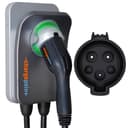
Emporia Level 2— the overall pick and the hedge: 40A on a NEMA 14-50 plug now, convertible to a hardwired 48A install later, which is the step a Lightning owner is most likely to want. The cheapest way to defer the expensive decision. See the Emporia review.
ChargePoint Home Flex— the pick for the most mature charging app in the category. It used to lead this page for its 16–50A amperage dial, but ChargePoint now sells the hardwired and plug-in versions separately and, as of 20 September 2026, the hardwired one is not listed on Amazon; the model we link is the NEMA 14-50 plug-in, a fixed 40A unit. Full detail in the Home Flex review.
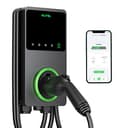
Autel MaxiCharger— the truck and outdoor pick: the strongest published enclosure rating in our registry, the highest output, and a long cable. The Autel review covers the panel headroom it assumes you have.
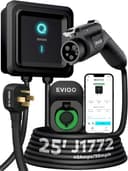
EVIQO 40A— the straightforward plug-in wall station for a Mach-E on an existing NEMA 14-50 outlet. No hardwiring, no app, and it comes off the wall with you.
What about Supercharger access?
Separate hardware, separate page. Our NACS-to-CCS adapters for a Fordguide covers the road-trip side, starting with why Ford’s own adapter program is the first thing to check. Home charging and Supercharging are independent decisions and neither constrains the other.
If you are cross-shopping trucks, the other large-battery page here is our Rivian charger roundup, which works the same cable-reach and amperage questions on a vehicle that parks differently. And if the sessions turn out slower than the charger’s rating, that is usually the onboard charger rather than a fault — see why an EV charges slowly at home.