Emporia vs ChargePoint Home Flex
A 48A charger that converts from plug-in to hardwired against the 40A plug-in Home Flex — amperage, enclosure rating, install path and app maturity, side by side.
These two get cross-shopped constantly, and the comparison used to be genuinely close: two smart Level 2 chargers that reached the top of residential amperage, each sold plug-in or hardwired, each with an app that schedules to off-peak rates. It is less close now. ChargePoint sells the Home Flex as three separate models, and as of 20 September 2026 the hardwired one — the 16–50A version — is not listed on Amazon. The Home Flex you can buy there is the NEMA 14-50 plug-in model, which ChargePoint publishes at 32A or 40A. The difference now comes down to 48A convertible versus 40A fixed, and how much you are willing to pay for a longer software track record.
The short answer: the Emporia is the better value, has the stronger enclosure rating and the higher ceiling, and for most buyers it is the one to get. The ChargePoint Home Flexearns its premium in one situation — when you already have a 14-50 outlet, want a 40A unit and value ChargePoint’s app and network account above everything else.
How this is funded: we earn a commission if you buy through our links, at no extra cost to you. It never changes which product we recommend, and we’ll tell you plainly when we’d skip one. Full disclosure.
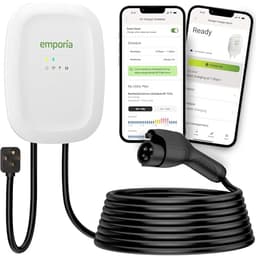 Emporia Level 2 EV Charger Emporia Level 2 EV Charger | 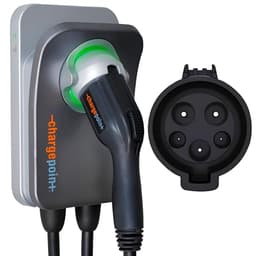 ChargePoint Home Flex (NEMA 14-50 plug) ChargePoint Home Flex (NEMA 14-50 plug) | |
|---|---|---|
| Connector | J1772 | J1772 |
| Max output | 48 A | 40 A |
| Max power | 11.5 kW | 9.6 kW |
| Cable length | 25 ft | 23 ft |
| Install | Plug-in (NEMA 14-50), convertible to hardwired | Plug-in (NEMA 14-50); hardwired 50A and NEMA 6-50 sold as separate models |
| Outdoor rating | NEMA 4 (outdoor) | NEMA 3R (indoor/outdoor) |
| Warranty | 3 years | 3 years |
| Price |
Amperage: the real difference
On a NEMA 14-50 plug the two are level: the Emporia ships preconfigured at 40A and the plug-in Home Flex runs at 40A on a 50A circuit or 32A on a 40A one. The gap opens when you hardwire. The Emporia converts to a hardwired 48A install; the plug-in Home Flex cannot be hardwired at all. ChargePoint’s hardwired Home Flex reaches 50A on a 60A circuit and configures down to 16A, but it is a separate product and it is not on Amazon as we write this, so it is not in this comparison.
That reverses the old verdict on flexibility. It used to be the Home Flex that covered an uncertain circuit, because it configured all the way down to 16A. Now the Emporia is the unit that hedges: start at 40A on a plug, step up to 48A hardwired later without buying a second charger. If you might one day need more than 40A, the Emporia is the only one of the two that can get there.
The install path
The Emporia has the cleaner story here. It ships preconfigured for a NEMA 14-50 plug at 40A and converts to hardwired 48A later, which lets you start on the cheaper install and upgrade only if it proves necessary. The Home Flex linked here is plug-in only; ChargePoint sells the hardwired version as a separate model, so that choice is made at purchase, and today it means buying elsewhere. Either way, remember that a plug caps you at 40A — a NEMA 14-50 is a 50A receptacle and the 80% continuous-load rule brings that to 40A. Anything above requires hardwiring. Our plug-in vs hardwired guide covers the full decision.
Enclosure: Emporia wins
The Emporia publishes NEMA 4; the ChargePoint publishes NEMA 3R. That is not marketing noise. NEMA 3R protects against falling rain, sleet and snow — fine under an eave. NEMA 4 adds windblown dust and splashing or hose-directed water, which is what you want on a wall that takes driving rain or sits where you wash the car. If the charger is going outdoors and unsheltered, this line alone may settle it. Our outdoor charger roundup decodes the ratings in full.
The apps
ChargePoint’s is the most mature in the category, with the longest track record and integration with its public charging network — genuinely useful if you use ChargePoint stations away from home, since it is one account for both. Emporia’s app comes from a home energy monitoring company, so the energy data side is the more coherent half.
For the feature that actually saves money — scheduling a charge into off-peak hours — both do the job, and so does your car if it is reasonably modern. Do not pay a premium for a scheduling feature you already own. Our cost-to-charge guide shows what the off-peak shift is actually worth at your rate.
Which should you buy?
Buy the Emporia if you know roughly what circuit you are getting (40A plug-in or 48A hardwired), if the charger is going somewhere exposed, or if value is the priority. That covers most people.
Buy the ChargePoint Home Flexif you have a 14-50 outlet, are certain 40A is all you will ever need, and you already use ChargePoint’s public network and want one app for everything. If your circuit is genuinely uncertain, the case that used to favour the Home Flex now favours the Emporia.
Buy neitherif you do not want an app at all. Both are smart chargers and you would be paying for software you will not open — the Lectron Nexus 40A does the core job with no connectivity and usually costs less. Our budget roundup covers the cheapest certified units.
And if what you actually want is the Emporia weighed against a metal box rather than against another app-led charger, our Emporia versus Grizzl-E comparison is the other side of this decision — 48A hardwired with panel-aware load management against a 40A plug-in unit you can adjust to whatever circuit you have.
Frequently asked questions
Is the ChargePoint Home Flex worth the extra money over the Emporia?
For most people, no. The Home Flex sold on Amazon as of 20 September 2026 is the NEMA 14-50 plug-in model, which runs at 32A or 40A; the 16A-50A hardwired model is not listed there. The Emporia matches it at 40A on a plug, converts to 48A hardwired later, costs less and has a better enclosure rating. Pay the ChargePoint premium only for the app and the network account.
Which is better for outdoor installation?
The Emporia. It publishes NEMA 4, which covers windblown dust and splashing or hose-directed water; the ChargePoint publishes NEMA 3R, which covers falling rain, sleet and snow. Under an eave either is fine — on an exposed wall, choose the Emporia.
Can both be installed plug-in and hardwired?
Only the Emporia: it ships on a NEMA 14-50 plug and converts to hardwired 48A. The Home Flex we link is the plug-in model and cannot be hardwired; ChargePoint's hardwired Home Flex (up to 50A on a 60A circuit) is a separate product that is not currently sold on Amazon. A NEMA 14-50 plug caps continuous draw at 40A on either unit.
Do I need either app?
Not for basic charging. The apps add scheduling and monitoring; scheduling is the feature worth having if your utility charges time-of-use rates, but most modern EVs schedule from the car's own screen for free.
Which is faster?
On a plug, neither: both run at 40A on a 50A circuit. Hardwired, only the Emporia goes further, to 48A on a 60A circuit — about 11.5 kW against the plug-in Home Flex's 9.6 kW. Both are still limited by your car's onboard AC charger, which on many EVs caps below either figure.
Sources
- U.S. DOE Alternative Fuels Data Center — Charging Electric Vehicles at Home — DOE guidance on Level 1 vs Level 2 home charging, 120V/240V service and installation (accessed July 19, 2026)
- EPA ENERGY STAR — Electric Vehicle Chargers — ENERGY STAR on certified EV chargers, safety certification and standby energy use (accessed July 19, 2026)
- EPA ENERGY STAR — Certified Electric Vehicle Chargers (AC Output) — The list of ENERGY STAR certified AC (Level 2) EV chargers (accessed July 19, 2026)
- U.S. EIA — Electric Power Monthly, Average Retail Price of Electricity (Table 5.3) — EIA average retail residential electricity price by month, in cents per kWh (accessed September 23, 2026)
Keep reading
Emporia Level 2 review
The 48A charger that ships on a plug and converts to hardwired later — the full review of the winner here.
Read the Emporia reviewChargePoint Home Flex review
The 40A plug-in model sold now, what happened to the 16-50A dial, and who should look at a cheaper 40A box instead.
Read the ChargePoint reviewWallbox Pulsar Plus review
The other 48A contender, and the smallest of the three on the wall — worth a look before you settle on either of these.
Read the Wallbox reviewBest 48A and 50A home chargers
The whole high-output field, with the three-part test for whether your panel and your car justify one.
See the 48A roundup