The certification point, which really matters here
Level 1 is where the cheapest, least accountable hardware in EV charging lives, and it is also where a failure has the most direct path to something bad. Think about what this device actually does: it sits in a standard household receptacle, drawing 12 to 16 amps continuously, for ten or twelve hours, in a garage, unattended, often overnight.
A 15A household circuit under a 12A continuous load is already at the top of what code contemplates. If the outlet is old, back-stabbed rather than screw-terminated, or shared with a freezer and a workbench, the margin is thin. A charger from a manufacturer that has put the unit through UL or ETL testing has been evaluated for exactly this duty cycle. One that names no lab has not.
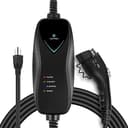
That is why the Lectron heads this list rather than a cheaper unit: it publishes ETL certification and comes from a company whose whole business is EV charging. On a device in this role, that is worth the price gap.
Check the outlet, not just the charger
Before you leave a Level 1 charger running overnight, plug it in and then feel the receptacle after an hour or two. Warm is worth investigating; hot means stop and call an electrician. Do not use an extension cord unless it is rated for the continuous load and you have no alternative — and never a household two-prong or thin-gauge cord. Avoid a circuit shared with other significant loads. These are the same habits that make any high-draw appliance safe, and they matter more with something running for half a day.
Dual-voltage: the upgrade that makes Level 1 worth carrying
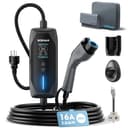
Several units here, including the bokman, ship with both a NEMA 5-15 plug (the standard household one, 120V) and a NEMA 6-20 plug (a 240V outlet found in workshops, garages and some laundry rooms). Swapping the plug roughly doubles the charging rate wherever a 240V receptacle exists.
That flexibility is what turns a Level 1 charger from a trickle device into a genuinely useful travel tool. Holiday houses, workshops, family garages and older properties frequently have a 240V outlet somewhere even when nobody thinks of it as an EV charging point. Carrying a unit that can use it is the difference between arriving with 40 miles added overnight and arriving with 100. Our main portable charger roundup covers the faster 40A units that plug into a NEMA 14-50.
How slow is Level 1, really?
The math is straightforward. 120V at 12A is about 1.4 kW; at 16A it is about 1.9 kW. A typical EV uses roughly 30 kWh per 100 miles, so 1.4 kW delivers something in the region of 4 to 5 miles of range per hour, before charging losses.
Practically: overnight gets you 40 to 60 miles. A full charge from near-empty on a large battery takes multiple days. Cold weather makes it worse, because some of the power goes to heating the battery rather than filling it — in deep winter a Level 1 charger on a big EV can lose ground on a cold night. Our types of chargers guide puts Level 1, 2 and 3 side by side, and the cost-to-charge guide works out what the electricity actually costs. There is one more place a 120-volt cordset is the only sensible choice: off a generator, where a 40-amp Level 2 charger would ask for 9.6 kW continuous and a Level 1 cordset asks for about 1.4 kW. Our guide to charging an EV with a generator does that arithmetic, including the floating-neutral problem that stops more sessions than a shortage of watts.
When Level 1 is the right answer
Low daily mileage. If you drive 25 miles a day and park at home for twelve hours, Level 1 keeps up indefinitely with zero electrical work.
Plug-in hybrids.A PHEV battery is small enough that Level 1 genuinely refills it overnight. For most PHEV owners, a Level 2 charger is unnecessary — and where it is not, our PHEV charger roundup covers the modest 16 to 32-amp units rather than the oversized ones.
A car that is parked rather than driven. A stored EV still draws on its own electronics and 12-volt system, and a Level 1 cord covers that from the wall instead of from the traction battery. Our guide to leaving an EV plugged in covers the charge limit to set before a long absence.
As a spare.A certified Level 1 unit in the trunk means you can charge anywhere there is a wall socket — a relative’s house, a holiday rental, a hotel with an outdoor outlet and a sympathetic manager.
While you wait for an install. Level 2 installs involve electricians, permits and lead times. A Level 1 charger covers the gap from day one.
When it is not
High daily mileage, a large battery you routinely run low, two EVs, no reliable overnight parking, or a cold climate with an outdoor parking spot. In all of those, a Level 2 charger is the answer rather than a better Level 1 unit — see our home charger roundup, or the budget picks if cost is the obstacle.
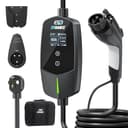
Two units that sit between the tiers are worth a look if a household socket is all you have today but a 240V outlet might appear later: the MEGEAR portable and the TopAutoGear dual-voltage unit both run from either supply.