Classic or Pro? Emporia’s own answer
Emporia publishes a side-by-side table, and it is refreshingly blunt about how little separates the two on the things buyers usually shop on. Read from that table on 2 September 2026:
- Charging speed: up to 48A. Both models.
- Cable length: 25 ft. Both models.
- Installation: NEMA plug or hardwire. Both models.
- Warranty: 3 years. Both models.
- UL Listed, NEMA rated, ENERGY STAR certified: both models.
The Pro-only column is short, and it is the entire buying case:
- PowerSmart load management, included rather than an upsell.
- Home energy monitoring, solar charging integration and peak-demand management, all included — on the Classic, Emporia footnotes each of these as requiring the Vue monitor, and PowerSmart as requiring the monitor plus an upgrade.
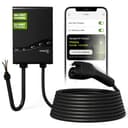
- Rear-entry hardwire installation, which routes the conduit in behind the unit instead of into its face. The Pro is a square case; the Classic is rounded with a front-facing connection.
Which reframes the decision honestly: the Pro is the Classic with the energy-monitoring hardware and license in the box. If you were going to buy a Vue monitor anyway, the bundle is the cheaper route. If you were not, you are buying it whether you want it or not.
What PowerSmart actually does
This is the feature the whole product rests on, so it is worth stating mechanically rather than in marketing terms.
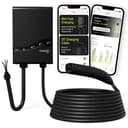
The bundled Vue 3 energy monitor installs inside your electrical panel, clamping current transformers around the service mains. It reads what the whole house is drawing in real time and sends that to Emporia’s cloud. PowerSmart uses that reading to raise or lower the charger’s output on the fly, so the total draw stays inside what your service can safely carry. When the dryer and the oven are both running, the car charges slower; at 2am it charges at full rate.
The value of that is not speed — it is permission. Ordinarily a 48A charger needs a dedicated 60A circuit, and code makes you account for that 60A against your service capacity whether the car is plugged in or not. On an older 100A panel there is frequently no room for it, and the quoted fix is a service upgrade. Dynamic load management is the recognized alternative: the charger becomes a managed load rather than a fixed one. Our load management guide explains the principle in full, and amps and circuits has the underlying arithmetic.
Emporia says this lets many homeowners skip a “$3,000–$8,000 panel upgrade”. We are quoting that figure, not endorsing it — it is Emporia’s marketing estimate, and real quotes vary enormously by region, panel and how much work the utility side needs. But the direction is right: a service upgrade is far and away the most expensive thing that can happen to an EV charger install, and avoiding one is worth much more than the price difference between these two chargers.
The caveats we would want told to us
The first is that you may not need it. Our Autel versus Emporia comparison puts it against a cheaper, higher-output charger with no load management, and on a panel with real headroom the cheaper unit wins. For the same argument against the other brand that solves a full panel in software, see Emporia Pro vs Wallbox Pulsar Plus — identical output and circuit, two different answers to a panel with no room.
Three, and none of them is a dealbreaker so much as something to go in with your eyes open about.
1. The protection is a cloud service, not local hardware
The Vue 3 sends load data to Emporia’s cloud, and PowerSmart makes the throttling decision there. That means the mechanism keeping your panel inside its capacity depends on your Wi-Fi, your internet connection and a company’s servers continuing to exist. Emporia states there is no subscription required for the smart features, which is genuinely good and not universal. It is still a service dependency on a safety-adjacent function, and it is the opposite trade from the deliberately dumb chargers we also recommend — the Lectron Nexus and the Grizzl-E Classic have nothing to drop offline because they have no radio at all. That is the whole argument in our Emporia versus Grizzl-E comparison, which sets this charger against the metal-box alternative spec by spec.
2. “No panel upgrade” is not “no panel work”
The Vue 3 clamps onto your service mains, which means an electrician still has to open the panel. You are avoiding a service upgrade, not avoiding a licensed visit. Budget for the install properly, and get the electrician to confirm your specific panel and circuit before you order anything — that conversation is the real first step of this purchase, not the charger choice.
3. The ENERGY STAR model number is not published
Emporia lists ENERGY STAR certification for both the Classic and the Pro. EPA’s certified-charger database carries a single Emporia Corp. family record — model EMEVSE1, 48A, a 25 ft output cord in 6 AWG, network capability “Yes”, qualified May 2022 — which lists fifteen further model numbers alongside it. That is consistent with the Pro being covered, and we have no reason to doubt the claim. But Emporia does not publish which of those numbers the Pro carries, and rebate forms almost always ask for an exact model number. If a utility rebate is part of your math, get that number from Emporia in writing before you buy. Our certification guide covers what the various marks mean and how to check one yourself.
Install: hardwired at 48A, or a plug at 40A
Emporia publishes both routes for the Pro. Hardwired, it does 48A and requires a 60A circuit — 48 amps is exactly 80% of 60, which is the continuous-load rule doing its job. On a NEMA 14-50 outlet it does 40A on a 50A circuit, because a plug caps continuous draw at 40A no matter what the box behind it can do.
The picks above are the hardwired SKUs, which is the configuration the whole PowerSmart argument is built around: if you are managing load to fit a tight panel, you want the 48A ceiling available for the hours when there is headroom for it. Emporia does also list a NEMA 14-50 plug-in version of the same charger, and it had only a handful of units showing when we checked, which is why we have not made it a buy row here. If you would rather have a plug you can unplug, our plug-in versus hardwired guidelays out both sides — and the Classic, which ships preconfigured on a plug and converts to hardwired later, is the more natural choice for that path.
One genuine hardware advantage worth naming: the rear-entry option. Conduit enters behind the unit rather than into its side or face, which on a finished garage wall is the difference between a clean install and a visible run. The Classic does not offer it.
Build, outdoor rating and cable
NEMA 4, rated for indoor or outdoor installation. NEMA 4 covers windblown dust, rain, splashing and hose-directed water, which is a real exterior rating rather than a vague “weather resistant” claim. The 25 ft cable is generous — plenty of competing units ship 16 ft, and cable reach causes more buyer regret than any other specification. Measure from where the unit will actually mount to where the charge port sits when the car is parked the way you really park it. Our outdoor roundup compares enclosure ratings across the field.
J1772 or NACS?
Emporia sells the Pro with either connector, and the choice is simply what your car has. J1772 fits almost every non-Tesla EV and plug-in hybrid sold in North America. NACS fits Teslas and the growing number of other EVs shipping with the Tesla-style port, with nothing dangling off the handle — our Tesla and NACS charger roundup compares the native-NACS field.
Worth knowing before you assume the Pro is the Tesla answer: Emporia sells a native-NACS version of the cheaper Classic too. If you do not need load management, that is the same connector for less money. Either unit can be made to work with the other kind of car through a J1772-to-Tesla adapter, though an adapter permanently parked on a wall charger is a wear point we would avoid where there is a choice.
Who should buy it
The Pro suits a specific and fairly common house: an older 100A or 125A service, an electric range or dryer or heat pump already on it, and an electrician who has said there is no room for a 60A circuit. That is the situation PowerSmart exists for, and in it the Pro is not a luxury — it is the cheapest way to get fast home charging without rewiring the house.
It also suits anyone who wanted whole-home energy monitoring anyway. The Vue 3 is a real product with its own price, and getting it bundled with solar excess-charging and peak-demand features in one app is a legitimately good deal. If your utility runs time-of-use rates, that is where the running-cost savings actually come from — our cost-to-charge guide shows the math with your own rate.
Who should buy something else
- Anyone with a roomy 200A panel. If a 60A circuit fits, you do not need managed load, and the Pro gives you nothing the Emporia Classic does not for less. This is the single most common reason to skip it.
- Anyone who wants to start cheap on a plug and upgrade later. The Classic ships preconfigured on a NEMA 14-50 at 40A and converts to hardwired 48A afterward, which is the better path if you are not sure yet — our 48A roundup works through that decision.
- Anyone who does not want a connected charger at all. The Pro is the most connected thing on this site: cloud throttling, a panel monitor and an account. If that is the opposite of what you want, the budget roundup and the Lectron Nexus are the no-radio alternatives.
- Anyone whose car cannot use 48A. The ceiling is your vehicle’s onboard charger, not the wall box, and most EVs sold in the US cap AC charging below 48A. If yours does, 40A is the amperage to shop, and load management matters less because the load is smaller.
- Anyone comparing on app maturity. ChargePoint has the longest software track record in the category — the Emporia versus ChargePoint comparison works through that trade directly.
The verdict
A good charger with an unusually honest pitch, once you strip the marketing back: it is the Emporia Classic plus the energy-monitoring hardware, plus the license that turns that hardware into panel protection, plus a tidier hardwire entry. At 48A, 25 ft, NEMA 4 and three years, the fundamentals are the same as the cheaper model, and they are good fundamentals.
Buy it if an electrician has told you your panel cannot spare a 60A circuit, or if you wanted whole-home energy monitoring anyway. Skip it if you have a 200A service with room — you will be paying a premium for a feature that solves a problem you do not have. And whichever way you go, get the model number for your rebate paperwork before you order, and compare Emporia’s own store against Amazon: we earn a commission on the Amazon link and nothing on the direct one, and we would still rather you paid less.