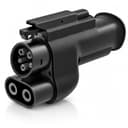
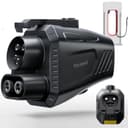
Check your charge port before anything else
The industry is partway through the transition to native NACSports, and GM has been part of it. Two minutes with the car saves buying the wrong part:
- A CCS1 port— the J1772 shape with two large DC pins below it — is what this page addresses. A NACS-to-CCS adapter is the hardware that lets it meet a Supercharger.
- A native NACS port plugs into a Supercharger directly and needs nothing here. What that car might want is the opposite adapter, for CCS stations.
Our connector guide has photographs of both.
The Bolt case: an adapter buys coverage, not minutes
This is the part worth being honest about, because it is where the marketing and the reality diverge most.
The Bolt’s DC fast-charging peak is modest by current standards — it was designed years ago, to a price, for a car whose job is commuting rather than long-distance running. Plugging it into an extremely powerful charger does not make it charge like a newer car. Your vehicle accepts what it accepts, and no adapter changes that.
So if you are buying an adapter hoping to fix the Bolt’s road-trip experience, adjust the expectation now. What you will actually get is somewhere to plug in, and for this car specifically, that is worth more than it sounds. The Bolt’s genuine road-trip weakness has always been as much about finding a working charger as about speed: an older car on a long trip is the one most likely to arrive at a two-stall CCS site to find both broken or occupied. Superchargers are numerous, reliable and busy-but-moving. That is the case for the adapter on a Bolt, and it is a real one.
If most of your driving is local and your charging is at home overnight, you probably do not need this at all — and our home charger guide for the Bolt is the page that will actually improve your ownership experience.
The Blazer EV and Equinox EV case
Newer platform, larger battery, meaningfully higher DC charging capability. Here the adapter genuinely expands what is available to you rather than merely where you can stop — a modern GM EV can make real use of a high-power stall.
Two caveats stay true regardless. First, the charge curve: every EV slows steeply as the battery fills, and the last 20% typically takes as long as the first 60. Charging to 80% and moving on is almost always faster overall than waiting for 100%. Our AC vs DC charging guide works through the taper and why DC behaves so differently from the AC charging you do at home.
Second, the architecture match. Peak numbers quoted for a car assume a station that suits it. A Supercharger stall is engineered around Tesla’s own architecture, and a non-Tesla car may settle somewhere below both devices’ individual capabilities. An adapter cannot change that — it is a passive connector translator, not a converter. Our adapter charging-speed guide covers exactly where the time goes.
How to verify compatibility before you buy
1. Check GM’s own adapter program for your vehicle and model year.Where an automaker supplies or endorses an adapter, use it: it has been validated against your car’s charging hardware, and it removes any warranty ambiguity if something goes wrong mid-session. Third-party units are for owners without that option, or who want a spare.
2. Confirm account enrollment and site availability.Non-Tesla Supercharger access is account-based and rolls out site by site — being able to physically plug in is not the same as being authorized. The Tesla app, GM’s own app and the DOE’s Alternative Fuels Data Center station finder all show which locations are open.
3. Check that your car’s software is current.Non-Tesla Supercharging depends on the vehicle’s charging software supporting the handshake, and that arrives through updates. A car several updates behind is a common reason a correctly-purchased adapter does not work.
4. Then buy the adapter, prioritizing one whose listing names UL 2252— the safety standard written for EV coupler adapters — and ideally one with an electronic interlock so it cannot be pulled off under load. Our main NACS-to-CCS roundup ranks the category on exactly that basis.
At the stall
Mind the parking.Supercharger stalls assume Tesla’s charge port position and use short cables. If your port sits elsewhere, expect to reverse in at an angle or occasionally straddle two bays. Try it somewhere quiet before you rely on it during a trip.
Support the weight. The adapter adds length and mass to the connector and all of it hangs off your charge port. Take the weight with a hand while seating it, and rest the assembly rather than letting it hang for the whole session.
Precondition if your car supports it.A cold battery accepts far less current, and the effect at a DC charger is dramatic. Navigating to the charger using the car’s own navigation is usually what triggers it — a phone map app does not. Our cold-weather guide covers it, and it is worth more than any adapter choice on a winter trip.
The summary
Bolt: buy it for reliability of access on trips, not for speed. If you rarely take trips, skip it and spend the money on the home install.
Blazer EV / Equinox EV:a genuinely useful addition to a long-distance vehicle, provided GM’s program, your account and your car’s software are all in order first.
Either way:check GM’s own adapter route before the third-party one, and read our Supercharger access guide for the three conditions that must all be true before any of this works.