Amp & Adapter

TopAutoGear 16A Level 1 & 2 Charger Review

The cheapest charger we recommend — 16A from any household outlet, an IP54 rating and a five-year warranty, and the eight feet of cable you give up for the price.

By Stephen V.Last updated How we rank

The honest version first, because the alternative is a review that oversells a cheap product. This charger is not fast, and nothing will make it fast. At 16A it draws roughly 1.9 kW from an ordinary 120V household outlet, which is somewhere around three to five miles of range per hour depending on the car and the weather.

If you are replacing a full day of driving every night, that is not enough and you should be reading our home charger roundup instead. But “not enough for everyone” is not the same as “not worth owning”, and at this price it is one of the more genuinely useful things you can leave in a trunk.

What earns it the slot over other cheap listings is what it is willing to publish: an IP54 rating, a five-year warranty and a 110-240V range, where most budget units publish none of the three. Everything below is read from that listing on the date shown under the pick. We own no units and run no bench tests; where a figure is not published, the spec table says so rather than guessing.

How this is funded: we earn a commission if you buy through our links, at no extra cost to you. It never changes which product we recommend, and we’ll tell you plainly when we’d skip one. Full disclosure.

Quick picks

Ranked on published specs, install flexibility and buyer fit. Select a row to jump to the full write-up. We have not bench-tested these units — here is exactly what we do instead.

#ProductBest forPrice
1
TopAutoGear Portable Level 1 & 2 Charger (16A)

TopAutoGear Portable Level 1 & 2 Charger (16A)

The cheapest charger on this site, and it earns the slot by publishing two things budget listings usually leave blank: an IP54 rating and a five-year warranty. 16A is slow by design, so treat it as the unit that lives in the trunk for the day you need it rather than the one you plan your charging around.

Our pick — the cheapest one worth owning
$119.89 · View on Amazon

Price as of September 2, 2026. #ad How we’re funded

The picks in full

#1Our pick — the cheapest one worth owning

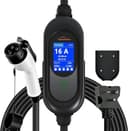
TopAutoGear Portable Level 1 & 2 Charger (16A)

The cheapest charger on this site, and it earns the slot by publishing two things budget listings usually leave blank: an IP54 rating and a five-year warranty. 16A is slow by design, so treat it as the unit that lives in the trunk for the day you need it rather than the one you plan your charging around.

Strengths

  • Rated 110V-240V rather than 120V only, so it is not locked to Level 1 speed
  • Publishes an IP54 rating and a five-year warranty, which most listings at this price do not
  • LCD display shows what the unit is actually drawing

Trade-offs

  • 17 ft of cable is short next to the 25 ft several rivals publish
  • The listing names no safety-certification body — no UL or ETL file is stated
  • The listing does not publish which NEMA plugs are in the box
ConnectorJ1772
Max output16 A
Max powerNot published
Cable length17 ft
InstallPlug-in (110-240V)
Outdoor ratingIP54
Warranty5 years

Spec note. The listing publishes 16A across a 110-240V range, a 17 ft cable, an IP54 rating and a five-year warranty. It does not publish a kW figure, a certification body or the plug types supplied. At 16A the arithmetic is roughly 1.9 kW on a 120V outlet — about 3-5 miles of range per hour — and roughly 3.8 kW where a 240V outlet is available.

Specs read from the product listing, on August 22, 2026. “Not published” means the manufacturer does not state that figure.

Work out whether 16A is enough for you

Do the sum rather than taking a slogan. It takes thirty seconds.

Miles driven per day ÷ miles gained per hour = hours of charging you need. Call the gain four miles per hour as a working figure on a 120V outlet, and check it against your own car once you have it.

  • 20 miles a day→ about five hours. Comfortably covered by any overnight window. Level 1 is genuinely sufficient for you.
  • 40 miles a day→ about ten hours. Covered by a full night if you plug in reliably every time, with no margin for a heavier day.
  • 60+ miles a day→ more hours than a night contains. You will fall behind, and the deficit compounds. A Level 2 charger is not optional for you.

Our how-long-to-charge guide works the equation through properly, and our Level 1 roundup makes the wider case for the category.

The dual-voltage part is the real upgrade

The listing rates the unit at 110-240V rather than 120V only. That matters more than the amperage does: the same 16A on a 240V supply is roughly 3.8 kW instead of 1.9 kW, which is the difference between adding about 40 miles overnight and adding about 90.

Holiday houses, workshops, family garages and older properties frequently have a 240V receptacle somewhere that nobody thinks of as an EV charging point. A unit that can use it is a travel tool; a 120V-only unit is a trickle charger. One caveat: the listing does not publish which plugs are in the box, so if you are buying specifically for 240V use, confirm the plug type with the seller before ordering. Our NEMA outlet types guide covers identifying what you are plugging into.

The certification line, which we will not paper over

This listing does not name a safety-certification body. No UL file, no ETL listing, no lab named at all — and that is worth stating plainly on a device that sits in a household receptacle drawing 16A continuously for ten or twelve hours, unattended, overnight.

It publishes an IP54 rating and a five-year warranty, which is more than most listings at this price disclose, but an ingress rating is not a safety certification and a warranty is a commercial promise rather than a test result. If that gap matters to you — and there is a good argument that it should — the Lectron Level 1 publishes ETL certification and comes from a company whose entire business is EV charging. It costs meaningfully more. That is the trade, stated honestly, and it is the same trade the whole budget end of this category asks you to make.

What to check before plugging into an unknown outlet

  • Use a dedicated circuit where you can. A continuous 16A draw plus whatever else is on that branch is how breakers trip and old wiring gets warm.
  • Never use a household extension cord. Ordinary cords are not built for continuous hours-long loads and are a genuine fire risk here. Move the car, not the electricity.
  • Feel the plug after twenty minutes.Warm is normal. Hot is not — stop, and use a different outlet. That is a wiring problem you have just found, not a charger problem.
  • Avoid worn or loose sockets. A plug that does not sit firmly is a poor connection, and a poor connection under sustained load generates heat.

The cable is where the price shows

17 feet is the weak figure on this spec sheet. Several rivals in the same bracket publish 25 ft, and cable length is the specification buyers most reliably regret under-buying — the outlet is rarely where you want it, and you cannot add reach later, because an extension cord is exactly what you must not use.

Measure before you order: from the receptacle you intend to use to where your charge port sits when the car is parked the way you actually park it, then add slack for the cable to hang rather than stretch. If that number is over about 15 feet, buy the EVDANCE dual-level unit with its published 25 ft cable and ETL listing instead.

The winter caveat, which is not small

At 120V there is very little power to spare, and in genuine cold a meaningful share of it goes into keeping the pack in a safe temperature range rather than into range. The comfortable summer figure can drop substantially in winter, and on the coldest nights the net gain can approach zero.

That is not a fault in this charger and no Level 1 unit is immune. Plug in every time the car is parked rather than only overnight, start while the pack is still warm from driving, and park in a garage if one exists. Our cold-weather guide covers it in full.

Who should buy something else

  • Anyone driving normal daily distances. Do the sum above. If it says more hours than a night contains, no amount of good advice fixes it.
  • Anyone who wants a named safety lab. Buy the ETL-listed Lectron and treat the difference as insurance on an unattended overnight load.
  • Anyone who needs reach. 17 feet is short. The 25 ft units cost a little more and solve a problem you cannot solve any other way.

The verdict

A modest product we recommend for exactly what it is: the cheapest charger on this site, dual-voltage, weather-rated, warrantied for five years, and slow by design. As insurance that lives in the trunk, or as the whole charging strategy for a low-mileage second car, it does the job and costs very little to own until the day you need it.

Go up a tier if you want a named certification body or a longer cable — both are real reasons and both cost real money. Do not buy it expecting it to replace a Level 2 install; you will be disappointed by the third night.
Frequently asked questions

How many miles of range per hour does it add?

On a standard 120V outlet, roughly three to five, depending on the car's efficiency and the temperature — about 1.9 kW at 16A. On a 240V supply the same 16A is roughly 3.8 kW, which roughly doubles the rate. In genuine cold both figures drop, because energy goes into keeping the battery warm rather than into range.

Is it certified?

The listing does not name a safety-certification body — no UL file and no ETL listing is published. It does publish an IP54 rating and a five-year warranty. If a named lab matters to you on a device drawing continuously overnight, the ETL-listed Lectron Level 1 is the unit to buy instead.

What plugs does it come with?

The listing publishes a 110-240V rating but does not state which NEMA plugs are supplied. If you are buying specifically to use a 240V outlet, confirm the plug type with the seller before ordering — this is the most common ordering error on dual-voltage units.

Is 17 ft of cable enough?

It depends entirely on your parking. Measure from the receptacle to where your charge port sits when the car is parked as you actually park it, then add slack. If that is over about 15 feet, buy a 25 ft unit instead — you cannot make up the difference with an extension cord, which is unsafe under a continuous load.

Can I use it as my only charger?

If you drive under roughly 40 miles a day and park at home overnight, yes — that describes a lot of drivers, and it is usually enough for a plug-in hybrid too. Above that you will fall behind night after night, and a Level 2 charger becomes the answer rather than a better Level 1 unit.

Sources

Keep reading