Tesla Wall Connector vs Emporia Level 2
Two 48A-class chargers at very different prices — and one of them lets you defer the expensive half of the decision until after the electrician has been.
On paper these two land in almost the same place: both are 48A-class connected chargers with outdoor-rated housings and energy monitoring. They cost meaningfully different amounts, and the difference is not really about quality.
It is about two structural properties. The Tesla unit has a native NACS handle and is hardwired only. The Emporia has a J1772 handle, and it ships configured for a NEMA 14-50 plug at 40A with a documented conversion to hardwired 48A later.
The short answer: buy the Tesla if a Tesla is one of the cars and you have a confirmed 60A circuit. Buy the Emporiaif you drive a J1772 car, or if you have not yet had the conversation with an electrician — because it is the only one of the two that lets you start cheap and upgrade later.
How this is funded: we earn a commission if you buy through our links, at no extra cost to you. It never changes which product we recommend, and we’ll tell you plainly when we’d skip one. Full disclosure.
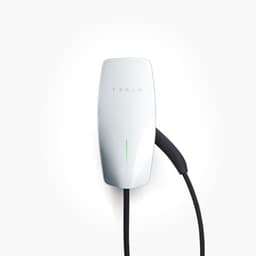 Tesla Wall Connector Tesla Wall Connector | 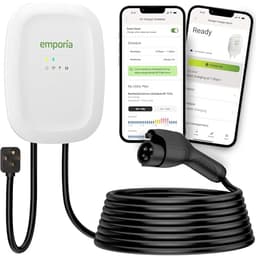 Emporia Level 2 EV Charger Emporia Level 2 EV Charger | |
|---|---|---|
| Connector | NACS (Tesla) | J1772 |
| Max output | 48 A | 48 A |
| Max power | 11.5 kW | 11.5 kW |
| Cable length | 24 ft | 25 ft |
| Install | Hardwired (60A circuit for full output) | Plug-in (NEMA 14-50), convertible to hardwired |
| Outdoor rating | Indoor/outdoor rated | NEMA 4 (outdoor) |
| Warranty | 4 years (residential) | 3 years |
| Price | $883.99 · View on Amazon Price as of October 18, 2026. #ad How we’re funded |
The Emporia’s real feature is not on the spec sheet
Charger reviews spend their time on apps and amperage. The Emporia’s genuinely distinguishing property is neither: it arrives set up for a NEMA 14-50 plug at 40A and converts to a hardwired 48A install afterwards.
That resolves the single most expensive uncertainty in this whole purchase. Right now you probably do not know what circuit your panel can spare, what the run to the garage costs, or whether 48A is worth having. The Emporia lets you buy the charger before you know — start on the cheap, ordinary 50A plug-in install, and step up only if the numbers later say so.
The Tesla unit does not offer that path. It is hardwired, full stop, which means the electrician and the 60A circuit are part of the purchase rather than a later option. If your panel can feed it, fine. If it cannot, you have bought a charger you cannot install as intended. Our plug-in vs hardwired guide covers why that fork matters more than the amperage does.
The connector: the real dividing line
The Tesla Wall Connector carries a native NACS handle. A Tesla plugs straight into it with nothing hanging off the connector, which is the whole argument for buying it and a genuinely nicer thing to live with outdoors. It also means the handle fits nothing else: a J1772 car needs a NACS-to-J1772 adapter, which Tesla does not include in the box.
Tesla does build a version that solves this — the Universal Wall Connector, with a J1772 adapter built into the handle — but it costs more than the standard unit and is just as hardwired, so it does not change the install side of this comparison.
The Emporia is a plain J1772 charger. For a J1772 car, ideal. For a Tesla, it works using the adapter that came with the car, or a better aftermarket one from our J1772-to-Tesla roundup. Thousands of Tesla owners charge exactly this way. You just have a small removable part living outdoors on the end of a cable.
Worth knowing: Emporia also sells a native-NACS variant of this charger, which we cover in our NACS home charger roundup. If the connector is your only objection to the Emporia, that roundup is where to look next.
Output: identical on paper, and identically theoretical
Both units top out around 48A, or roughly 11.5 kW. Both need a 60A circuit to get there, because EV charging is a continuous load and code sizes the breaker about 25% above the draw.
Two ceilings sit above that number and both are commonly ignored. The first is your panel: 60A is where spare capacity runs out in a lot of houses, and a service upgrade costs more than either charger. The second is your car’s onboard AC charger— if it is rated below 11.5 kW, neither unit can deliver 11.5 kW to it, regardless of the circuit. Look that figure up in your owner’s manual before you pay for output. Our amps and circuits guide has the full breaker table and the arithmetic.
On the Emporia’s plug-in configuration you get 40A rather than 48A — roughly 9.6 kW, about eight miles per hour less. Across a ten-hour night that is around 300 miles of replenishment instead of about 380. For nearly everyone both read as “full by morning”.
Apps, data and the honest test
Both are connected chargers with scheduling and energy monitoring. Emporia’s wider product line is home energy monitoring, so the charger slots into a coherent whole-home energy picture — a more sensible story than most charger apps manage. Tesla’s integrates with the Tesla app, which is genuinely tidy if you already live in that app for the car.
The test we would apply either way: can your car already schedule its own charging?Most modern EVs can, from the car, and that removes the most-cited reason to buy connectivity. What a car cannot do is measure the circuit or manage household load — those are the features that justify a smart charger on their own merits. Our smart charger roundup works through it.
Buying, support and the practical asymmetry
The Tesla unit is sold primarily direct from Tesla, so retail stock and pricing elsewhere can be inconsistent. Emporia is a conventional retail product with ordinary availability and returns. If you want to order today and have it arrive this week, that difference is worth weighing alongside the specifications.
The verdict
Buy the Tesla Wall Connector if every car in the household is a Tesla and an electrician has confirmed a 60A circuit. The native handle and the integration with the app you already use for the car are what you are paying the premium for, and in a Tesla-only garage they are worth something.
Buy the Emporia Level 2 in almost every other case, and especially if you have not yet had the electrician out. It is the cheaper unit, it starts on the cheaper install, and its upgrade path means you are not betting money on a circuit you have not confirmed. Our full Emporia review covers where it falls short.
If you want the same Tesla unit measured against a different opponent, we also compare it to the ChargePoint Home Flex and the Grizzl-E Classic.
Frequently asked questions
Can the Emporia charge a Tesla?
Yes, using the J1772 adapter that ships with every Tesla, at the same rate as any other J1772 charger. Emporia also sells a native-NACS version of this charger if you would rather not have an adapter permanently attached to the connector outdoors.
Which is cheaper to install?
The Emporia, because it can run plug-in at 40A on a NEMA 14-50 receptacle fed by an ordinary 50A circuit. The Tesla unit is hardwired only and wants a 60A circuit for full output, which is where many panels run out of spare capacity and a service upgrade enters the conversation.
Can the Emporia really be upgraded to 48A later?
Yes — that is its defining feature. It ships configured for a NEMA 14-50 plug at 40A and supports conversion to a hardwired 48A install afterwards. It lets you install the cheaper circuit now and revisit only if your own charging arithmetic says the extra output is worth the bigger circuit.
Do I actually need 48A?
Usually not. At 40A you replace roughly 300 miles of range across a ten-hour night; at 48A, roughly 380. That gap only matters with a large battery, a low arrival state of charge and an early departure. It also requires your car's onboard AC charger to accept that much — many cap lower.
Is the Tesla Wall Connector worth the extra money?
In a Tesla-only garage it can be: the native NACS handle removes the adapter from your daily routine and the charger is managed from the Tesla app. If any car in the household uses J1772, you are paying a premium for a handle that will not fit it without a further adapter.
Sources
- U.S. DOE Alternative Fuels Data Center — Charging Electric Vehicles at Home — DOE guidance on Level 1 vs Level 2 home charging, 120V/240V service and installation (accessed July 19, 2026)
- EPA ENERGY STAR — Electric Vehicle Chargers — ENERGY STAR on certified EV chargers, safety certification and standby energy use (accessed July 19, 2026)
- EPA ENERGY STAR — Certified Electric Vehicle Chargers (AC Output) — The list of ENERGY STAR certified AC (Level 2) EV chargers (accessed July 19, 2026)
- SAE International — J3400 North American Charging System (NACS) for Electric Vehicles — The SAE standard for the NACS connector (Tesla's plug), alongside the J1772 AC standard (accessed July 19, 2026)
Keep reading
Emporia Level 2 review
The full review of the unit on the right — and why its upgrade path is the smartest thing about it.
Read the Emporia reviewTesla Wall Connector review
The full review of the unit on the left — the NACS handle, the hardwired install and the circuit it demands.
Read the Tesla reviewEmporia vs ChargePoint Home Flex
The same Emporia against the other charger people cross-shop it with most.
See that comparisonBest 48A and 50A home EV chargers
The whole high-output field, with the three-part test for whether you need it at all.
See the 48A roundup