Step one: find your onboard charger rating
This takes about two minutes and saves more money than any other step in the process. Three reliable places to look, in order of how much we trust them:
- The owner’s manual, charging section. It is stated directly, usually in kW, and it is specific to your model year and trim. This is the answer.
- Hyundai’s published specification page for your model year. Look for “onboard charger” or “AC charging” — not the DC fast-charge figure, which is a much larger and completely irrelevant number here.
- The car itself. Plug into a charger you know exceeds the car’s rating and read the kW the car reports on its charging screen. That is the ceiling, empirically.
Do not take the figure from a forum post or a spec-aggregator site. Onboard charger ratings have changed between model years and between trims on this car, and a wrong number here costs you either a wasted upgrade or a charger that throttles you.
Step two: turn that number into an amperage
The arithmetic is one line: kW ÷ 240V × 1000 = amps. Then round up to the nearest charger you can buy. Worked through for the ratings you are likely to find:
- A 7.2 kW onboard charger draws about 30A. A 32A charger saturates it. A 40A charger is fine and gives you headroom for your next car; a 48A charger delivers nothing extra, ever.
- A 10.9 kW onboard charger draws about 45A. A 48A charger saturates it; a 40A charger throttles you slightly, by roughly a tenth of the rate.
- An 11 kW onboard chargerdraws about 46A. Same answer as above — 48A saturates, 40A costs you a little.
Now put the circuit cost against that. Under the 80% continuous-load rule a 40A charger needs a 50A breaker and a 48A charger needs a 60A breaker, and in most houses that step is the difference between an ordinary afternoon’s work and a conversation about the service panel. Our amps and circuits guide has the full breaker table, and our installation cost guide explains why the same charger can cost wildly different amounts to fit.
The honest conclusion for most Ioniq 5 owners: 40A is the right answer, and it is the right answer even if your onboard charger is rated a little above it, because the difference is a few miles of range per hour on a car that sits for ten hours. Our 40A roundup makes that case in full.
Check your charge port before you buy anything
The industry is midway through the switch to native NACS ports, and Hyundai is part of that transition. Go and look at your car:
- A J1772 port (round, five pins visible on the AC section) is what the picks on this page plug into directly. Nothing else needed.
- A NACS port(smaller, flatter) needs either a native-NACS wall charger — see our NACS home charger roundup, which covers every factory-NACS unit regardless of what car you drive — or a J1772-to-NACS adapter hanging off a J1772 charger. Both work. The adapter is far cheaper; the native charger is tidier and puts nothing extra in the weather.
If you are unsure which you have, our connector guide has photographs of each.
The question behind the question: which port does your AC charging?
“Does the car have a NACS port?” is not quite the right question, and getting it wrong is the most expensive mistake available on this page. What actually decides your home charger is which port the car uses for Level 2 AC charging, and those are not always the same socket.
The Ioniq 5 is the straightforward case, and it was the first mass-market non-Tesla model to ship a factory NACS port. On the NACS-equipped cars the NACS port is the AC port too — it handles Level 2 at home and DC fast charging on the road. So an Ioniq 5 with a NACS port can take a native-NACS wall charger directly, or a J1772 charger through a J1772-to-NACS adapter. Both are correct; the adapter is far cheaper.
Other manufacturers have not all done it that way, which is why we spell this out. The 2026 Nissan Leaf, for instance, carries a NACS port that does DC fast charging only, plus a separate J1772 port that is the only way to AC charge it — a native NACS wall charger will not charge that car at all without an adapter, despite the NACS socket on the fender. Same connector on the body, opposite answer at the garage wall.
Before you buy an adapter, look in the car. Manufacturers have been shipping charging adapters with NACS-port vehicles, and buyers routinely purchase a second one they already own. Check the trunk well and the charging section of the manual first — if there is a J1772-to-NACS adapter in there, a J1772 charger from the picks above becomes the cheapest correct answer on this page. Our J1772-to-NACS adapter roundup is for when it is genuinely missing, or you want a better one than the bundled part.
Why we picked these four
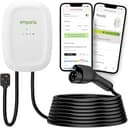
Emporia Level 2is the pick when you do not yet know your onboard charger rating or your panel’s headroom: it ships configured for a NEMA 14-50 plug at 40A and converts to a hardwired 48A install later. Start cheap, upgrade only if the numbers say so, which removes the only genuinely irreversible decision here. The Emporia review goes deeper.
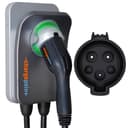
ChargePoint Home Flexis here for the most mature charging app in the category. It used to answer the same uncertainty with a 16–50A amperage dial, but ChargePoint now sells the hardwired and plug-in versions separately and, as of 20 September 2026, the hardwired one is not listed on Amazon; the model we link is the NEMA 14-50 plug-in, a fixed 40A unit — which, as the section above explains, is the right amount for most Ioniq 5 owners anyway. Our full Home Flex review covers what changed.
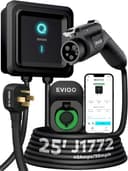
EVIQO 40A is the straightforward choice if you already have a NEMA 14-50 outlet or are having one fitted: a purpose-built wall station on a plug, no electrician needed for the charger itself, no app to manage.
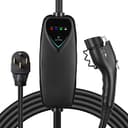
Lectron 40A Portable is here because the Ioniq 5 is a road-trip car and this unit does two jobs. It hangs on the wall at home and rides in the frunk for the weekends where the destination has a dryer outlet and nothing else. Our road-trip charger guide covers what else belongs in that bag.
Two Ioniq 5 details worth knowing
Vehicle-to-load.If your car and trim support V2L, it can supply household AC out of the pack through an adapter Hyundai supplies or sells. That is not a charging feature and no wall charger interacts with it — but it is worth knowing you own it before you buy a separate power station.
Preconditioning and the schedule. Charging schedules set in the car and schedules set in the charger app can fight each other, and the usual symptom is a car that did not charge overnight. Pick one and disable the other. In a cold climate we would set it in the car, because the car is the only one of the two that knows the battery temperature — see our cold-weather guide for why that matters more than it sounds.
What about Supercharger access?
Different problem, different hardware, and a genuinely different answer for this car because of that 800V architecture. We wrote it up separately in NACS-to-CCS adapters for an Ioniq 5, including why the fastest-charging car on the road can be unremarkable at a Supercharger stall. Nothing on this page affects that, and nothing on that page affects this one.
If the household also has the Ioniq 5’s platform sibling, the answer is close but not identical: Kia publishes a 10.9 kW onboard charger for the EV6 and moved it to a NACS inlet for the 2025 model year, which rules out some chargers that suit this car. Our home chargers for the Kia EV6 works through that separately.