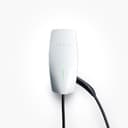
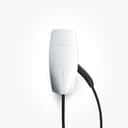
Side by side: what Tesla’s own manuals publish
This table is built from Tesla’s documents rather than the retail listings, because the listings for both units use near-identical feature text and do not show you where they differ.
| Published spec | Wall Connector | Universal Wall Connector |
|---|
| Tesla part number | 1457768 | 1734412 |
| Connectors | NACS handle | NACS handle + docked J1772 adapter |
| Output range | 12-48A | 12-48A |
| Breaker for full 48A | 60A double-pole | 60A double-pole |
| Cable | 24 ft | 24 ft (13.1 ft variant on the datasheet) |
| Install | Hardwired only | Hardwired only |
| Enclosure | Type 3R, IP54 | Type 3R, IP54 |
| Operating temperature | -22°F to 122°F | -22°F to 122°F |
| Size on the wall (H x W x D) | 13.6 x 6.1 x 4.3 in | 13.6 x 6.1 x 5.9 in |
| Weight with wirebox | 10 lb | About 13 lb |
| Wi-Fi | 2.4 GHz, 802.11b/g/n | 2.4 GHz, 802.11b/g/n |
| ENERGY STAR record | Certified, qualified 2023-09-18 | Certified, qualified 2023-09-18 |
| Residential warranty | 48 months | 48 months |
Read down the two columns and only three rows really differ: the connectors, the part number, and the size and weight that the adapter dock adds. Output, circuit, cable, enclosure, connectivity and warranty are the same. Nothing on this sheet makes the Universal faster, tougher or cheaper to install. What you are deciding is whether that docked adapter is worth paying for.
The question that decides it: what port is on the other car?
Walk out to the driveway and look at the charge ports, not the badges. That tells you more about this purchase than any spec sheet. Then check one more thing in each owner’s manual: which port the car uses for AC charging. They are not always the same port. As our NACS home charger roundup explains, the 2026 Nissan Leaf has a NACS port for DC fast charging and a separate J1772 port that is its only way to charge on AC. For choosing between these two chargers, a car like that is a J1772 car.
Every car charges on AC through a NACS port
Buy the standard Wall Connector and keep the difference. That includes a Tesla alongside a non-Tesla EV that has a NACS port, a connector the industry standardized as SAE J3400 and one that carmakers have been moving new models to. Tesla’s manual lists the Wall Connector’s default access setting as “All Vehicles: default option, any vehicle can charge from this Wall Connector”. It also describes a Compatibility Mode “compatible with older generation vehicles”, to be used only if you see faults, at the cost of some software functionality. For a NACS-port household, the Universal’s adapter is a part you would never take out of its dock.
One of the cars charges on AC through a J1772 port
This is the household the Universal was built for. A J1772-port EV parked beside a Tesla is the most common version, but it is not the only one. A visiting relative who charges overnight counts, and so does a used EV you expect to buy in the next few years. Most non-Tesla EVs already on the road take AC charging through a J1772 port, and a hardwired charger is not something you swap when you change cars.
Nobody drives a Tesla, and every port is J1772
Neither of these is your charger. You would be paying for a NACS handle to permanently wear an adapter. A J1772 wall charger does the same job for less, and several of them can plug into a NEMA 14-50 outlet instead of being hardwired. Our home charger roundup starts there.
The adapter route, and the line in Tesla’s manual
The obvious way around the Universal’s premium is to buy the standard Wall Connector and a third-party NACS-to-J1772 adapter for the J1772 car. The adapters are real, widely sold and cheap next to either charger. Our Tesla-to-J1772 adapter roundup covers the category, and plenty of owners charge exactly this way.
Before you do, read the safety section of Tesla’s Gen 3 Wall Connector manual, the one that covers part number 1457768. It contains two short cautions: “No adapters or conversion adapters are allowed to be used” and “Cord extension sets are not allowed to be used.” Separately, Tesla’s Charging Equipment Limited Warranty excludes damage from the “use of non-genuine Tesla accessories or parts”.
We want to be exact about what that does and does not mean. We are not telling you an adapter will damage the charger or the car, and we are not telling you Tesla will refuse a claim. We cannot know either, and Tesla does not publish how it applies the exclusion. What we can say is narrower and checkable. The adapter route runs against a written caution in the manufacturer’s own manual. If something fails with a third-party adapter in the chain, the warranty language gives Tesla a published basis to decline.
The Universal avoids both problems. Its J1772 adapter is Tesla’s own part, listed in the Universal manual as one of the unit’s external components, and we found no equivalent adapter caution in that manual’s safety section. The manual’s instruction for using it is a single line: “To use J1772 handle, press the black button on the J1772 adapter to remove the handle from the dock.”
The honest counterweight is that an adapter has uses the dock cannot match. It travels, and these adapters are sold for Tesla destination chargers as much as for home units. It also costs a small fraction of a charger. If you mainly want a J1772 car to borrow a Tesla unit at somebody else’s house, an adapter is the realistic tool and the Universal is not really the alternative. The Universal is the answer to a different question: what should go on your own wall, every night, for years.
Price, and who is actually selling it
Price is where this comparison gets awkward, and we would rather tell you than let the buy buttons do the talking.
When we checked on 16 September 2026, the Amazon offers for both units came from the same third-party seller, not from Tesla. The standard Wall Connector’s offer also showed a shipping lead time of more than a week. The Universal had been missing from Amazon since August, when its old listing went dead; it has now returned under a new product number.
For a reference point on Tesla’s own pricing, a May 2026 news report recorded Tesla cutting the Universal’s price on its official Amazon storefront and said the Tesla site carried the same price. The third-party offer on Amazon today is well above that figure. The prices shown on this page come from our daily check of the live listings and will move. Even so, we would price Tesla’s own shop before ordering either unit here. Buy on Amazon if the gap is small or its returns process matters more to you than the difference.
The number that actually decides this page is the gap between the two units, not either price on its own. Take the difference between the two live prices, then set it against the price of a quality adapter from our roundup. If the premium costs about as much as the adapter, the Universal is the easy call for any household with a J1772 car. If the premium is several times the adapter, you are paying mostly for the manual’s blessing and a tidier wall. That can still be worth it, but you should know that is what you are buying.
The dock is a physical thing on your wall
The Universal is 5.9 in deep against 4.3 in for the standard unit, per Tesla’s manuals, and about 13 lb against 10 lb with the wirebox. Tesla’s 2023 Universal datasheet gives 15 lb including the bracket, so plan on the heavier figure when you pick the mounting surface. Height and width are identical.
An extra inch and a half sounds trivial until you picture a narrow garage walkway between the wall and a car door. The Universal manual also asks for “ample clearance on all sides” so the cable can loop around the unit and the handle can land in its side dock. It sets a maximum mounting height of 60 in, a recommended height of about 45 in, and minimums of 24 in outdoors and 18 in indoors, measured to the bottom of the unit. Measure where the car doors actually swing before you mark the wall.
Install and circuit: identical, so budget the same
Both manuals carry the same breaker table: a 60A double-pole breaker for 48A, then 50A for 40A, 40A for 32A, 30A for 24A, 20A for 16A and 15A for 12A. The breaker size is programmed during commissioning. Both manuals also say to “Hardwire branch circuits” and “Do NOT install cord-and-plug type connections”, so neither can hang on a NEMA 14-50 outlet and neither leaves with you when you move. Our Wall Connector vs NEMA 14-50 comparison covers that trade.
The electrician’s quote should therefore be the same for either unit, and the choice between them should not change the install. If your panel cannot spare a 60A circuit, both run happily at a lower setting. Both manuals also document an optional energy meter for dynamic power management and power sharing across a group of Wall Connectors, which our load management guide explains. One caveat applies to both units, and Tesla prints it itself: “Some Tesla vehicles may draw less current than the max output.” Check your car’s onboard charger rating before paying for a 60A run. Our amps and circuits guide has the arithmetic.
ENERGY STAR and the rebate form
EPA’s ENERGY STAR dataset certifies both families. Model 1457768 is listed under the brand “Tesla”, and model 1734412 under the brand “Universal Wall Connector”. Both were qualified on 18 September 2023, both at 48A and 11.52 kW. Two details are worth knowing before you file anything. The EPA records list a 22 ft cord, while Tesla publishes 24 ft. And the Amazon listing for the Universal reports part number 1734411-02-E, which does not match the 1734412 family on the certification record.
Neither detail changes the certification, but rebate programs match on model numbers, so confirm with your utility which number to enter before you buy. The federal section 30C credit is no longer available for chargers placed in service after 30 June 2026, which makes a utility rebate the lever still worth pulling. Our certification guide explains what ENERGY STAR does and does not test.
Which should you buy?
Buy the Universal Wall Connector if a J1772-port car lives on your driveway or visits often enough to charge there. It is also the right pick if you would rather not run a third-party adapter on a charger whose manual cautions against one. You still need a confirmed 60A circuit if you want the full 48A.
Buy the standard Wall Connector if every car you own or expect to own has a NACS port, if the gap between the two prices is large, or if wall depth is tight. Nothing else on the spec sheet favors the Universal.
Buy neither if you want a plug-in charger, rent your home, or drive only J1772-port cars. Our renters roundup and two-EV guide cover the households these two hardwired Tesla units do not suit.