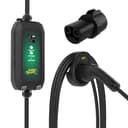
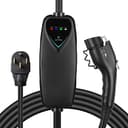
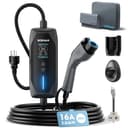
The five, side by side
Read from the same registry entries as the reviews above, so the table cannot drift from the write-ups. The install column is the one that matters most here: it names the plug each unit ships on, and the plug is what caps the amps.
| Product | Max output | Max power | Cable | Install | Weather rating | Warranty | Price |
|---|
| Battery Tender eCharge 32 (Level 1 + 2) | 32 A | 7.7 kW | 25 ft | Plug-in (NEMA 14-50; 120V 5-15 adapter included) | IP66 | 3 years | |
|---|
| Lectron 40A Portable Level 1/2 Charger | 40 A | 9.6 kW | 21 ft | Plug-in (NEMA 14-50 + 5-15 adapter) | IP66 connector | 1 year | |
|---|
| EVDANCE Level 1 & 2 Portable Charger (16A, 25 ft) | 16 A | 3.8 kW | 25 ft | Plug-in (NEMA 5-15 or 6-20) | Not published | Not published | |
|---|
| TopAutoGear Portable Level 1 & 2 Charger (16A) | 16 A | Not published | 17 ft | Plug-in (NEMA 6-20, with a 5-15 adapter) | Not published | Not published | |
|---|
| bokman Portable Level 1 & 2 Charger (16A) | 16 A | Not published | 20 ft | Plug-in (NEMA 6-20 or 5-15) | Not published | Not published | |
|---|
The five criteria we ranked on
1. Does it publish a current for both voltages?This is the first filter and it eliminates more listings than you would expect. A unit described as “110V/240V compatible” with a single amp figure is telling you half the story, because the 120-volt side is usually derated well below the 240-volt rating. The EVDANCE publishes both numbers plainly — 12 A at 120 V, 16 A at 240 V — and the TopAutoGear publishes an adjustable 8–16 A range across both. Battery Tender goes furthest and publishes kilowatts for each.
2. Which plugs actually ship in the box?A dual-voltage charger with no 240-volt adapter is a Level 1 charger you paid extra for. The listings in this class are frequently vague about contents, which is why we flag it on every card: where the box is not published, assume the plug in the photograph is all you get. Buying the adapter separately is cheap — our NEMA adapter roundup covers the one-foot cords that convert a dryer or welder receptacle — but it needs to be in the budget rather than a surprise.
3. Is there a named certification body?This device sits in a household receptacle drawing current unattended for ten or twelve hours. UL and ETL listings both mean an independent lab tested it; “certified” with nothing after it means nobody you can look up has. Four of the five picks name a lab. The fifth is on the page as a second source and its missing certification is stated on its card rather than buried.
4. Cable length.On a travel charger this is not a convenience spec, it is whether you charge at all — the outlet at a motel or a relative’s garage is wherever it is. The spread here is 17 to 25 ft, and the longest cable in the 16-amp class costs only a few dollars more than the shortest.
5. Adjustability.A charger that can be dialed down is a charger that can use outlets it would otherwise overload. This matters most with a NEMA adapter: behind a 30-amp dryer circuit you must set the unit to 24 A, and the adapter will not do it for you. The TopAutoGear publishes 8–16 A and the Lectron publishes adjustable output on some units; the fixed-16 A units simply cannot be matched to a 20-amp circuit the same way.
What each tier actually adds to the battery
The arithmetic, so the price differences make sense. At 120 V and 12 Ayou are adding roughly 1.3–1.4 kW, which is three to five miles of range per hour — about 40 miles across an overnight charge, and genuinely enough for a short commute or a plug-in hybrid. At 240 V and 16 Ait is about 3.8 kW, roughly 12 miles per hour. At 240 V and 32 Ait is about 7.7 kW and 20–25 miles per hour, which is a full overnight charge for almost any EV. At 240 V and 40 Ait is about 9.6 kW and roughly 30 miles per hour, the ceiling for anything on a plug. Your own figure depends on the car’s efficiency and its onboard charger — plenty of cars cap below 40 A, in which case the extra amps are spent before they reach the battery. Our charging time guide works this through with your own numbers.
How we ranked these five
The Battery Tender eCharge 32 wins on verifiable detail, and it is the only unit here that is a serious Level 2 charger as well as a Level 1 one.Thirty-two amps on a NEMA 14-50 is 7.7 kW — the same output as plenty of wall-mounted chargers — and the 120-volt side is a published figure rather than an afterthought. Battery Tender publishes a minimum 40-amp circuit for the 240-volt side, a 25 ft cord, IP66, 6.37 lb, and cETLus to UL 2594 with ENERGY STAR, FCC and ICES marks. The honest cons: it is by far the most expensive unit on this page, it is 32 A rather than 40, and at over six pounds it is the heaviest thing here to carry. It also appears on our 32A roundup, which is the page to read if the home side is what you actually care about.
The Lectron 40A Portable is the most power you can get in this class.Forty amps and 9.6 kW on a NEMA 14-50, with a 5-15 adapter for the Level 1 side, a published IP66 connector and a 21 ft cable, from the brand with the deepest catalog in this niche. It is the top pick on our main portable roundupfor good reason. Two cons: the warranty is one year where the Battery Tender publishes three, and on a standard 120-volt outlet it drops to Level 1 speed like everything else — which is the physics of the socket, not a defect in the charger. Full detail in our Lectron review.
The EVDANCE Level 1 & 2 is the pick for reach.Its 25 ft cable is eight feet longer than the budget pick’s and five more than the next unit, which on a travel charger is the difference between reaching an outlet across a parking space and not charging. It publishes 12 A at 120 V, 16 A at 240 V, both 5-15 and 6-20 plug options and an ETL listing, and states compatibility with all EVs and PHEVs. The cons are what it leaves unpublished: no enclosure rating and no warranty term, and the brand publishes one year on its other portables. If you are weighing it against the rest of the brand’s range, we wrote a page on the alternatives to EVDANCE.
The TopAutoGear 16A is the budget pick, chosen on certification rather than price.It is not the absolute cheapest thing in this class at every check, and that is deliberate: it names an ETL certification where the floor of the market names nothing, and it adds an adjustable 8–16 A range, an LCD display and a NEMA 6-20 plug with a 5-15 adapter. The cons: a 17 ft cable, which is the shortest here, and no published kW figure, enclosure rating or warranty term. For a charger that lives in a trunk against the day you need it, that is a defensible set of trade-offs.
The bokman 16A is here as a second source, with one caveat stated plainly.It publishes 16 A, a 20 ft cable and both NEMA 6-20P and 5-15 plug options — more cable than the TopAutoGear for similar money — but it does not name a certification body, a kW figure or a warranty term. We would take the ETL listing over the extra three feet, and we would only buy this one if the certified units were unavailable. It is listed rather than hidden because a roundup that pretends the rest of the market does not exist is not much use.
When a dual-voltage charger is the wrong buy
If you only ever charge at home on a 240-volt outlet, the 120-volt capability is dead weight and you should buy a single-purpose 40-amp portable or a wall charger instead — see portables under $200 or plug-in wall chargers. The money is better spent on amps, cable length or an enclosure rating.
If you only have a 120-volt socket and no prospect of a 240-volt circuit, the 240-volt side is the dead weight instead, and a purpose-built Level 1 unit is cheaper and lighter. Our Level 1 roundup makes that case honestly, including the part most pages skip: for under about 40 miles of daily driving, Level 1 genuinely covers it.
And if the plan is to plug a dual-voltage unit into an extension cord, stop — the problem is the duration of the load rather than the voltage, and it is the one shortcut in this category that is genuinely dangerous. Our extension cord guide explains why, and charging from a dryer outlet covers the legitimate way to reach a 240-volt circuit you already own.
One last practical note for anyone buying a dual-voltage unit as their main charger: put it on an industrial-grade receptacle. A NEMA 14-50 outlet was designed for appliances that cycle on and off, and a continuous 32- or 40-amp draw every night is a harder life than the part was specified for. Our NEMA 14-50 outlet roundup explains what separates a proper one from the twelve-dollar version, and a holster keeps the connector off the floor between sessions.