Yes, in most houses — and it is genuinely the cheapest way to get 240-volt charging without an electrician. The catch is a number: a 30-amp circuit permits a 24-amp continuous draw, and the charger has to be set to it. A plug adapter alone does not make this safe. It changes the shape of the plug and nothing about how much current the charger asks for.
Why a dryer circuit is a good candidate
A Level 2 charger wants three things: 240 volts, a dedicated circuit with nothing else on it, and a proper ground. A dryer outlet already has all three. That is a rarer combination in a house than people assume — it is why the dryer and the range are the two outlets anyone shopping for cheap home charging ends up looking at.
What it does not have is the capacity a charger assumes. The standard EV receptacle is a NEMA 14-50 on a 50-amp circuit, which supports a 40-amp charger. A dryer receptacle sits on a 30-amp circuit. The circuit is the constraint, and everything below follows from it.
The 24-amp rule, and where it comes from
EV charging is a continuous loadin the code’s sense: it runs at full draw for hours without letting up. Continuous loads are sized at 125% of their draw, which is the same thing as saying a circuit may be loaded to 80% of its rating continuously.
Run that on each outlet you might use:
- 30-amp circuit — 24 amps continuous. At 240 volts that is about 5.7 kW.
- 50-amp circuit— 40 amps continuous, about 9.6 kW. The standard EV install.
- 20-amp 240V circuit(NEMA 6-20) — 16 amps, about 3.8 kW.
- 15-amp 120V household socket— 12 amps, about 1.4 kW. Level 1.
The 5.7 kW figure is not our arithmetic alone — it is what Tesla publishes. The Mobile Connector owner’s manual carries a charging-rate table listing 24A / 5.7 kW on NEMA 14-30 and 10-30, against 32A / 7.6 kW on a 14-50 or 6-50, and states that the maximum current is “controlled by the appropriate adapter”. That is a manufacturer confirming both the rate and the mechanism.
Practically, 5.7 kW over an eight-hour window is roughly 45 kWh. For the overwhelming majority of drivers — who arrive home with a half-full battery and leave in the morning — that finishes hours before you wake up. Our charging-time guide lets you check it against your own battery and commute.
How Tesla does it, and why that distinction matters
Tesla’s approach is worth understanding because it explains what the cheap adapters below are not doing.
The Mobile Connector takes interchangeable adapters, and the manual says the maximum current is controlled by the adapter itself — fit the 14-30 adapter and the charger knows it is on a 30-amp circuit and limits itself to 24 amps. The current limit is enforced by the hardware.
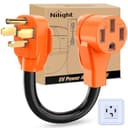
A generic plug adapter— a NEMA 14-30P on one end, a 14-50R on the other — does no such thing. It is a short cord that changes the plug shape. A 40-amp charger plugged into it will happily try to draw 40 amps from a 30-amp circuit, and what stops it is either the breaker tripping or, worse, a marginal connection getting hot before the breaker notices. You have to set the charger’s amperage yourself.
So the honest shopping rule for this route: buy a charger with adjustable output. Several on this site step down to 24, 20 or 16 amps from buttons or an app — the 32A roundup and plug-in hybrid page cover the adjustable units. A charger with a fixed 40-amp output is the wrong tool for a dryer circuit, whatever adapter you fit.
14-30 or 10-30: identify yours before buying
Go and look at the receptacle. There are two, and they take different adapters.
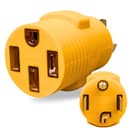
NEMA 14-30— four slots, one of them L-shaped. Two hots, a neutral and a separate equipment ground. This is what essentially every house built or rewired in recent decades has, and it is the better case: the ground is its own conductor. Picks one and two are for this outlet.
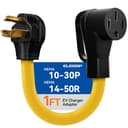
NEMA 10-30— three slots. Two hots and a combined neutral/ground, from an era when the neutral was allowed to do both jobs. It is a 30-amp 240-volt circuit and it will charge a car, but there is no separate equipment ground, which is a genuine electrical difference rather than a technicality. Pick three is the adapter for it.
Our honest advice on the 10-30: ask an electrician what replacing it with a 14-30 would cost before you commit to living on an adapter. Where the cable to the outlet has a suitable conductor the change can be straightforward, and where it does not, knowing that is worth more than the adapter price. Our NEMA outlet guide decodes the whole numbering system, and our adapter page covers the wider set.
What to check before the first overnight session
- Read the breaker.Confirm the circuit is actually 30 amps, not 20 or 50. The number is printed on the breaker handle. Size your charger setting off that, not off the receptacle’s shape.
- Set the charger to 24 ampsor the nearest setting below, and confirm the figure on the charger’s display or app rather than assuming the default.
- Inspect the receptacle. A dryer outlet that has been in the wall for thirty years and never carried more than an intermittent load is a different proposition under six hours of continuous 24-amp draw. Discolouration, a loose fit or a scorch mark is a replace-it signal.
- Put your hand on the plug after an hour. Warm is a warning, hot is a stop. This is the single most useful check on any plug-in charging arrangement, and it applies doubly here.
- Keep the run short and uncoiled.No household extension cords in the chain — see our extension cord guide for why that is a flat no.
When to stop doing this and install a circuit
Three situations, stated plainly.
- The plug swapping gets old. Most people tolerate it for a few months. Unplugging the dryer to charge the car is the reason this is usually a transitional arrangement rather than a permanent one.
- 5.7 kW stops being enough. If you are routinely arriving near-empty and leaving early, or two cars share the outlet, the 30-amp circuit becomes the binding constraint. Our 40A roundup is the next step up.
- The receptacle or circuit is suspect. Old wiring, an aluminium conductor, a 10-30 with no ground, or a receptacle that runs warm. At that point the money is better spent on the circuit than on an adapter. Our installation cost guide covers what a dedicated circuit involves.
The short answer
Charge from the dryer outlet, at 24 amps, with the right adapter for your receptacle and a charger you can actually turn down. Expect about 5.7 kW — Tesla’s own figure for those outlets — which is roughly 45 kWh overnight and more than most drivers use in a day. Check the breaker, check the plug temperature, and treat a three-prong 10-30 as a conversation with an electrician rather than a purchase.