The certification, actually verified
Start here, because it is the specification we refuse to trade away on this site. A home charger carries its rated current continuously, for hours, unattended, in a garage, while you sleep. Testing to a recognized standard by a recognized laboratory is not a feature; it is the floor.
Lectron publishes testing to UL 2594, UL 2231, UL 2251 and UL 817 with an ETL listing. Those numbers are worth separating, because cheap listings routinely blur them:
- UL 2594 is the standard for the charging station itself — the whole unit. This is the one that matters.
- UL 2231 covers the personnel-protection system, the circuitry that is supposed to cut power when something goes wrong at the car end.
- UL 2251 covers the connector and its plug. A charger advertised only as “UL 2251” has a certified handle and an uncertified box, which is a very different purchase.
- UL 817 covers the cord set.
Our certification guide covers what those marks mean and how to check one before you order. The short version: a full-unit listing on a mid-priced charger is the outcome you want, and it is not universal at this price.
The independent half is better still. Both Nexus models appear in EPA’s ENERGY STAR certified-EVSE list — the 40A plug-in as LECHGNexusNEMA14-50J1772 and the 48A hardwired as LECHGNexusHWJ1772, both under the partner name Dropcases Ltd. DBA Lectron, both qualified in April 2026 for the United States and Canada. That record is maintained by EPA, not by the seller, and it publishes numbers the listing does not.
What the ENERGY STAR record adds — and where it disagrees
Three things come out of that database that you cannot get from the product page.
1. The cable is a foot shorter than the marketing figure
Lectron publishes 23 ft. ENERGY STAR records the output cord at 22 ft, in 8 AWG. Both are honest figures measured somewhere slightly different, and the gap is small — but cable reach is the specification that causes the most buyer regret, because a cord two feet short is a daily annoyance you cannot fix without moving the charger or the car.
So plan around 22 ft. Measure from where the outlet will be to where the charge port sits when the car is parked the way you actually park it, and if you sometimes reverse in and sometimes nose in, use the longer of the two and add slack. Even at 22 ft this is well ahead of the 16 ft that many competing units ship with, and cable length is the one thing you genuinely cannot engineer around after installation.
2. There is no network hardware in it at all
ENERGY STAR records network capability: No for both models. Not “an app we did not test” — no WiFi, no cellular, no wake protocol. This is a dumb box by design, and the listing’s silence on smart features is accurate rather than an omission.
Whether that is a drawback depends entirely on your car. Almost every EV sold in the last several years can schedule its own charging from the car’s screen or app, which is the better place for it anyway — the car knows its state of charge and the charger does not. If your utility has time-of-use rates and your car can set a departure time, a smart charger buys you very little. If your car cannot schedule, or you want per-session energy reporting, or you are billing a tenant, you want a connected unit instead: our smart charger roundup covers those, and load management explains the one case where the charger genuinely has to be the smart component.
3. It costs almost nothing to leave powered
ENERGY STAR’s test data records 1.88 W in its no-vehicle mode and 5.29 W in idle mode for the 40A unit, against allowances of 4 W and 20 W. Under 2 W standing by is roughly 16 kWh across a full year — a couple of dollars at a typical residential rate. Standby draw is not a reason to buy any charger, but a unit that sits well inside its allowance is a small sign of a competently engineered power supply.
40A plug-in or 48A hardwired?
Same housing, same cable, same certifications, same warranty. The decision is about your electrical panel and your car, in that order — not about the charger.
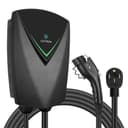
The 40A plug-in is the default, and it is the one we would buy. It delivers about 9.6 kW, which replaces roughly 300 miles of range across a ten-hour night: more than almost any household actually consumes in a day. It needs a NEMA 14-50 outlet on a 50A circuit, which is a much easier ask of an older panel than the 60A circuit a 48A unit requires. And because it plugs in, it can be unplugged — moved to a new house, swapped out, or taken off the wall.
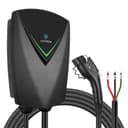
The 48A hardwired model is a narrower buy.It delivers about 11.5 kW, and there are two independent conditions on it paying for itself. Your panel has to be able to carry a 60A dedicated circuit under the 80% continuous-load rule — many 100A services cannot — and your car has to be able to draw 48A on AC, which most EVs sold in the US cannot. The ceiling is the vehicle’s onboard charger, not the wall box: our amps and circuits guide has the arithmetic, and our 48A roundup makes the case for the households where it genuinely pays.
There is one non-speed argument for hardwiring that we do take seriously. Hardwiring removes the receptacle, and the receptacle is the part of a plug-in install that fails: ordinary NEMA 14-50 outlets are built for the intermittent loads of ranges and RVs, not a continuous multi-hour draw, and cheap ones are a known overheating risk. If you are installing outdoors, or on an unknown-quality existing outlet, that argument is worth more than the extra amps. Our plug-in versus hardwired guide lays out both sides.
Outdoors, and the IP66 rating
Lectron publishes an IP66 housing rated for indoor and outdoor use. IP66 means dust-tight and protected against powerful water jets — a real rating for an exterior wall, not the “weather resistant” phrasing that unrated units use. That puts the Nexus in a smaller group than its price suggests; plenty of chargers in this bracket publish no enclosure rating at all, which we treat as indoor-only.
Two caveats we would still apply outdoors. A rated enclosure does not make a plug-in install outdoor-safe by itself — the receptacle and its in-use cover have to be rated too, and that is the electrician’s call. And an exposed installation still benefits from a cover or a shaded position; our outdoor roundup and charger covers cover both.
Which cars it fits
The models reviewed here have a J1772 connector, which is the AC standard for almost every non-Tesla EV and plug-in hybrid sold in North America. A Tesla charges from a J1772 charger using the adapter that came with the car, or a better one from our J1772-to-Tesla roundup.
Lectron also sells the same Nexus hardware with a native NACS connector — the ENERGY STAR record lists those as variants of the same certified models. If your car has a NACS port and you would rather not live with an adapter on the wall, our Tesla and NACS charger roundup is the page to read; it compares the native-NACS units we have verified against each other.
Who should buy it
The buyer this suits is specific: you want a charger that is certified as a whole unit, rated for the wall you are putting it on, with enough cable to actually reach the car — and you do not want an app. That combination is harder to find than it should be. Most units that publish a full UL 2594 listing and an IP66-class housing either cost more or bundle connectivity you did not ask for and cannot remove.
It also suits a second charger in a two-EV household, where the connected unit handles the car with the complicated schedule and a dumb box handles the other. Our two-EV guide covers how to split a single circuit between them.
Who should buy something else
- Anyone who wants scheduling from the charger.There is no network hardware here and no firmware path to adding it. Check whether your car can schedule first — most can — and if it cannot, buy a connected unit like the Emporia or the ChargePoint Home Flex.
- Anyone who wants one charger that fits any circuit.Lectron does not publish an amperage-adjustment setting for the Nexus, so each model is what it says on the box. The hardwired Home Flex dials from 16A to 50A, which is the safer buy if the electrician has not been yet — but check which model you are getting, because the plug-in Home Flex on Amazon as of 20 September 2026 runs only at 32A or 40A.
- Anyone who wants a long service track record. ENERGY STAR records the Nexus as available from April 2026. Lectron has been selling charging equipment for years, but this specific model has months of owner feedback behind it, not years. If that matters more to you than the spec sheet, the Grizzl-E Classic is the established, similarly dumb, similarly rugged alternative.
- Anyone on the tightest budget. This is a mid-priced charger, not a bargain one. The cheaper end of our budget roundup will charge your car perfectly well; you will give up some combination of certification detail, cable length and enclosure rating to get there, and the page is explicit about which.
The one upgrade to buy alongside it
If you take the 40A plug-in model, spend money on the receptacle. An inexpensive NEMA 14-50 outlet is the cheapest part of the install and the likeliest to fail: they are designed for cyclic loads, not for a 40A draw held for eight hours a night, and overheated outlets are a documented failure mode. An industrial-grade receptacle costs several times a bargain one and is the single cheapest safety upgrade in the whole job — our NEMA 14-50 outlet roundup covers the ones worth buying.
The charger ships with a wall-mount J-hook and a plug holder, so you do not need a separate holster for the connector unless you want a second docking point.
The verdict
A genuinely good mid-priced wall charger with an unusually verifiable specification sheet. The full-unit UL 2594 testing, the IP66 housing and the ENERGY STAR record do more for our confidence than any feature list, and 22 to 23 ft of cable solves the problem people actually write to us about. The honest caveats are that it is a new model without years of field history, that the app is not merely limited but absent, and that the amperage is fixed at whatever model you choose.
Buy the 40A plug-in unless a 60A circuit and a 48A-capable car are both already true for you. And before you order, compare Amazon against Lectron’s own store — the Nexus is sold in both places and the prices are not always the same. We earn a commission on the Amazon link and nothing on the direct one, and we would still rather you paid less.