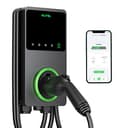
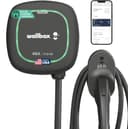
Autel MaxiCharger Home
A polished 50A unit with Wi-Fi, Bluetooth and a clean app, built to a higher hardware standard than most — and the widest published temperature range in this registry, -40 to 131 °F behind an IP65 / NEMA 4X shell. The catch is the circuit: Autel's own store page asks for a 70-amp feed to reach 50 amps, which is a bigger panel ask than the 60-amp circuit a 48-amp charger needs.
Strengths
- Up to 50A / 12 kW, adjustable down to 16A in the app
- IP65 / NEMA 4X enclosure rated -40 to 131 °F — the widest published range of any charger here
- Wi-Fi, Bluetooth and Ethernet, with scheduling and access control
- Autel lists Adaptive Load Management and charger-to-charger Dynamic Load Balancing
- CSA certified and ENERGY STAR certified, with a 3-year warranty
Trade-offs
- Autel publishes a 70A circuit for full 50A output — more than the 60A a 48A charger needs, and more than many panels can spare
- Hardwired only at this output; the plug-in NEMA 14-50 and 6-50 versions are separate 40A models
- Autel does not publish what sensor hardware Adaptive Load Management needs, so you cannot cost the feature before buying
- Connectivity adds a failure point a charger with no radio does not have
| Connector | J1772 |
|---|---|
| Max output | 50 A |
| Max power | 12 kW |
| Cable length | 25 ft |
| Install | Hardwired (70A circuit for 50A); plug-in sold as separate 40A models |
| Outdoor rating | IP65 / NEMA 4X (indoor/outdoor) |
| Warranty | 3 years |
Spec note. Autel sells this as the MaxiCharger AC Elite Home 50A. Autel's own US store listing publishes: "Maximum 12 kW (240 VAC @ 50 A model)" adjustable 16-50A, hardwired with a 70A circuit required for full output, an SAE J1772 connector on a "25 ft. (7.5 m)" cable, "IP65 / NEMA 4X", "-40 to 131 °F (-40 to 55 °C)" operating temperature, Bluetooth / Wi-Fi / Ethernet / CAN / RS485, "Adaptive Load Management (ALM); Dynamic Load Balancing (DLB)", CSA and ENERGY STAR certification, a 3-year warranty and about 15.4 lb with the in-body holster. Autel's product page repeats the NEMA 4X rating and the -40°F to 131°F figure and describes ALM as sharing power between loads in the home, but neither page states what sensor hardware ALM requires or (on the product page) the circuit size for 50A. The 50A unit is hardwired — the plug-in NEMA 14-50 and NEMA 6-50 versions are separate 40A models, so the install type is chosen at purchase rather than configured on the wall. The listing we link is the hardwired 50A.
Specs read from the product listing, on October 12, 2026. “Not published” means the manufacturer does not state that figure.