Who it’s for
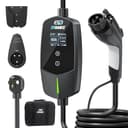
Three groups get real value from this unit. Renters, because a portable charger on a plug is not an installation and comes with you when you move — you are asking a landlord for an outlet rather than permission to mount equipment on their wall. People who travel to the same places repeatedly, such as a holiday house or family you visit often, where a NEMA 14-50 already exists for an RV or a dryer. And anyone who wants one device to do both jobs rather than buying a wall charger and a travel unit separately.
It is a poor fit for someone who wants a permanent, tidy, always-in-place setup with the cable managed on the wall. That person should buy a fixed unit — our home charger roundup covers the field, and the budget roundup covers the cheap end.
The IP67 connector, and why it matters here
IP67 means dust-tight and protected against temporary immersion in water. On a wall-mounted charger that would be mild overkill. On a portable unit it is genuinely useful, because a travel charger lives a harder life: it gets set down on wet ground, plugged into an outdoor outlet in the rain, coiled into a trunk with road salt on it and pulled out again three months later.
Note carefully what the rating covers — the connector. The control box and the plug end are separate questions, and the sensible habit with any portable charger is to keep the box off wet ground and out of standing water regardless of what the connector is rated for.
40A and the circuit behind it
A 40A charger needs a 50A circuit under the 80% continuous-load rule, and a NEMA 14-50 receptacle is exactly that. This is the most common EV-capable outlet in North America because it is also the standard RV and range outlet, so it turns up in garages, workshops, campsites and holiday properties.
One important limit: 40A is where a plug-in charger stops. Reaching 48A requires hardwiring, because no common residential plug is rated to carry that continuously. If you want more than 40A you are buying a fixed installation, and our 48A roundupcovers whether that is worth it — for most drivers, it is not.
Do not plug this into a cheap outlet
This is the single most important practical point about any plug-in charger. A hardware-store NEMA 14-50 receptacle under a 40A continuous load is one of the more common causes of heat damage in home EV setups. The contacts are not built for hours of full-rated current, they loosen with heat cycling, and a loose contact under 40A gets hot enough to melt the receptacle face.
Buy an industrial-grade receptacle and have it installed properly — our NEMA 14-50 outlet guide shows what separates them, and it costs a fraction of the charger. When traveling, you cannot control the outlet you find, so check it before committing to a long unattended session: if the receptacle is scorched, loose or warm to the touch after an hour, stop.
The adapter-kit trade-off
Portable chargers in this class are commonly sold with interchangeable plug adapters so one unit can work with several outlet types. That flexibility is the point, and it is genuinely useful when you do not know what you will find.
The honest downsides are that adapter configurations vary by listing— check which plugs are actually in the box for the exact unit you buy rather than assuming from the product family — and that every adapter is another connection in the path, which means another place for resistance and heat. Adapters also get lost. If you only ever use one outlet type, a charger with the correct plug molded on is simpler and has one fewer failure point.
What we’d change
We would like clearer published detail on what the control box itself is rated for, given how specific the connector rating is. A published warranty term longer than a year would also be welcome on a device designed to be knocked about. And as with the whole category, the cable stiffens in the cold — no portable charger escapes that, but it is more noticeable when you are coiling it back into a trunk at a service station in February.
The alternatives
The Lectron 40A portable is the closest competitor and the pick in our main portable roundup. If you drive a Tesla, the same units work with the adapter your car came with — see our portable chargers for Tesla page. And if you only need a trickle-charge safety net rather than a real Level 2 unit, the cheaper Level 1 chargers do that job for considerably less.