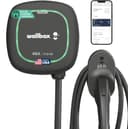
Who it’s for
Buy the Pulsar Plus when space is a real constraint rather than a preference. A narrow single-car garage where a briefcase-sized charger on the wall costs you door clearance. A carport post. A wall where the only spot left is between two obstructions. In those situations the Pulsar Plus solves a problem no amount of amperage or app polish can solve, and it does so while still delivering full 48A output.
It also suits people who genuinely like app-led hardware — who want scheduling, power sharing and usage data on a phone and do not miss physical controls. If that is you, this is a well-executed version of that idea.
48A in that housing
The headline is that the compact size costs you nothing in output: this is a 48A unit, the top of residential Level 2. The obligation that comes with it is the same as every 48A charger — a 60A hardwired circuit, because the 80% continuous-load rule caps a 60A circuit at 48A and no common residential plug is rated to carry that continuously.
So the size advantage applies to the box on the wall, not to the install behind it. You still need the heavier conductors and the electrician, and on an older panel you may still need the upgrade. If your panel cannot support 60A, the Pulsar Plus can be configured lower — but at that point a cheaper 40A charger does the same job, and you would be paying for compactness alone. Our 48A roundup works through whether this tier is worth it, and the amps and circuits guide has the breaker table.
Check the car, not just the wall
As with every high-amperage charger: your car’s onboard AC charger sets the real ceiling. Many EVs cap at 32A or 40A, and against such a car a 48A charger delivers exactly what the car allows. Check the owner’s manual for your model year before paying for amperage or the circuit that carries it.
The app-led design, fairly assessed
Wallbox’s app handles scheduling, monitoring and power management, and the scheduling piece is genuinely valuable where a utility charges time-of-use rates — shifting a full charge to off-peak is the largest recurring saving a home charger produces. Our cost-to-charge guide quantifies it at your own rate.
The counterpoint is straightforward. A charger that routes its controls through an app is a charger whose controls can be affected by a firmware update, an account problem or a Wi-Fi drop. Connectivity is the most common complaint across this entire product category, and a minimal physical interface removes the fallback. Many EVs also schedule charging from the car’s own screen, which makes the app a duplicate of something you already have. If you want a charger that simply delivers power with no account at all, the Grizzl-E Classic is the deliberate opposite of this design and costs less.
Enclosure and placement
The published rating is NEMA 3R, which is the entry level for outdoor use: protection against falling rain, sleet and snow. That is genuinely fine under an eave, a soffit or a carport roof. It is a step below the NEMA 4 found on the Grizzl-E, the Emporia and the Autel, which adds windblown dust and hose-directed water — the difference matters on a fully exposed wall that takes driving rain. Our outdoor charger roundup decodes the ratings properly.
What we’d change
We would like more on the unit itself — even a simple physical way to start, stop or set amperage would make the app a convenience rather than a dependency. We would also prefer a NEMA 4 option for people who want the small footprint on an exposed wall, which is currently a combination you cannot buy.
The alternatives
If space is not actually your constraint, almost every buyer is better served elsewhere: the ChargePoint Home Flex for the most mature app on a 40A plug-in, the Emporia for 48A value with a plug-in starting point, or the Grizzl-E for rugged simplicity at 40A. The full field is in our main home charger roundup.
Two head-to-heads if you have already shortlisted this one: Autel MaxiCharger vs Wallbox Pulsar Plus for the outdoor-rating question, and Wallbox Pulsar Plus vs Tesla Wall Connector if there is a Tesla in the household and the connector is the real decision. A third, if load management is what brought you here: Emporia Pro vs Wallbox Pulsar Plus sets Power Sharing against PowerSmart at the same 48A output.