Why 40A is the sweet spot
The arithmetic behind the recommendation is simple and worth doing yourself. Under the National Electrical Code, a continuous load may draw no more than 80% of its circuit’s rating — and EV charging is the textbook continuous load. So a 50A circuit permits a 40A charger, and a 60A circuit permits 48A. Our amps and circuits guide works through this in full.
The reason that 80% rule matters so much to your wallet is that 50A circuits are ordinary and 60A circuits often are not. A 50A branch is the same size circuit an electric range or an RV outlet uses; many panels have room for one, and the parts are commodity. Sixty amps is where panels start running out of space and where the conversation turns to a service upgrade. Our installation cost guide breaks down what actually drives the quote.
The other 40A advantage: the plug
A 40A charger can run on a NEMA 14-50 receptacle. A 48A charger cannot — at that output it must be hardwired. That difference is worth more than the eight miles per hour you gave up:
- You can take it with you. A plug-in charger unplugs when you move. A hardwired one stays with the house.
- A failed unit is a swap, not a service call. Unplug the dead one, plug in the replacement.
- You can install the charger yourself.The circuit and outlet are absolutely an electrician’s job. Hanging the charger on the wall and plugging it in is not.
The trade-off is that the receptacle becomes a component that can fail, and cheap ones genuinely do — a continuous 40A draw is far harder on a 14-50 outlet than the oven it was designed for. Do not put a bargain-bin receptacle behind a 40A charger; our NEMA 14-50 outlet guide shows what separates an industrial-grade one. The whole plug-versus-hardwire question is covered in plug-in vs hardwired. And if the amperage itself is still an open question, our 40A vs 48A comparison puts the same charger at both amperages side by side.
How we ranked these five
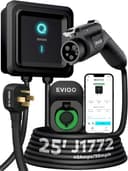
The EVIQO J1772 40A leadsbecause it is a purpose-built wall-mounted station that still runs on a plug — the combination most buyers actually want and few products deliver. It is a young brand, which is the honest caveat, and the listing publishes less than the established names do. Our full EVIQO review goes into what it does and does not tell you.
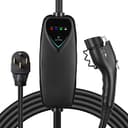
The EVPOVO is here for one specification: a published 25 ft cable at a price closer to a portable unit. Cable length is the most common regret in this category, because a 16 ft cord that cannot reach a charge port on the far side of the car makes the entire install useless. Measure the actual path — down the wall, across the floor, around the car — before you buy anything. The caveat is that this listing does not name a certification body, so check that on the page before ordering.
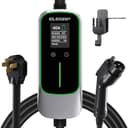
The ELEGRP is the price floor with a real certification. ETL listed, 25 ft cable, no app, no frills. If the budget is the binding constraint and you already have a 14-50 outlet, this is where the list bottoms out honestly. Read the ELEGRP review for where the money was saved.
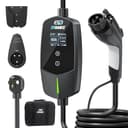
The Lectron and EVDANCE portables are on a home-charger page deliberately.A 40A portable plugged into a NEMA 14-50 does precisely what a wall-mounted 40A charger does — it is simply not bolted down, and it packs into the trunk when you travel. For a renter, or anyone who wants one device covering home and away, that is better value than a fixed box. The EVDANCE earns its spot on a sealed IP67-rated connector, which matters more on a unit that gets carried around. Our portable roundup covers the category properly.
When 40A is the wrong answer
It is the right answer more often than the market admits. The Honda Prologue is a good example: Honda publishes 34.1 miles of range per hour on 240 volts, which a 40A charger covers outright. And if your service is the constraint rather than the car, our 100-amp panel roundup is the page to read before you size anything.
Two situations genuinely justify going higher. The first is a large-battery vehicle on a short charging window— a truck with a 130 kWh pack, plugged in at midnight and needed full at 6am, is a real case for 48A. The second is two EVs on one charger, where the extra throughput compresses the nightly queue. Both are covered in the 48A and 50A roundup.
Going loweralso has legitimate cases. If your panel can only spare a 30A or 40A circuit, a charger that dials down — like the ChargePoint Home Flex, which configures from 16A — is worth more to you than a fixed-40A unit you cannot legally run at full output; our 32A charger roundup covers the units built for a 40A circuit. And if you drive fewer than about 40 miles a day, Level 1 charging from an ordinary socket genuinely covers it; our Level 1 roundup makes that case honestly.
The one thing not to compromise
Buy nothing that will not name its certification body in plain text. UL and ETL listings both mean an independent lab tested the unit. A listing that says only “certified” or nothing at all means nobody you can name has checked a device that pulls 40 amps continuously for hours, unattended, on a wall in your house. The EPA’s ENERGY STAR program publishes a searchable list of certified EV chargers and cross-checking a model against it takes under a minute.