Amp & Adapter

Tesla Wall Connector vs Mobile Connector

A 48A box bolted to the wall against a 32A cable that lives in the trunk. Tesla stopped putting one of them in the car in 2022, so this is now a purchase — and the NEMA adapter on the end decides most of it.

By Stephen V.Last updated How we rank

For years this was not a decision, because a Mobile Connector came in the trunk. That ended with orders placed from 17 April 2022, when Tesla stopped including one with a new car — Musk’s stated reason at the time was that “usage statistics were very low”. So a new owner now buys a charging solution, and the two obvious candidates are Tesla’s own.

They are not the same class of product. The Wall Connector is a fixed 48A station that an electrician hardwires to your wall. The Mobile Connector is a 32A cordset that plugs into an outlet, and whose actual current is set by whichever NEMA adapter is screwed onto the end of it. One is infrastructure; the other is a cable.

We compared them on the five things that genuinely decide it, in the order they decide it: 1. The speed you actually need for the hours the car is parked. 2. What is already on the garage wall— an outlet, or bare drywall. 3. The adapter question, which is the one buyers get wrong and which neither Amazon listing answers. 4. Permanence, and the handful of things only the wall unit does. 5. Price and where you are actually buying.

We own neither unit and we do not bench-test chargers — here is what we do instead. Everything below is read from Tesla’s own Mobile Connector and Wall Connector manuals, EPA’s ENERGY STAR certified-charger dataset and the live Amazon listings’ own published text, all checked on 30 September 2026.

How this is funded: we earn a commission if you buy through our links, at no extra cost to you. It never changes which product we recommend, and we’ll tell you plainly when we’d skip one. Full disclosure.

Quick picks

Ranked on published specs, install flexibility and buyer fit. Select a row to jump to the full write-up. We have not bench-tested these units — here is exactly what we do instead.

#ProductBest forPrice
1
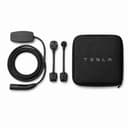
Tesla Mobile Connector Bundle (32A, NACS)

Tesla Mobile Connector Bundle (32A, NACS)

Tesla's own portable cordset, in the listing that says Bundle. The hardware is a 32A / 7.6 kW Level 2 charger on a NACS handle, and on a NEMA 14-50 outlet that is enough to refill an overnight commute several times over. It is the cheapest honest way to charge a Tesla properly at home, and it comes out of the garage with you.

Best for most Tesla owners
$400.00 · View on Amazon

Price as of September 30, 2026. #ad How we’re funded

2
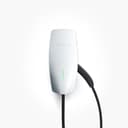
Tesla Wall Connector

Tesla Wall Connector

Tesla's own home charger, and the tidiest thing you can bolt to the wall of a Tesla-only garage: a native NACS handle, 48A output and scheduling from the app you already have open for the car. The handle fits nothing else without an adapter, and it is hardwired only, so it earns its premium in one specific household rather than in general.

Best when you want 48A and nothing to unplug
$885.00 · View on Amazon

Price as of September 30, 2026. #ad How we’re funded

3
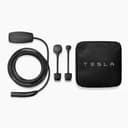
Tesla Mobile Connector (32A, NACS)

Tesla Mobile Connector (32A, NACS)

The same Mobile Connector hardware on the listing that does not say Bundle, and it sits below the bundle listing by roughly the price of a NEMA 14-50 adapter. That is the whole decision: if a 240V adapter is already in your trunk this is the cheaper buy, and if it is not, the cable is a 120V trickle charger until you source one.

Cheapest, if you already own the 240V adapter
$300.00 · View on Amazon

Price as of September 30, 2026. #ad How we’re funded

The picks in full

#1Best for most Tesla owners

Tesla Mobile Connector Bundle (32A, NACS)

Tesla's own portable cordset, in the listing that says Bundle. The hardware is a 32A / 7.6 kW Level 2 charger on a NACS handle, and on a NEMA 14-50 outlet that is enough to refill an overnight commute several times over. It is the cheapest honest way to charge a Tesla properly at home, and it comes out of the garage with you.

Strengths

  • Native NACS handle — nothing hanging off the connector on any Tesla
  • 32A / 7.6 kW on a NEMA 14-50 or 6-50 adapter, per Tesla's own charging-rate table
  • Packs into the trunk, so the same cable covers home, a relative's house and a rental
  • A fraction of the price of a wall unit, and it needs no electrician of its own once the outlet exists

Trade-offs

  • 32A is the ceiling — a Wall Connector reaches 48A, and no adapter changes that
  • The Amazon listing does not publish its box contents, so confirm which NEMA adapters ship with it before you count on 240V
  • Tesla's adapters are sold by Mobile Connector generation, and the listing does not state which generation this is
  • Falls to about 1.3 kW on a standard household socket — that is the outlet, not the cable
ConnectorNACS (Tesla)
Max output32 A
Max power7.6 kW
Cable length20 ft
InstallPlug-in (the NEMA adapter sets the current)
Outdoor ratingType 4X
Warranty1 year (per the Amazon listing)

Spec note. Tesla's Mobile Connector owner's manual publishes a maximum of 32A "controlled by the appropriate adapter", 100-240V single phase, a 20 ft cable with the adapter installed, Enclosure Type 4X, 5.2 lb and an operating range of -22F to +122F. Its charging-rate table reads 32A / 7.6 kW on NEMA 14-50 and 6-50, 24A / 5.7 kW on 14-30 and 10-30, 16A / 3.8 kW on 6-20, 12A / 2.8 kW on 6-15, 16A / 1.7 kW on 5-20 and 12A / 1.3 kW on 5-15. This listing's Amazon part number, 1937825-00-C, matches the ENERGY STAR certified record 1937825-XX-X under partner Tesla, Inc. — a "Level 1/Level 2 Dual Input" unit, 32A, 7.68 kW, 19 ft cord, 10 AWG, "Model is portable", no network capability, qualified 26 March 2024. EPA's 19 ft cord and 7.68 kW differ slightly from Tesla's published 20 ft and 7.6 kW; both figures are stated rather than one being chosen. Tesla defines its own Mobile Connector Bundle as the connector plus a NEMA 5-15 adapter, a NEMA 14-50 adapter and a storage bag; the Amazon listing carries the word Bundle but does not itemize the box.

Specs read from the product listing, on September 30, 2026. “Not published” means the manufacturer does not state that figure.

#2Best when you want 48A and nothing to unplug

Tesla Wall Connector

Tesla's own home charger, and the tidiest thing you can bolt to the wall of a Tesla-only garage: a native NACS handle, 48A output and scheduling from the app you already have open for the car. The handle fits nothing else without an adapter, and it is hardwired only, so it earns its premium in one specific household rather than in general.

Strengths

  • Native NACS handle — a Tesla plugs straight in with nothing hanging off the connector
  • Up to 48A / 11.5 kW with a published 24 ft cable
  • Wi-Fi, over-the-air updates and load management, managed from the Tesla app

Trade-offs

  • Hardwired only — Tesla's manual does not permit a cord-and-plug install, so the electrician is part of the purchase
  • Tesla's manual for it cautions that no adapters or conversion adapters are to be used, so a J1772 car is really the Universal version's job
  • Typically the most expensive route to 48A at home
ConnectorNACS (Tesla)
Max output48 A
Max power11.5 kW
Cable length24 ft
InstallHardwired (60A circuit for full output)
Outdoor ratingIndoor/outdoor rated
Warranty4 years (residential)

Spec note. The listing publishes Level 2, up to 48A and a 24 ft cable. Tesla's own support material adds the rest: hardwired only — cord-and-plug connection is not permitted — a double-pole 60A breaker for full output, approval for indoor or outdoor installation, Wi-Fi, and a 48-month residential warranty. This is the NACS-handle unit (Tesla's Gen 3 Wall Connector manual covers part number 1457768), distinct from the Universal Wall Connector, which docks Tesla's own J1772 adapter on the side of the unit. That manual's safety section states: "No adapters or conversion adapters are allowed to be used" (read 2026-09-16).

Specs read from the product listing, on September 30, 2026. “Not published” means the manufacturer does not state that figure.

#3Cheapest, if you already own the 240V adapter

Tesla Mobile Connector (32A, NACS)

The same Mobile Connector hardware on the listing that does not say Bundle, and it sits below the bundle listing by roughly the price of a NEMA 14-50 adapter. That is the whole decision: if a 240V adapter is already in your trunk this is the cheaper buy, and if it is not, the cable is a 120V trickle charger until you source one.

Strengths

  • The cheapest listing for Tesla's own NACS cordset
  • Identical published hardware to the bundle listing: 32A maximum, 20 ft cable, NACS handle
  • A sensible trunk spare even in a household that already has a wall charger

Trade-offs

  • The listing does not state which NEMA adapters are included — without a 240V adapter this charges at Level 1 speed
  • Priced below the listing that says Bundle, which is the signal that something is not in the box
  • 32A ceiling, same as the bundle — the saving buys you nothing in charging speed
  • Adapters are sold per Mobile Connector generation and the listing does not name one
ConnectorNACS (Tesla)
Max output32 A
Max power7.6 kW
Cable length20 ft
InstallPlug-in (the NEMA adapter sets the current)
Outdoor ratingType 4X
Warranty1 year (per the Amazon listing)

Spec note. Published as "up to 32A with 20ft Cable" on a NACS plug, brand Tesla, Amazon part number 1101789-00-M and model 1991254-00-A. The listing's feature text describes the charging and the cable but never itemizes the box, so the NEMA adapters it ships with are not a published fact — ask the seller. Neither published number matches either Tesla row in EPA's ENERGY STAR certified-EVSE dataset (1457768-##* for the Wall Connector, 1937825-XX-X for the portable unit), so if a utility rebate is part of your plan, confirm the model number before you file. Tesla also sells a seven-piece NEMA adapter set separately for the Gen 2 Mobile Connector (5-20, 6-15, 6-20, 10-30, 14-30, 14-50 and 6-50).

Specs read from the product listing, on September 30, 2026. “Not published” means the manufacturer does not state that figure.

Side by side: what Tesla and EPA actually publish

This table is built from the manufacturer’s documents and EPA’s certification records rather than the retail listings, because the listings for both products lean on marketing text and skip the rows that decide the purchase.

Published specWall ConnectorMobile Connector
What it isFixed wall stationPortable cordset
ConnectorNACS handleNACS handle
Maximum output48A, 11.5 kW32A, 7.6 kW
What sets the currentCommissioned at install: 48/40/32/24/16/12AThe NEMA adapter fitted to it
Cable24 ft20 ft with adapter installed
InstallHardwired onlyPlugs into an existing outlet
Circuit for full output60A double-pole50A (a NEMA 14-50 outlet)
EnclosureType 3R, IP54Type 4X
Wi-Fi and app controlYes, with over-the-air updatesNo
Load sharingUp to six units linkedNo
WeightAbout 11 lb5.2 lb
ENERGY STAR record1457768-##*, qualified 2023-09-181937825-XX-X, qualified 2024-03-26
Travels with youNoYes

Two rows on that sheet do most of the work. The Wall Connector is 50% more current, and the Mobile Connector needs no electrical work of its own once a suitable outlet exists. Almost every argument below is a version of trading one of those against the other.

Criterion 1: the speed you need is set by the clock, not the spec sheet

Tesla’s own Wall Connector listing claims “up to 44 miles of range per hour of charge, with up to 11.5 kW / 48 amp output, depending on Tesla model and breaker size”. The Mobile Connector’s published ceiling is 32A, which Tesla’s charging-rate table puts at 7.6 kW on a NEMA 14-50 or 6-50 adapter. Call it roughly two-thirds the rate.

That sounds decisive until you put a clock on it. A car that is home from 7pm to 7am is plugged in for twelve hours. At 7.6 kW those twelve hours move something on the order of 90 kWh into the battery — more than most Teslas hold, and far more than a typical day removes. The faster unit finishes sooner, but both finish long before you wake up, and a battery that is already at your charge limit does not care which cable got it there.

The 48A argument gets real in specific households. Two EVs sharing one charger. A driver who arrives home nearly empty and leaves again the same evening. A long-range vehicle plus genuinely long daily mileage. If you recognize yourself there, the Wall Connector’s extra 16A is worth paying for. If you do not, you are buying headroom you will sleep through. Our charging-time guide works the arithmetic for your own battery and daily miles, and our 40A vs 48A comparison takes the same question up a tier.

One ceiling applies to both: your car’s onboard AC charger. Neither unit can push more AC than the vehicle will accept, so check that rating before you pay for amps. It is the most common reason a faster charger changes nothing.

Criterion 2: look at the garage wall before you look at either product

The Mobile Connector plugs in. The Wall Connector does not, and Tesla is explicit about it: the Gen 3 Wall Connector manual instructs installers not to fit cord-and-plug connections, so it is hardwired or nothing. That single line reshapes the comparison depending on what your wall already has.

There is already a suitable 240V outlet

This is the Mobile Connector’s strongest case by a distance. Buy the cable, fit the right adapter, plug in tonight. No electrician, no permit, no waiting. Tesla’s manual asks only that the outlet be on “a dedicated and properly grounded circuit” rated for at least 15A, and that it sit within roughly 13 ft of the charge port and at least 18 in above the ground.

A word of caution on a receptacle you inherited rather than chose. A 14-50 that was installed for a dryer or an RV is carrying a continuous EV load it was never bought for, and cheap receptacles are a known failure point — our NEMA 14-50 outlet roundup explains what separates a heavy-duty EV-rated receptacle from a hardware-store one, and why the difference shows up as heat.

There is no 240V circuit yet

Now the products are closer than their prices suggest, because the expensive item is identical in both routes: the circuit. Wire sized for the load, conduit, a breaker, and the labor to run it from the panel to wherever the car parks. That bill is set by distance and difficulty, not by what sits at the end of the run. Our installation cost guide breaks a quote into its four real drivers.

What differs is only the last few feet: a receptacle and its termination for the Mobile Connector, or a hardwire termination for the Wall Connector. If you are paying an electrician either way, ask for both prices — and ask about GFCI, because a 240V receptacle installed for EV charging carries code requirements a hardwired unit does not. Our 14-50 versus hardwired guide covers that trade in full.

You rent, or you expect to move

The Mobile Connector wins outright, and it is not close. A hardwired charger is a fixture; you leave it behind. A cordset goes in a box with everything else. Our charger guide for renters covers the rest of that situation, including the cases where even an outlet is not on the table.

Criterion 3: the adapter question, which neither listing answers

This is the part that catches people out, so it is worth being precise. The Mobile Connector does not have a fixed plug. Tesla’s manual states the maximum as 32A “controlled by the appropriate adapter” — the NEMA adapter screwed onto the wall end is what sets the current, and Tesla publishes a rate for each one:

  • NEMA 14-50 or 6-50— 32A, 7.6 kW. This is the one that makes it a real home charger.
  • NEMA 14-30 or 10-30— 24A, 5.7 kW. The dryer outlets. Still perfectly usable overnight.
  • NEMA 6-20 — 16A, 3.8 kW. NEMA 6-15— 12A, 2.8 kW.
  • NEMA 5-20 — 16A, 1.7 kW. NEMA 5-15— 12A, 1.3 kW. This is the ordinary household socket, and it is Level 1 trickle charging.

Read that list again and the risk becomes obvious: the same cable is a 7.6 kW Level 2 charger or a 1.3 kW trickle charger depending entirely on a part that may or may not be in the box. And neither Amazon listing publishes its box contents. The feature text on both describes the charging, the NACS plug and the 20 ft cable, and never once says which adapters ship with it.

What we can check is this. Tesla defines its own Mobile Connector Bundle as the connector plus a NEMA 5-15 adapter, a NEMA 14-50 adapter and a storage bag. On Amazon, one listing carries the word Bundle in its title and the other does not, and the one that does sits above the one that does not by roughly what a single 240V adapter sells for. That is consistent, but it is an inference, not a published fact — so if you buy the cheaper listing, message the seller and confirm the adapters before you count on charging at 240V.

There is a second trap underneath the first. Tesla sells NEMA adapters by Mobile Connector generation — its own seven-piece set (5-20, 6-15, 6-20, 10-30, 14-30, 14-50 and 6-50) is published for the Gen 2 unit — and neither Amazon listing states which generation it is shipping. If you plan to buy adapters separately, confirm the generation first, or you will own a set that does not fit.

Criterion 4: what only the fixed unit does

Set speed aside and the Wall Connector still owns four capabilities the cordset has no answer for, all of them published on its own listing or manual.

It shares a circuit.Tesla’s listing describes linking up to six Wall Connectors so they manage power between them. For a two-EV household on a panel that cannot feed two full circuits, that is the feature that makes the whole thing possible — see our two-EV charging guide for the alternatives.

It is commissioned to your circuit. The listing publishes selectable maximum outputs of 48, 40, 32, 24, 16 and 12A, so an electrician dials it to whatever your panel can honestly support instead of you buying a smaller charger. The Mobile Connector has no equivalent: its current is whatever the adapter says.

It is connected.Wi-Fi brings over-the-air firmware updates and remote access control. EPA’s record for it lists network capability as Yes. The portable unit’s ENERGY STAR record says No, and there is no app. Whether that matters depends on whether you schedule charging in the car already — most Tesla owners do, which blunts the advantage.

It is always there.A wall-mounted handle does not get left at a relative’s house, borrowed, or walked off with. That is a small thing until it happens.

The honest counterweight is the one thing the cordset does that no wall unit ever will: it comes with you. A Mobile Connector in the trunk turns any 240V outlet in the country into a charger, which matters on road trips and at destinations with an RV pedestal rather than a charging station. Our road-trip charging kit guide builds that case out. Plenty of households end up owning both, and that is not an indulgence — it is the wall unit for home and the cable for everywhere else.

Criterion 5: the rebate paperwork, and where you are actually buying

If a utility rebate is part of your plan, check the model number rather than the product name. EPA’s ENERGY STAR dataset carries two Tesla rows. The wall unit appears as 1457768-##*, qualified 18 September 2023, at 48A and 11.52 kW with a 22 ft cord on the record. The portable unit appears as 1937825-XX-X, qualified 26 March 2024, listed as “Level 1/Level 2 Dual Input” at 32A and 7.68 kW, 19 ft of 10 AWG cord, with the product feature “Model is portable”.

Two things follow from that. First, a portable cordset being ENERGY STAR certified is genuinely useful, because some rebate programs will accept it. Second, the part numbers on the two Amazon listings are not the same: the listing that says Bundle publishes part number 1937825-00-C, which matches the certified record, while the cheaper listing publishes 1101789-00-M and model 1991254-00-A, neither of which matches either Tesla row. If the rebate is material to your budget, that difference may be worth more than the price gap. Our certification and standards guide explains what each mark on a charger actually covers.

Note also that EPA’s figures and Tesla’s do not perfectly agree: 19 ft of cord against Tesla’s published 20 ft “with adapter installed”, and 7.68 kW against Tesla’s own charging-rate table of 7.6 kW. We state both rather than pick one. The gap is a rounding and measurement-basis difference, not a contradiction that should change anyone’s buying decision.

On price, one practical warning. Tesla sells both of these products through its own store as well, and the Amazon offers for Tesla hardware frequently come from marketplace sellers rather than Tesla itself. The prices on this page refresh daily from the live listings, which is exactly why you should compare them against Tesla’s own store on the day you buy rather than assuming the marketplace is cheaper. It often is not.

So which one should you buy?

Buy the Mobile Connector — the bundle listing — if you have a 240V outlet already, or can get one, and your car sits at home overnight. That is the majority case, and 7.6 kW is more charging than an ordinary day consumes. It is also the right answer if you rent, expect to move, or want one cable that works at home and everywhere else.

Buy the Wall Connector if you are having electrical work done anyway and want the job finished properly: a permanent handle, 48A when the panel allows it, commissioning down to a smaller circuit when it does not, and power sharing if a second EV is coming. It is also the better answer when the charger lives outdoors in a place where an outlet and a dangling cordset would not age well.

Buy the cheaper Mobile Connector listing only if you already own the 240V NEMA adapter you intend to use, and you have confirmed the generation matches. Otherwise the saving is not a saving; it is a missing part.

Buy neither ifa car in the household charges on AC through a J1772 port rather than a NACS one. Both of these carry a NACS handle, and Tesla’s Wall Connector manual cautions that no adapters or conversion adapters are to be used with it. That household wants the dual-connector unit or a J1772 charger instead — our Wall Connector versus Universal Wall Connector comparison settles the first question, and our home charger roundup covers the second.
Frequently asked questions

Is the Tesla Mobile Connector enough to charge at home?

For most owners, yes. On a NEMA 14-50 or 6-50 adapter Tesla publishes 32A and 7.6 kW, which over a twelve-hour overnight stop moves far more energy than a typical day uses. It is slower than the Wall Connector's 48A, but both finish before morning. The case for 48A is a household with two EVs on one charger, a very long daily commute, or a car that has to turn around quickly the same evening.

Does a new Tesla still come with a Mobile Connector?

No. From orders placed on 17 April 2022, Tesla stopped including the Mobile Connector with new vehicles, with Musk quoted at the time saying usage statistics were very low. It is sold separately, which is why this comparison is now a purchase decision rather than an upgrade decision.

Which NEMA adapters come with the Tesla Mobile Connector?

Neither Amazon listing publishes its box contents, which is the single most important gap in both listings. Tesla defines its own Mobile Connector Bundle as the connector plus a NEMA 5-15 adapter, a NEMA 14-50 adapter and a storage bag, and Tesla sells a separate seven-piece NEMA adapter set. Because the adapter is what sets the current, confirm with the seller before you buy: without a 240V adapter the cable charges at Level 1 speed, about 1.3 kW on a standard household socket.

Can the Tesla Wall Connector plug into a NEMA 14-50 outlet?

No. Tesla's Gen 3 Wall Connector manual instructs installers not to fit cord-and-plug connections, so it is hardwired only. If you want a charger that plugs into an outlet and leaves with you when you move, the Mobile Connector or a third-party plug-in charger is the route.

Is the Mobile Connector ENERGY STAR certified for utility rebates?

There is a certified record for it. EPA's ENERGY STAR dataset lists model 1937825-XX-X under partner Tesla, Inc. as a Level 1/Level 2 Dual Input unit, 32A and 7.68 kW, qualified on 26 March 2024, with the note that the model is portable. The Amazon listing that says Bundle publishes part number 1937825-00-C, which matches that record; the cheaper listing publishes a different part number that does not. Rebate programs vary, so confirm your model number with the program before filing.

Can I use the Mobile Connector as a backup if I already have a Wall Connector?

That is one of its best uses. A Wall Connector cannot leave the garage, so a Mobile Connector in the trunk turns any suitable 240V outlet into a charger while traveling, and covers you if the wall unit or its circuit ever needs service. Many households own both for exactly that reason.

Will either one charge a non-Tesla EV?

Both carry a NACS handle, so a non-Tesla EV with a NACS charge port plugs straight in. A car that takes AC charging through a J1772 port does not, and the safety section of Tesla's Gen 3 Wall Connector manual states that no adapters or conversion adapters are allowed to be used with it. For a mixed-port household, the Universal Wall Connector with Tesla's own docked J1772 adapter, or a J1772 charger, is the cleaner answer.

Sources

Keep reading