Do the arithmetic on your own truck
Three numbers, and you will know whether to pay for 48A. Charging power in kW is simply amps × 240 ÷ 1000:
- 32A→ about 7.7 kW
- 40A→ about 9.6 kW
- 48A→ about 11.5 kW
Now take the usable capacity of your pack in kWh, decide the worst realistic state of charge you will come home at, and divide the gap by each of those figures. Add roughly 10% for conversion losses, which are real and which nobody includes. If the 40A answer fits inside your overnight window with margin, buy 40A and spend the difference on the install. If it does not, 48A is doing real work for you rather than decorating a spec sheet. Our how-long-to-charge guide walks the same equation with worked examples.
One ceiling still applies, and it is the car’s: whatever your onboard AC chargeris rated at caps everything. A wall charger rated above it delivers nothing extra. Find the figure in your owner’s manual or Rivian’s published specification for your model year and configuration, and buy to that number rather than to the biggest one on the shelf.
The 48A circuit is the real cost
Under the 80% continuous-load rule, a 48A charger requires a 60A circuit, and 48A units are typically hardwired rather than plug-in. Two consequences worth pricing before you commit:
- A 60A branch is where panels run out of room.A 50A circuit for a 40A charger is an ordinary job in most houses. Sixty amps is where the electrician starts talking about a load calculation and sometimes a service upgrade — which can cost more than the charger several times over.
- Hardwired means it stays. A plug-in charger unplugs and comes with you, and swaps out in five minutes if it fails. A hardwired one does neither. Our plug-in vs hardwired guide covers that trade properly.
Get a load calculation before you shortlist on amperage. If your panel cannot spare 60A, do not give up on a decent charger — our load management guide covers circuit sharing and load-managed chargers, which are frequently the cheaper answer than the panel upgrade.
Outdoor installs: the specification Rivian owners actually need
More Rivians live outside than the average EV — driveways, carports, cabins, job sites. If your charger is going on an exterior wall, the enclosure rating matters more than two amps ever will:
- NEMA 3R protects against falling rain, sleet and snow. Adequate under an eave or in a garage.
- NEMA 4 adds windblown dust and hose-directed water. This is what you want on a genuinely exposed wall.
- NEMA 4Xadds corrosion resistance — the specification for salt air or anywhere the truck and the wall both get washed down.
And the part nobody puts on the box: UV, not water, is what kills outdoor charging hardware. A cable jacket baked by a summer of direct sun is the one that cracks in January. Our outdoor charger roundup decodes the ratings in full and our covers and enclosures guide covers the cheaper protection route.
Why we picked these four
Emporia Level 2is the overall pick because it is the hedge: it ships for a NEMA 14-50 plug at 40A and converts to hardwired 48A later. You can order it before the electrician has given you a final answer on the 60A circuit, start on the cheaper install, and step up only if your own arithmetic above says 40A is not enough. On a purchase where the circuit is the uncertain half, that is worth real money — see the Emporia review.
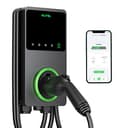
Autel MaxiChargeris the outdoor pick: the strongest published enclosure rating in our registry, the highest output, and a long cable — which matters on a vehicle this size, where the port and the wall are rarely close together. The Autel review covers the panel headroom it quietly assumes.
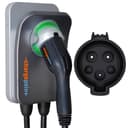
ChargePoint Home Flexheld the overall slot here for its 16–50A amperage dial, but ChargePoint now sells the hardwired and plug-in versions separately and, as of 20 September 2026, the hardwired one is not listed on Amazon. The model we link is the NEMA 14-50 plug-in, a fixed 40A unit. It stays on the list for the Rivian owner whose arithmetic says 40A fits and who wants the most mature charging app in the category on a plug-in — see the full review for what changed.
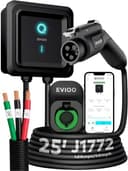
EVIQO 48Ais the cheapest route to a genuine 48A hardwired unit. Buy it only once an electrician has confirmed the 60A circuit exists — otherwise you have bought amps you cannot use and lost the plug-in flexibility that would have let you adapt.
Rivian-specific notes
Check what Rivian offers first.Where an automaker sells or endorses its own wall charger for your vehicle, it is worth pricing against the third-party options — not because it will charge faster, but because support and app integration are simpler when one company owns both ends.
Cable length is a truck problem.Measure from where the outlet or junction box will be to where the charge port sits when the vehicle is parked the way you actually park it — nose-in one week, backed in the next. Then add slack. A cable that is two feet short is a daily annoyance you cannot fix without moving the charger. The same problem on the other electric truck is covered in our Ford charger roundup, and the units that actually reach are in the long-cable roundup.
Supercharger access is a separate purchase. Our NACS-to-CCS adapters for a Rivian guide covers the road-trip side, including why the automaker’s own adapter program is the first thing to check. Nothing on this page changes that answer.