Amp & Adapter

Lectron Level 1 EV Charger Review

An ETL-certified 15A charger for an ordinary wall socket — genuinely useful for some drivers, genuinely inadequate for others. Which one you are, in numbers.

By Stephen V.Last updated How we rank

Level 1 charging has a reputation problem. It is routinely described as “trickle charging”, which makes it sound like a token gesture, and enthusiast advice treats buying a Level 2 charger as the obvious first move after buying the car. For a substantial number of drivers, that advice is wrong, and it costs them a four-figure install they did not need.

Here is the arithmetic that decides it. A 15A charger on a 120V socket delivers roughly 1.4 kW, which for a typical EV is about 4 to 5 miles of range per hour. Plugged in from 6pm to 7am — thirteen hours, which is just “overnight” — that is roughly 55 to 65 miles. The average American drives around 37 miles a day.

So for a driver with an ordinary commute and a socket near where they park, Level 1 does not merely take the edge off. It fully covers the daily driving, with margin, using an outlet that already exists, requiring no electrician, no permit and no landlord conversation.

This review covers Lectron’s version, which leads our Level 1 roundup. Everything below is read from the published listing on the date shown under the pick. We own no units and run no bench tests; unpublished figures read “Not published”.

How this is funded: we earn a commission if you buy through our links, at no extra cost to you. It never changes which product we recommend, and we’ll tell you plainly when we’d skip one. Full disclosure.

Quick picks

Ranked on published specs, install flexibility and buyer fit. Select a row to jump to the full write-up. We have not bench-tested these units — here is exactly what we do instead.

#ProductBest forPrice
1
Lectron Level 1 EV Charger (15A, 110V)

Lectron Level 1 EV Charger (15A, 110V)

The one Level 1 charger we would actually recommend, because it is ETL certified and comes from a brand that specializes in EV charging. A Level 1 unit is a spare and a safety net, not a primary charger — buy it on that basis and it is a genuinely useful thing to own.

Our pick — best Level 1 charger
$159.99 · View on Amazon

Price as of September 2, 2026. #ad How we’re funded

The picks in full

#1Our pick — best Level 1 charger

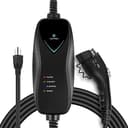
Lectron Level 1 EV Charger (15A, 110V)

The one Level 1 charger we would actually recommend, because it is ETL certified and comes from a brand that specializes in EV charging. A Level 1 unit is a spare and a safety net, not a primary charger — buy it on that basis and it is a genuinely useful thing to own.

Strengths

  • ETL certified — the single most important thing on a device left plugged in overnight
  • Plugs into any standard 110V household outlet, so it works anywhere
  • Includes a 16 ft extension cord alongside the J1772 cable

Trade-offs

  • Level 1 is slow — plan on topping up rather than a full charge overnight
  • Costs more than the no-name Level 1 units, which is the trade for the certification
  • 15A on a shared household circuit can trip a breaker if something else is on it
ConnectorJ1772
Max output15 A
Max powerNot published
Cable length16 ft
InstallPlug-in (standard 110V outlet)
Outdoor ratingNot published
WarrantyNot published

Spec note. The listing publishes 110V, 15A, ETL certification and a 16 ft extension cord with a J1772 cable. 110V at 15A works out to roughly 1.6 kW, but the listing does not publish a kW figure so the spec table leaves it blank rather than printing our arithmetic as a manufacturer spec.

Specs read from the product listing, on August 11, 2026. “Not published” means the manufacturer does not state that figure.

Why the ETL listing is the headline here

In most product categories, certification is a box to tick. In Level 1 charging it is the entire reason to pay more than the floor price, and it is why this unit leads.

The reason is the outlet. A Level 2 charger runs on a dedicated circuit installed by an electrician under permit for exactly that purpose. A Level 1 charger runs on a general-purpose household socket that is decades old, of unknown wiring quality, and quite possibly shared with half the room. And it draws close to that circuit’s continuous limit for twelve hours at a stretch, night after night.

That is a demanding duty cycle on infrastructure nobody inspected for it. An ETL listing means Intertek — a nationally recognized testing laboratory — tested this device against the applicable safety standard, including its thermal behavior and its fault handling. Cheap uncertified Level 1 chargers exist in large numbers, and this is the category where we would least be willing to buy one.

The EPA’s ENERGY STAR program publishes a searchable list of certified EV chargers, and cross-checking any model against it takes under a minute. Do that for anything you consider.

15A versus 12A: a real difference

Most Level 1 chargers — including the cables that shipped with cars — run at 12A. This one publishes 15A. That is 25% more power, which turns roughly 48 miles overnight into roughly 60.

The important caveat: a 15A draw needs a dedicated 20A circuitto be within the 80% continuous-load rule, and many household sockets are on 15A circuits shared with other outlets. On such a circuit, 15A continuous is over the limit. Before running this at 15A, have an electrician confirm what the circuit is and what else is on it. If in doubt, set it to 12A — you lose about ten miles a night and gain certainty. Our amps and circuits guide explains the rule.

This is genuinely the thing to get right. Charging is one of the few household loads that runs at near-maximum for many consecutive hours, and old wiring that handles a kettle fine can be unhappy about it.

Who this genuinely suits

The ordinary commuter with a socket near the car. If you drive under about 50 miles a day and park within cable reach of an outlet, this covers you indefinitely. You may never need Level 2.

Plug-in hybrid owners.A PHEV has a small battery — often 10 to 18 kWh — which Level 1 refills comfortably overnight. Buying a Level 2 charger for a PHEV is usually money wasted.

Renters and apartment dwellers. No permission needed, nothing installed, nothing left behind. Our renter charging guide covers the wider picture.

Anyone as a backup.Even with Level 2 at home, a Level 1 unit in the trunk means any socket anywhere becomes a charge point — see our road trip guide.

Second cars. The car that does the school run and the shops needs very little.

Who should buy Level 2 instead

High-mileage drivers. If you regularly cover 80 or more miles a day, Level 1 will not keep up and you will slowly fall behind through the week.

Short parking windows.Level 1’s whole model depends on long dwell time. If the car is home for six hours between trips, you get 25 to 30 miles, and that is a different calculation.

Large batteries recovered from low. Filling a 100 kWh truck pack from 10% at 1.4 kW takes several days. Level 1 maintains such a vehicle beautifully; it does not recover one.

Cold climates.This is the underrated one. In deep cold, a meaningful share of Level 1’s modest output goes into battery thermal management rather than the battery itself, and the net can approach zero on the worst nights. Our cold weather guide covers what changes and how to mitigate it. If you have real winters and rely on Level 1, expect to plug in more and charge while the car is still warm.

If you land in this group, our 40A roundup is the sensible next step, and installation cost covers what the circuit will run you.

The 16 ft cable, and using it safely

Sixteen feet is a normal Level 1 length and it is the specification most likely to frustrate you, because Level 1 charging happens wherever the socket happens to be — which is rarely where you would have chosen. Measure the real path before buying: from the outlet, along the wall, out to the car, around to the charge port, plus slack.

If it does not reach, the correct fixes are moving the car, having an electrician add an outlet nearer the parking spot, or a properly rated extension. Level 1 through a heavy-gauge, outdoor-rated cord of the shortest workable length is the commonly accepted approach — but check your charger’s manual first, because some manufacturers prohibit it outright, and a thin indoor cord is genuinely unsafe under a twelve-hour continuous load.

Two habits worth keeping: check the plug and socket by hand after the first hour of a new setup — warm is worth investigating, hot is a stop signal — and get the cable and connector off the ground when it is not in use. A few dollars of hook or holster keeps grit and standing water out of the pins.
Frequently asked questions

Is Level 1 charging enough?

For a great many drivers, yes. At 15A it adds roughly 4 to 5 miles of range per hour, so about 55 to 65 miles across a thirteen-hour overnight — well above the roughly 37 miles the average American drives daily. If you cover more than about 50 miles a day, or park for only a few hours at a time, you need Level 2.

Can I run this at 15A on any household outlet?

No. A 15A continuous draw requires a dedicated 20A circuit under the 80% rule, and many household sockets sit on 15A circuits shared with other outlets. Have an electrician confirm the circuit and what else is on it. If in doubt, run it at 12A — you lose about ten miles a night and gain certainty.

Why does certification matter more on a Level 1 charger?

Because of what it plugs into. A Level 2 charger runs on a dedicated circuit installed for the purpose; a Level 1 charger draws near a general-purpose household circuit's continuous limit for twelve hours a night, on wiring that may be decades old. An ETL or UL listing means an independent lab tested the device's thermal behavior and fault handling for exactly that duty.

Does Level 1 charging work in winter?

It works, but the net gain drops — sometimes sharply. In deep cold a meaningful share of Level 1's modest output goes into keeping the battery warm rather than filling it. If you rely on Level 1 in a cold climate, plug in whenever the car is parked and start charging while the pack is still warm from driving.

Should I buy this if I already have a Level 2 charger?

As a backup, it is worth the small cost. A Level 1 unit in the trunk turns any household socket anywhere into a charge point, which is exactly what you want at a relative's house, a rental or a campsite where no charging station exists.

Sources

Keep reading