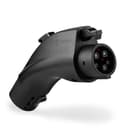
What it actually opens up
The value of this adapter is entirely about how often you encounter Tesla AC equipment. Three situations where you will:
- Tesla Destination chargers.Hotels, restaurants, wineries and parking lots that installed Tesla Wall Connectors as an amenity. These are AC Level 2 chargers — ordinary overnight charging — and they are common enough that a night away can hinge on having this adapter in the glovebox.
- A friend’s or family member’s home charger. If they have a Tesla Wall Connector on the garage wall, this is what lets you plug in when you visit.
- A Tesla Mobile Connector. The portable cordset Tesla owners carry. Same principle.
It is a small, pocketable part, it needs no setup, and it lives permanently in the glovebox costing you nothing until the night it saves the trip. That is the whole argument, and for most non-Tesla drivers it is enough.
The one thing it cannot do — and no adapter of this type can
It will not let you Supercharge.This is not a limitation of Lectron’s implementation, and no competing product solves it. It is a category boundary.
AC and DC charging are physically different processes. AC charging hands alternating current to the car, and the car’s onboard charger converts it. DC fast charging bypasses the onboard charger entirely and pushes high-voltage DC straight at the battery under a continuous negotiated protocol. The connectors carry different pins doing different jobs, and an adapter that bridges the AC pins cannot bridge a DC session.
Supercharging a non-Tesla car is a separate problem with separate hardware — a NACS-to-CCS adapter — plus account enrollment and site support. Our NACS-to-CCS roundup covers that category, and our Supercharger access guide covers the three conditions that must all be true. Our AC vs DC guide explains why an adapter can bridge AC connectors but never DC ones.
The failure mode that is not the adapter’s fault
Worth knowing before you buy, because it produces a return that should not have happened. Some Tesla Wall Connectors are configured to reject non-Tesla vehicles.The owner or the venue can set that, and when they have, no adapter will start a session — the equipment is declining you at the software level, not the physical one.
Similarly, some Destination charger locations restrict use to guests or to Tesla vehicles as a matter of policy. That is not a hardware question either.
So the honest expectation is: this adapter makes Tesla AC equipment physically usable, and most of the time that is sufficient. Occasionally it will not be, and the reason will be a setting rather than the part in your hand.
Amperage: more headroom than you can use
The published rating is well above what any Level 2 AC circuit will ask of it. That is the right way round — you want the adapter to be the least stressed component in the chain, not the bottleneck.
What actually determines your charging speed is the lowest of three things: the charger’s output, the circuit behind it, and your car’s onboard AC charger rating. The adapter is not in that list, and a well-made one never is. Our amps and circuits guide works through the arithmetic.
Lectron versus the cheaper option
We rate the EVDANCE Tesla-to-J1772 as the top pick in our roundup of this category, on price and a higher published amp rating. So why buy the Lectron?
One reason, and it is a legitimate one: Lectron is an established adapter specialist with a published warranty term, which several competitors in this category do not state. On a part you will use occasionally over several years and probably lose track of the receipt for, a named warranty from a brand that will still exist has value that does not show up in a spec table.
If you want the cheapest working part, buy the EVDANCE. If you want the one with a company behind it, buy this. Both do the same job.
Practical notes
Keep it in the car, not in the house. The entire value is being unexpectedly somewhere with a Tesla connector. An adapter in a kitchen drawer is worth nothing. A small case in the glovebox keeps it from rattling around and getting lost.
Support the weight when it is fitted. Any adapter adds length and mass to a connector and it hangs on your charge port. Take the weight while seating it rather than letting the assembly swing.
Do not leave it attached.It is a small expensive part that is easy to forget on someone else’s charger. Make unplugging it part of the same motion as unplugging the cable.
The verdict
Cheap, small, and occasionally the difference between charging and not charging on a trip. Buy it if you drive a J1772 car and travel; skip it if you never leave your own driveway and no one you know owns a Tesla charger. Just make sure you are buying the direction you actually need — if you drive a Tesla and want to use J1772 stations, you want the other adapter entirely.