Why the J1772 adapter is not optional
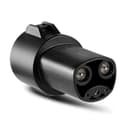
J1772 is the AC connector standard every non-Tesla EV in North America has used for over a decade. That means it is what the overwhelming majority of public Level 2 charging uses: shopping centers, parking lots, hotels, workplaces, curbside chargers, and any friend or relative with a non-Tesla EV.
Your car has a NACS port. Without the adapter, all of that infrastructure is invisible to you. With it, none of it is. For a $40 part that fits in a glovebox, that is the best value in EV ownership, and our full Lectron adapter review covers what the 80A rating means and where the limits are.
One warning, because it is the most expensive misunderstanding in this category. A J1772 adapter is AC only. It does not work at any DC fast charger, and it does not turn anything into a Supercharger customer. AC and DC charging are different electrical processes — on AC the car’s own onboard charger does the conversion, so an adapter is essentially a pin remap; on DC the station does the conversion and negotiates directly with the battery, which needs a fundamentally different part. Our AC vs DC guide explains it, and it is the single most useful thing to understand before buying any adapter.
If you want a Tesla to fast-charge at CCS stations, that is a CCS-to-Tesla adapter— a different, much more serious and much more expensive product.
The holster: the cheapest thing that extends charger life
A charging connector left on the garage floor sits in dust, grit and whatever water came in on the tires. Those contaminants work into the pin housing, and the pins are where several kilowatts transfer every night. It is the most common, most preventable degradation in home charging, and a holster costing about $15 eliminates it.
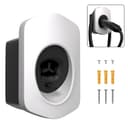
The MCEVKELN is the pick because it is shaped for NACS. Most holsters on the market are J1772-shaped, because that is the older and more numerous standard, and a NACS head in a J1772 cradle sits loose. This one docks the connector properly and includes cable organization in the same part, which is more than most single-purpose holders manage.
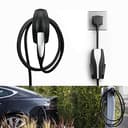
The SEVEN SPARTA is the plain cable mount, and it earns its place partly on longevity — it is one of the longest-standing listings in this category, which counts for something on a part whose only job is to not break. It holds the cable rather than docking the connector, so pair it with a holster if you want both. Two mounts along a long cable run is the tidy arrangement, and both together still cost less than $35.
Our cable organizer roundup covers the wider category including universal hooks, and holsters and docks covers J1772 options if your household has a mixed fleet.
Protecting the adapter
An adapter lives in the car, which means it lives in a trunk or a glovebox with everything else. It gets knocked, it slides around, and grit finds its contact pins — which are the interface for real current.
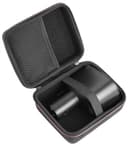
The Maoershan hard case is a rigid EVA shell sized for CCS1 and J1772 adapters, and at around $10 it is straightforwardly good value for protecting a part that costs four times as much. Note the listing is explicit that it is the case only, which is easy to miss.
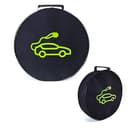
The BLIRITEL bagis the equivalent for a portable charger and its cable. If you carry a travel charger — and our road trip guidemakes the case that you should — a dedicated bag is the difference between a charger you actually take and one that rolls around the trunk until you leave it at home.
Keep the adapter in the car, not the garage
Worth stating because it defeats the purpose otherwise. The entire value of a J1772 adapter is that it works away from home. An adapter in a drawer in your garage is worth nothing at a hotel in another state. Glovebox, in a case, permanently.
And do not leave it hanging on a public station when you unplug. It collects water and dirt in the pins, and it is how adapters get stolen and forgotten.
While it is in use at a public station, the risk is different: the car holds the adapter, but anyone can release the station’s handle from it and end your session. If you charge at busy shared stations, a lock ring for the adapter is the fix — our J1772 adapter lock roundup compares them on the only thing they do, which is fit.
What we would not buy
Being specific about this is more useful than another pick.
Decorative charge-port accessories. Illuminated rings, colored surrounds, port covers. They do nothing and the ones that add material around the port can interfere with an adapter seating properly.
Unrated splitters and Y-adapters. Anything promising to charge two cars from one connector. The charging handshake is between one station and one car; devices that interpose on that are not something we would put between a 240V circuit and a car.
Cheap adapters with no published rating. An AC adapter is a simple part, but it still carries real current through two mechanical connections. Buy one that publishes an amperage and voltage rating. The alternatives are in our J1772-to-Tesla roundup.
A second home charger “for the other car” before checking whether one charger plus scheduling covers both. Two EVs sharing one 40A charger overnight is usually fine, and our load management guidecovers the options when it is not — several of which are much cheaper than a second circuit.
If you are also buying a home charger
One strategic note, because it interacts with everything on this page. You can buy a native NACS home charger, or a J1772 charger plus the $40 adapter. They cost about the same. The J1772 route charges any EV that ever visits or that you later buy; the NACS route needs its own adapter for anything that is not a Tesla. Our Tesla home charger roundup covers both, and our 40A roundup covers the J1772 units worth pairing with the adapter above.