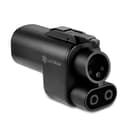
Amp & Adapter

NACS-to-CCS Adapters for a Volkswagen ID.4

The adapter is rarely the reason a session fails to start — the software precondition nobody checks, and how to get it right before you spend anything.

By Stephen V.Last updated How we rank

Most adapter guides treat this as a hardware problem: pick the right plug shape, plug it in, charge. For an ID.4 owner that framing hides the thing most likely to go wrong. The adapter is the easy part. The part that fails is the handshake — the software conversation between your car and the station that has to succeed before a single amp moves.

Non-Tesla Supercharging is not simply a matter of the pins lining up. Your vehicle’s charging software has to support the protocol, your account has to be enrolled, and the specific site has to be open to non-Tesla vehicles. Any one of those missing produces exactly the same symptom — you plug in, nothing happens — and the adapter takes the blame for all three.

The ID.4 is a car where this matters more than average, because it has been through a substantial amount of software evolution across its life. A vehicle several updates behind can behave quite differently at a charger from an identical-looking one that is current. Below: how to check all of that before you spend money, then the adapters worth buying.

How this is funded: we earn a commission if you buy through our links, at no extra cost to you. It never changes which product we recommend, and we’ll tell you plainly when we’d skip one. Full disclosure.

Quick picks

Ranked on published specs, install flexibility and buyer fit. Select a row to jump to the full write-up. We have not bench-tested these units — here is exactly what we do instead.

#ProductBest forPrice
1
A2Z NACS to CCS1 Adapter (Typhoon Pro)

A2Z NACS to CCS1 Adapter (Typhoon Pro)

This is the DC-fast adapter that lets a CCS car (before its NACS retrofit) pull power from a Tesla Supercharger. A2Z's version is the enthusiast favorite for build quality and higher sustained current — a serious piece of kit, priced like one.

Best built
$169.99 · View on Amazon

Price as of September 2, 2026. #ad How we’re funded

2
FOCSPROD NACS to CCS1 Adapter (Interlock, 500A)

FOCSPROD NACS to CCS1 Adapter (Interlock, 500A)

The mid-price NACS-to-CCS option that still publishes the two things that matter on a DC adapter: a UL 2252 reference and an electronic interlock. It sits between the budget units and the A2Z, and the interlock is the reason to prefer it over anything cheaper.

Best interlock for the price
$109.99 · View on Amazon

$125.9913% off

Price as of September 2, 2026. #ad How we’re funded

3
Lectron Vortex NACS to CCS1 Adapter

Lectron Vortex NACS to CCS1 Adapter

Lectron's take on the NACS-to-CCS DC adapter, generally a step cheaper than the A2Z while covering the same core job — Supercharging a CCS car. A sensible value option if your vehicle is on the supported list.

Best-known brand
$199.99 · View on Amazon

Price as of September 2, 2026. #ad How we’re funded

The picks in full

#1Best built

A2Z NACS to CCS1 Adapter (Typhoon Pro)

This is the DC-fast adapter that lets a CCS car (before its NACS retrofit) pull power from a Tesla Supercharger. A2Z's version is the enthusiast favorite for build quality and higher sustained current — a serious piece of kit, priced like one.

Strengths

  • Unlocks the Tesla Supercharger network for a CCS1 vehicle
  • Built for high sustained DC current with a metal housing
  • Widely reported to work across V3 Superchargers with Magic Dock-style support

Trade-offs

  • Expensive — this is the priciest adapter category by far
  • Your car and the network must both allow it; compatibility is vehicle-specific
ConnectorNACS (Tesla) → CCS1
Max outputNot published
Max power500 kW
Cable lengthNot published
InstallPlug-on DC adapter
Outdoor ratingNot published
Warranty1 year

Spec note. DC fast charging adapter. Compatibility depends on the specific vehicle and the Supercharger site — confirm your car is on the supported list before relying on it for a trip.

Specs read from the product listing, on August 11, 2026. “Not published” means the manufacturer does not state that figure.

#2Best interlock for the price

FOCSPROD NACS to CCS1 Adapter (Interlock, 500A)

The mid-price NACS-to-CCS option that still publishes the two things that matter on a DC adapter: a UL 2252 reference and an electronic interlock. It sits between the budget units and the A2Z, and the interlock is the reason to prefer it over anything cheaper.

Strengths

  • Publishes an electronic interlock, so the adapter cannot be pulled off under load
  • Rated to 500A / 1000V — the full envelope of a Supercharger stall
  • Cites UL 2252, the standard written for exactly this part

Trade-offs

  • Smaller brand than Lectron or A2Z, with less of a support track record
  • Supercharger access still depends on your vehicle and account being enabled — the adapter alone is not enough
  • The listing does not publish a warranty term or a cable/handle weight
ConnectorNACS → CCS1
Max output500 A
Max powerNot published
Cable lengthNot published
InstallPlug-on adapter
Outdoor ratingNot published
WarrantyNot published

Spec note. The listing publishes a maximum 500A / 1000V rating, an interlock mechanism and a UL 2252 reference. It does not publish a kW figure, a warranty term or an operating temperature range, so those read as not published. Confirm your own vehicle is enabled for non-Tesla Supercharging before buying any adapter.

Specs read from the product listing, on August 11, 2026. “Not published” means the manufacturer does not state that figure.

#3Best-known brand

Lectron Vortex NACS to CCS1 Adapter

Lectron's take on the NACS-to-CCS DC adapter, generally a step cheaper than the A2Z while covering the same core job — Supercharging a CCS car. A sensible value option if your vehicle is on the supported list.

Strengths

  • Cheaper route to Tesla Supercharger access for a CCS car
  • Compact, from a brand that specializes in adapters
  • Covers the common DC-fast use case

Trade-offs

  • Sustained-current ceiling is generally below the priciest options
  • Same vehicle/site compatibility caveats as any NACS-to-CCS adapter
ConnectorNACS (Tesla) → CCS1
Max outputNot published
Max powerNot published
Cable lengthNot published
InstallPlug-on DC adapter
Outdoor ratingNot published
Warranty1 year

Spec note. A DC fast-charging adapter, not an AC one. As with every NACS-to-CCS adapter, whether it works depends on your specific EV and the Supercharger — check the supported-vehicle list first.

Specs read from the product listing, on July 19, 2026. “Not published” means the manufacturer does not state that figure.

Step one: check your charge port

The industry is midway through the transition to native NACSports. Look at the car rather than assuming:

  • A CCS1 port— a J1772 shape with two large DC pins beneath it — is what this page is about. A NACS-to-CCS adapter is the part that lets it meet a Supercharger.
  • A native NACS port plugs into a Supercharger directly. What that car would want instead is the opposite adapter, so it can use CCS stations.

Our connector guide has photographs of each.

Step two: the software precondition

This is the ID.4-specific section and the reason this page exists.

DC fast charging is a negotiation. Before current flows, the station and the car exchange identity, agree a voltage and current, and continuously check that everything is still safe. Non-Tesla Supercharging adds a layer to that: the car must speak a protocol the network expects, and be recognized as an authorized vehicle. All of that lives in vehicle software, and vehicle software is updated.

So before buying anything:

  1. Check that your car is on current software. Depending on model year that may be over the air or a dealer visit. A car several versions behind is among the most common reasons a correctly-bought adapter appears not to work.
  2. Check Volkswagen’s own guidance for your model year.Where an automaker supplies or endorses an adapter for its vehicles, use it — it has been validated against your car’s charging hardware and avoids awkward warranty conversations. Third-party units are for owners without that option, or who want a spare.
  3. Check account enrollment and site availability.Access is account-based and rolls out site by site. The Tesla app, Volkswagen’s own app and the DOE’s Alternative Fuels Data Center station finder all show which locations accept non-Tesla vehicles.

Our Supercharger access guide sets out the three conditions that must all be true, and why buying the adapter first is the common expensive mistake.

Step three: buy the adapter properly

Prioritize a listing that names UL 2252— the safety standard written specifically for EV coupler adapters. This part carries several hundred volts of DC in the weather while you hold it, so certification outranks price here.

Prefer an electronic interlock as well. It prevents the adapter being pulled off the connector while current is flowing, which on a DC part is a safety feature rather than a convenience. That is why the FOCSPROD unit appears on this list at a price below the A2Z.

Our main NACS-to-CCS roundup ranks the whole category on that basis, with the reasoning shown.

What to expect once it works

Set expectations before the first trip so the experience matches them.

You will not necessarily hit your car’s headline peak.Peak figures assume a station that suits the car’s architecture. A Supercharger stall is engineered around Tesla’s own vehicles, and a non-Tesla car may settle below what either device could do individually. The adapter cannot change this — it is a passive connector translator, not a converter. Our adapter charging-speed guide is the full explanation.

The charge curve dominates everything. Every EV tapers steeply as the battery fills; the last 20% typically takes as long as the first 60. Charging to 80% and moving on is nearly always faster in total than waiting for a full battery. Our AC vs DC guide explains why.

Cold changes everything.A cold pack accepts dramatically less current, and preconditioning is the fix. On most vehicles it triggers when you navigate to a fast charger using the car’s own navigation — not a phone map app. Our cold-weather guide covers it, and it will do more for a winter trip than any adapter choice.

Practicalities at the stall

Parking.Supercharger stalls assume Tesla’s charge port position and use short cables. If your port sits elsewhere on the car, expect to reverse in at an unusual angle or occasionally take two bays. Practice somewhere quiet before you depend on it.

Weight. The adapter adds length and mass, and all of it hangs on the charge port. Support it by hand while seating, and rest the assembly rather than letting it dangle for a whole session.

Have a fallback. Keep the app for at least one CCS network on your phone and set up before you leave. An adapter widens your options; it should not be your only one. Our public charging guide covers what to set up ahead of time and what to keep in the trunk.

The honest summary

An adapter is worth having for an ID.4 if you take trips into areas where CCS coverage is thin or unreliable — it converts a large, well-maintained network from unusable to usable. It is not worth having if your driving is local and your charging is at home overnight, which for most ID.4 owners it is. That home half is covered in our home charger roundup and our amps and circuits guide, and it is where the real quality-of-life gains are.
Frequently asked questions

Can a Volkswagen ID.4 use a Tesla Supercharger?

With a CCS1 port, a suitable adapter, current vehicle software, an enrolled account and a participating site — yes. All five have to be true. The adapter is the cheapest and easiest of them, which is why so many owners buy it first and then discover one of the others is the actual blocker.

Why won't my Supercharger session start even with the adapter fitted?

Almost always one of three things, none of which is the adapter: your vehicle's charging software is out of date, your account is not enrolled for non-Tesla Supercharging, or that specific site is not open to non-Tesla vehicles. Check all three before assuming the hardware is faulty.

Does the adapter reduce my charging speed?

A well-made adapter is not the limiting factor. What limits you is the match between your car's electrical architecture and the station's, the state of charge you arrive at, and the battery's temperature. Our adapter charging-speed guide breaks down where the time actually goes.

Should I buy Volkswagen's adapter or a third-party one?

Check Volkswagen's own program for your model year first. An automaker-supplied or endorsed adapter has been validated against your car's charging hardware and removes warranty ambiguity if something goes wrong mid-session. Third-party units are for owners without that option, or who want a spare.

Do I need this for charging at home?

No. Home charging is AC through a J1772 or NACS connector — an entirely separate problem from DC fast charging, and one no NACS-to-CCS adapter touches. If you want to use Tesla AC equipment such as a Destination charger, that is a Tesla-to-J1772 adapter, a different and much cheaper part.

Sources

Keep reading