Amp & Adapter

Best EV Chargers for a 100-Amp Panel

A 100-amp service does not mean you cannot charge at home. It means you buy a charger that manages the panel or one that asks less of it — and the two routes cost very different amounts.

By Stephen V.Last updated How we rank

Buy the Emporia Pro. It is the one charger here that reads your whole-home draw and throttles the car instead of asking your panel for headroom it does not have. That is what lets a 48A charger live on a 100-amp service. If you would rather not pay for load management, the honest alternative is a 32A hardwired charger on a 40A circuit — the Leviton EV320 at pick two — which is slower and considerably cheaper.

A 100-amp service is the most common reason people are told they cannot have a home charger, and the advice they get is usually “upgrade your panel”. That is sometimes true and often a four-figure answer to a problem a different charger would have solved. Before you commit to a service upgrade, it is worth knowing that the charger market has two products specifically for your situation.

The arithmetic that matters is not the charger’s amperage, it is your spare capacity. A 100-amp service already feeds whatever the house uses, and a continuous load is sized at 125% of its draw — so a 48A charger asks for a 60A circuit and a 32A charger asks for 40A. The question is how much of your 100 amps is genuinely unclaimed after an electrician does the load calculation, and the answer is frequently somewhere between 20 and 40 amps.

We own no units and we do not bench-test chargers — here is exactly what we do instead. Every charger figure below is the manufacturer’s own published specification, and the code points come from an installer network’s published explanation of the NEC requirements rather than from our reading of the code itself.

How this is funded: we earn a commission if you buy through our links, at no extra cost to you. It never changes which product we recommend, and we’ll tell you plainly when we’d skip one. Full disclosure.

Quick picks

Ranked on published specs, install flexibility and buyer fit. Select a row to jump to the full write-up. We have not bench-tested these units — here is exactly what we do instead.

#ProductBest forPrice
1
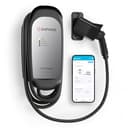
Emporia Pro (48A, hardwired, J1772)

Emporia Pro (48A, hardwired, J1772)

Not a faster charger than the Emporia Classic — Emporia's own comparison puts both at 48A — but a charger you can install where 48A would not otherwise fit. The premium buys PowerSmart load management and the Vue 3 panel monitor it depends on, which throttles charging to whatever headroom your service has left. On a 100A panel that is the difference between charging fast and rewiring the house; on a roomy 200A panel it is a feature you are paying for and will not use.

Best overall — manages the panel
$599.00 · View on Amazon

Price as of October 5, 2026. #ad How we’re funded

2
Leviton EV320 32A (hardwired)

Leviton EV320 32A (hardwired)

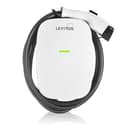
The plainest well-documented 32A wall charger you can buy: hardwired on a 40A breaker, ENERGY STAR certified under its own model number, and nothing to connect to Wi-Fi. That last point cuts both ways, since there is no app to fail and no app to schedule with, and the 18 ft cable is the shortest here, so measure before you buy.

Best simple 32A unit
$649.00 · View on Amazon

Price as of October 5, 2026. #ad How we’re funded

3
Enphase IQ 40 32A (hardwired)

Enphase IQ 40 32A (hardwired)

The ClipperCreek line under Enphase's name: a 32A hardwired station with a NEMA 4 enclosure, a 25 ft cable and the longest warranty in our 32A roundup, five years. It is also the most expensive, and its Wi-Fi scheduling earns that premium mainly for a household already running Enphase solar that wants the charger to follow it.

Best if you have solar
$779.00 · View on Amazon

Price as of October 5, 2026. #ad How we’re funded

4
Battery Tender eCharge 32 (Level 1 + 2)

Battery Tender eCharge 32 (Level 1 + 2)

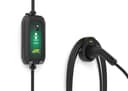
A 32A plug-in charger from a long-established battery-charger brand, ENERGY STAR certified under its own model number, with a 120V adapter in the box so it doubles as a Level 1 travel cord. It has no app by design. You pay well over the budget 32A units for that paper trail and the 3-year warranty.

Best plug-in at 32A
$349.99 · View on Amazon

$399.9512% off

Price as of October 5, 2026. #ad How we’re funded

5
EVPOVO Level 2 32A (NEMA 14-50)

EVPOVO Level 2 32A (NEMA 14-50)

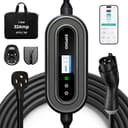
The cheapest route to 32A in our roundup that still publishes a safety listing, a 3-year warranty and a 25 ft cable. Every figure is the seller's own claim, and the model number is not among the families EPA certifies, so this is the pick for a buyer who wants the price and accepts a thinner paper trail.

Best value
$141.53 · View on Amazon

$148.985% off

Price as of October 5, 2026. #ad How we’re funded

The picks in full

#1Best overall — manages the panel

Emporia Pro (48A, hardwired, J1772)

Not a faster charger than the Emporia Classic — Emporia's own comparison puts both at 48A — but a charger you can install where 48A would not otherwise fit. The premium buys PowerSmart load management and the Vue 3 panel monitor it depends on, which throttles charging to whatever headroom your service has left. On a 100A panel that is the difference between charging fast and rewiring the house; on a roomy 200A panel it is a feature you are paying for and will not use.

Strengths

  • PowerSmart load management is bundled, not an upsell — the Vue 3 panel monitor it needs is in the box
  • 48A / 11.5 kW hardwired, or 40A on a NEMA 14-50 outlet, from the same unit
  • NEMA 4 rated for indoor or outdoor installation, with a 25 ft cable
  • Rear-entry hardwire option the Classic does not offer, which hides the conduit
  • Solar excess-charging and whole-home energy monitoring in the same app, with no subscription
  • 3-year warranty, and Emporia publishes UL Listed, NEMA rated and ENERGY STAR certification

Trade-offs

  • No faster than the cheaper Emporia Classic — both are 48A, so if you do not need load management you are paying for nothing
  • PowerSmart depends on the Vue 3 sending load data to Emporia's cloud, so the throttling that protects your panel is a connected service, not local hardware
  • The Vue 3 clamps onto your service mains, so an electrician still has to open the panel — 'no panel upgrade' does not mean 'no panel work'
  • Emporia's own “$3,000-$8,000 panel upgrade” saving is the manufacturer's marketing figure, not an independent estimate
  • Emporia does not publish the Pro's ENERGY STAR model number, which rebate forms usually ask for
ConnectorJ1772
Max output48 A
Max power11.5 kW
Cable length25 ft
InstallHardwired (48A); a NEMA 14-50 plug-in SKU runs at 40A
Outdoor ratingNEMA 4 (outdoor)
Warranty3 years

Spec note. Emporia publishes: up to 48A hardwired on a 60A circuit, up to 40A on a NEMA 14-50 outlet (50A circuit), a 25 ft cable, a NEMA 4 indoor/outdoor rating, a rear-entry hardwire option, a 3-year warranty, and UL Listed / NEMA Rated / ENERGY STAR Certified marks. Its own Classic-vs-Pro table lists BOTH models at up to 48A, 25 ft and 3 years — the Pro's differences are PowerSmart load management, the bundled Vue 3 energy monitor, solar and peak-demand features, the square case and rear entry. EPA's ENERGY STAR certified-EVSE database holds one Emporia Corp. family record (EMEVSE1, 48A, 25 ft output cord, 6 AWG, network capability 'Yes', qualified May 2022) covering fifteen further model numbers; Emporia does not publish which one the Pro carries, so confirm the model number with Emporia before filing a rebate that requires it.

Specs read from the product listing, on September 2, 2026. “Not published” means the manufacturer does not state that figure.

#2Best simple 32A unit

Leviton EV320 32A (hardwired)

The plainest well-documented 32A wall charger you can buy: hardwired on a 40A breaker, ENERGY STAR certified under its own model number, and nothing to connect to Wi-Fi. That last point cuts both ways, since there is no app to fail and no app to schedule with, and the 18 ft cable is the shortest here, so measure before you buy.

Strengths

  • Hardwired, so a plain breaker feeds it and there is no receptacle to wear, overheat or trip a GFCI
  • Leviton publishes its full standards list, including UL 2594, and EPA's ENERGY STAR dataset lists the EV320 by model number
  • NEMA Type 3R enclosure and a cable Leviton says is designed not to freeze and crack, rated -30°C to 50°C
  • Optional RFID access control, switched off out of the box

Trade-offs

  • 18 ft cable, the shortest in our 32A roundup
  • 2-year limited warranty, against 3 to 5 years on the other 32A picks
  • No Wi-Fi or app, so any scheduling has to come from the car
  • Amazon showed 'Only 11 left in stock (more on the way)' when we checked on 18 September 2026
ConnectorJ1772
Max output32 A
Max power7.7 kW
Cable length18 ft
InstallHardwired (40A breaker)
Outdoor ratingNEMA Type 3R (indoor/outdoor)
Warranty2 years (limited)

Spec note. Leviton publishes: 32A, 208/240 VAC, 7.6 kW output, a 40A breaker, an 18 ft (5.5 m) cable, hardwired only, a PC+PBT plastic NEMA Type 3R enclosure, -30°C to 50°C operation, a 20 mA CCID per UL 2231, certification to UL 2594, UL 2231-1/-2, UL 2251 and others with cETLus, and ENERGY STAR. EPA's dataset lists model EV320 (qualified 2022-10-24, 18 ft cord). It has no Wi-Fi; the Wi-Fi sibling is the EV32W. Leviton's own store listed it above the Amazon price when we checked.

Specs read from the product listing, on September 18, 2026. “Not published” means the manufacturer does not state that figure.

#3Best if you have solar

Enphase IQ 40 32A (hardwired)

The ClipperCreek line under Enphase's name: a 32A hardwired station with a NEMA 4 enclosure, a 25 ft cable and the longest warranty in our 32A roundup, five years. It is also the most expensive, and its Wi-Fi scheduling earns that premium mainly for a household already running Enphase solar that wants the charger to follow it.

Strengths

  • 5-year limited warranty, the longest of the 32A picks
  • 25 ft cable and a sealed NEMA 4-rated enclosure for indoor or outdoor mounting
  • UL 2594 certified per the listing, and EPA's ENERGY STAR dataset names this exact model number
  • Wi-Fi scheduling in the Enphase App, plus solar-surplus charging with an Enphase Energy System

Trade-offs

  • The most expensive of the 32A picks
  • Hardwired, so it stays with the house when you move
  • The listing still says you may qualify for federal tax credits; the federal home-charger credit ended for property placed in service after June 30, 2026
  • Solar-surplus charging needs at least 1.92 kW (8A) of excess solar before a session starts, per Enphase
ConnectorJ1772
Max output32 A
Max power7.7 kW
Cable length25 ft
InstallHardwired (40A circuit)
Outdoor ratingNEMA 4 (indoor/outdoor)
Warranty5 years (limited)

Spec note. The listing publishes: 32A on a 40 Amp circuit, suited to vehicles that accept up to 7.7 kW, up to 31 miles of range per hour (the manufacturer's best case), UL 2594, a sealed NEMA 4-rated enclosure, a 25 ft cable, Wi-Fi with the Enphase App and a 5-year limited warranty. Enphase's store lists the hardwired SKU as IQ-EVSE-NA-1040-0100-0100, and EPA's ENERGY STAR dataset names that exact number among the additional models on an Enphase family record qualified 2023-03-17. Enphase also sells NEMA 14-50 and 6-50 plug-in versions.

Specs read from the product listing, on September 18, 2026. “Not published” means the manufacturer does not state that figure.

#4Best plug-in at 32A

Battery Tender eCharge 32 (Level 1 + 2)

A 32A plug-in charger from a long-established battery-charger brand, ENERGY STAR certified under its own model number, with a 120V adapter in the box so it doubles as a Level 1 travel cord. It has no app by design. You pay well over the budget 32A units for that paper trail and the 3-year warranty.

Strengths

  • ENERGY STAR certified: EPA's dataset lists the 022-3017 family, and the maker publishes cETLus to UL 2594
  • Level 1 and Level 2 in one box: a NEMA 14-50 plug plus a 14-50R-to-5-15P adapter
  • 25 ft output cord, an IP66 rating and a 3-year warranty
  • No app to set up or fail; status and error messages show on an LCD

Trade-offs

  • Costs well over twice the cheapest 32A plug-in units
  • Plug-in, so a GFCI-protected garage receptacle can trip with it
  • No scheduling app, so off-peak timing has to come from the car
  • Amazon showed 'Only 4 left in stock (more on the way)' when we checked on 18 September 2026
ConnectorJ1772
Max output32 A
Max power7.7 kW
Cable length25 ft
InstallPlug-in (NEMA 14-50; 120V 5-15 adapter included)
Outdoor ratingIP66
Warranty3 years

Spec note. Battery Tender publishes: 32A Level 2 at about 7.7 kW (about 20-25 miles of range per hour), about 1.9 kW on 120V, a dedicated 240V 40 Amp circuit minimum, a 25 ft output cord, IP66, cETLus (UL 2594), ENERGY STAR, FCC and ICES, 6.37 lb, and a 3-year warranty. EPA's ENERGY STAR dataset lists the 022-3017-XX-XX family as a Level 1/Level 2 dual-input charger (qualified 2024-01-04, 25 ft cord). The maker's own store listed it above the Amazon price when we checked. A bundle with a Tesla adapter is sold as a separate listing.

Specs read from the product listing, on September 18, 2026. “Not published” means the manufacturer does not state that figure.

#5Best value

EVPOVO Level 2 32A (NEMA 14-50)

The cheapest route to 32A in our roundup that still publishes a safety listing, a 3-year warranty and a 25 ft cable. Every figure is the seller's own claim, and the model number is not among the families EPA certifies, so this is the pick for a buyer who wants the price and accepts a thinner paper trail.

Strengths

  • Adjustable 16/20/24/32A from the buttons or the app, so it fits a 20A to 40A circuit
  • The listing claims ETL listing to UL 2594 and UL 2231-1/-2, with CCID20 leakage protection
  • 25 ft cable the seller says stays flexible down to -22°F
  • 3-year warranty per the listing, and optional Wi-Fi scheduling (Smart Life app, 2.4 GHz)

Trade-offs

  • Its model number (ZA11 prefix) is not among the families EPA's ENERGY STAR dataset certifies, so it will not satisfy a rebate that requires ENERGY STAR
  • The listing publishes no numeric enclosure rating
  • Plug-in, so a GFCI-protected garage receptacle can trip with it
  • A young brand with far less owner history than Leviton or Battery Tender
ConnectorJ1772
Max output32 A
Max power7.7 kW
Cable length25 ft
InstallPlug-in (NEMA 14-50)
Outdoor ratingNot published
Warranty3 years

Spec note. The listing publishes: 32A, 7.68 kW, a NEMA 14-50 plug, a 25 ft TPU cable rated flexible to -22°F, adjustable 16/20/24/32A, Wi-Fi through the Smart Life app (2.4 GHz) or button control, ETL listing to UL 2594 and UL 2231-1/-2, CCID20 leakage protection and a 3-year warranty, with the seller's estimate of about 22-25 miles of range per hour. Amazon reports model ZA11-U007KBF-F004. EPA's ENERGY STAR dataset certifies the Zopoise ZA05 and ZA10 families at 32A but not ZA11, so we do not treat it as ENERGY STAR certified. The enclosure is described only as weather-resistant, with no rating number.

Specs read from the product listing, on September 18, 2026. “Not published” means the manufacturer does not state that figure.

Step one: get the load calculation, not an opinion

Nothing on this page is actionable until you know how many amps your service actually has spare. That is a calculation an electrician does from your panel, your square footage and your existing fixed loads — the furnace, the water heater, the dryer, the range, the air conditioner. It is not something you or we can estimate from the number on the main breaker.

Two houses with identical 100-amp panels can have wildly different answers. A house with gas heat, a gas range and a gas water heater may have 50 amps genuinely spare. A house that is all-electric with a heat pump may have almost nothing. Our amps and circuits guide walks through what goes into that calculation so you can have an informed conversation rather than accepting the first number you are given.

Once you have it, the decision is simple:

  • 40A or more spare— buy a 32A charger on a 40A circuit. Pick two, three, four or five. No load management needed, no panel work beyond the new circuit.
  • 20 to 40A spare— this is where load management earns its price. Pick one lets you install a 48A charger and have it back off when the house is drawing hard, rather than sizing the circuit for the worst case that almost never happens.
  • Under 20A spare— load management is still the cheaper answer than a service upgrade, but have the electrician confirm it before you buy. There is a floor below which the honest answer is Level 1 charging or a panel upgrade.

What 32 amps actually gets you

It is worth being concrete, because “slower” sounds worse than it is. A 32A charger delivers about 7.7 kW. Over an eight-hour overnight window that is roughly 61 kWh — which is a full charge on most mid-size EV batteries and a very large top-up on a big one.

For the overwhelming majority of households, the car arrives home with 30 to 60% in the battery and leaves full. In that pattern a 32A charger and a 48A charger are indistinguishable, because both finish hours before you wake up. The amperage only starts to matter when you routinely arrive near-empty and leave early, or when two cars share one charger.

Where 32A does cost you something real is the exception day: the unplanned evening trip after you got home at 20%. A 48A charger buys back roughly half the waiting time on that day. Whether that is worth the circuit, the load management and the price is a judgment about your life rather than about the hardware. Our 40A versus 48A page works the same trade-off at the next amperage up, and our 32A roundup is the wider field at this one.

How load management works, and when to pay for it

A load-managing charger puts a sensor on your panel’s main feed and watches the whole house. When the dryer and the oven come on together, it reduces the car’s draw so the total stays under your service rating. When the house goes quiet at midnight, it gives the car everything.

That is a genuinely better engineering answer than sizing a circuit for a worst case, because it uses capacity that is sitting idle most of the night. It is also the reason pick one is first despite being the most expensive charger here: it is the only one that changes what your panel is capable of rather than working around it.

The honest caveats. It adds an installation step — the sensor has to go on the main feed, which means the electrician is inside the panel. It depends on the charger’s software continuing to work. And it is only worth the money if your spare capacity is genuinely the binding constraint; if you have 50 amps free, you are paying for a problem you do not have. Our load management guide goes through it properly.

Hardwired is the right answer here more than usual

Three of the five picks are hardwired only, and on a constrained panel that is a feature rather than a limitation.

A hardwired charger sidesteps the GFCI conflict that makes plug-in units nuisance-trip: NEC 210.8(A) requires GFCI protection for 125- to 250-volt garage receptacles and NEC 625.54 requires it for receptacles installed for EV charging, but a hardwired charger is not subject to that receptacle requirement. Since the charger has its own ground-fault protection, stacking an external GFCI on top is where the false trips come from.

It also removes a receptacle from a house where every connection matters, and it is the install route every load-managing charger assumes. Our plug-in versus hardwired guide makes the general case. Pick four is the plug-in option if you need the charger to be removable.

What we left out, and why

  • 48A chargers without load management. A 60A circuit on a 100-amp service is possible in a gas-heated house and impossible in an all-electric one, and we are not going to recommend it sight-unseen. If your load calculation says you have the room, our 48A roundup is the right page.
  • Panel upgrades. Sometimes the correct answer, and not a product we can rank. If an electrician tells you the service genuinely cannot support 32A, that is a real finding rather than an upsell.
  • Level 1 charging as a recommendation.It works on any panel and asks for 12 amps, and if your spare capacity is truly tiny it is the honest answer — see our Level 1 roundup. We have not ranked it here because this page is about getting Level 2 to work.

The short answer

Get the load calculation first. With 40 amps or more spare, buy a 32A hardwired charger and stop thinking about it — the Leviton if you want the simplest possible unit, the Enphase if you have solar, the Battery Tender if it needs to be plug-in. With 20 to 40 amps spare, the Emporia Pro and its panel sensor is cheaper than a service upgrade and faster than a 32A unit. A panel upgrade is the last resort, not the first quote.

One buying note. Several of these brands sell direct as well as on Amazon, and the prices are not always the same. We earn a commission on the links here and nothing on the direct ones, and we would still rather you paid less — check both.
Frequently asked questions

Can you install an EV charger on a 100-amp panel?

Usually yes, without upgrading the service. The constraint is not the 100-amp rating itself but how much of it is unclaimed after an electrician's load calculation. With 40 amps or more spare, a 32A charger on a 40A circuit fits directly. With 20 to 40 amps spare, a load-managing charger lets a larger unit share the capacity you have. A service upgrade is the last resort, not the first answer.

What size EV charger for a 100-amp service?

A 32A charger on a 40A circuit is the straightforward fit, because a continuous load is sized at 125% of its draw. A 48A charger needs a 60A circuit, which a 100-amp service can sometimes spare in a gas-heated house and usually cannot in an all-electric one — unless the charger does load management, in which case it throttles itself to stay inside your service rating.

Is a 32A charger fast enough?

For most households, yes. A 32A charger delivers about 7.7 kW, which is roughly 61 kWh across an eight-hour overnight window — a full charge on most mid-size EVs. It only becomes a real limitation if you routinely arrive near-empty and leave early, or if two cars share one charger.

How does EV charger load management work?

A sensor on your panel's main feed lets the charger watch the whole house. When several large loads run together it reduces the car's draw to keep the total under your service rating; when the house goes quiet it gives the car full power. That uses capacity that would otherwise sit idle overnight, which is why it can be cheaper than a service upgrade.

Should the charger be hardwired on a 100-amp panel?

Generally yes. A hardwired charger avoids the GFCI conflict behind most nuisance tripping — NEC 210.8(A) and 625.54 attach GFCI requirements to receptacles rather than to hardwired equipment, and the charger already has its own ground-fault protection. It also removes one more connection from a house where the electrical system is already working near its limit, and it is the install route every load-managing charger assumes.

Is a panel upgrade cheaper than a load-managing charger?

Almost never. A load-managing charger is a hardware premium on a charger you were buying anyway, where a service upgrade means a new panel, a new meter base and usually utility coordination. Get a quote for both before deciding, but start with the charger — if it solves the problem, the upgrade was avoidable.

Sources

Keep reading