Why 7.2 kW ends the amperage argument
Charging at home is a negotiation with one winner. The charger on the wall tells the car the most it is allowed to draw; the car’s onboard charger decides the most it candraw; and the session runs at whichever number is lower. On an Ariya that lower number is published and it does not change with trim, battery size or model year: 7.2 kW, which is 30 amps at 240 volts.
That makes 32 amps the right purchase, because 32 is the smallest standard charger rating that clears 30. Buy a 40-amp charger and the Ariya draws 30. Buy a 48-amp charger, pay for a 60-amp circuit and an electrician’s afternoon, and the Ariya still draws 30. There is no “future-proofing” argument inside the car either — an onboard charger is not a setting, it is hardware.
The only honest reason to buy more than 32 amps for an Ariya is a different car: a second EV now, or the one that replaces the Ariya later. That is a real reason, and it is why picks four and five are here — both are fixed 40-amp units, so the Ariya will draw 30 and the extra capability waits for the next car. If that is your situation, read 40 amps vs 48 amps before you spend, and amps, circuits and the 125% rule to find out what your panel can actually feed. A 32-amp charger needs a 40-amp circuit, which Leviton publishes for its own unit; a fixed 40-amp charger needs a 50-amp one.
What Nissan’s own charge times tell you
The press kit publishes Level 2 charge times for 0 to 100%: 10.5 hours on the 66 kWh pack (63 kWh usable) and 14 hourson the 91 kWh pack (87 kWh usable). Those are Nissan’s figures, not ours, and they are worth more than the arithmetic. Divide 63 kWh by 7.2 kW and you get about 8.75 hours; Nissan says 10.5. The gap is charging losses and the taper near the top of the pack, and it is normal — but it means the long-range Ariya is a 14-hour car from empty, which no overnight window covers.
The practical conclusion is a habit rather than a purchase: plug in daily and top up, rather than running the pack down and trying to refill it in one night. That also happens to be the gentler routine for the battery, which is the argument in EV battery health and charging limits. If you want the per-hour view instead, EVPOVO estimates about 22 to 25 miles of range per hour at 32 amps — a seller’s own estimate rather than an EPA figure, but the right order of magnitude for what an Ariya will see.
Your Ariya already takes a J1772 plug
This is the part Ariya owners most often get sold something they do not need for. The car has a CCS1 combo inlet: a J1772 socket on top for AC, two big DC pins below it for fast charging. Every charger on this page terminates in a J1772 handle, so each one plugs directly into the top half of that inlet. No adapter, no dongle, nothing hanging off the connector in the weather.
Where an adapter does earn its money on an Ariya is away from home, because the Supercharger network uses NACS. Nissan sells its own NACS adapter as a port-installed accessory and the press kit prices it at $235; the aftermarket alternatives are in best CCS-to-Tesla adapters, and if the three connector names are still a blur, J1772, NACS and CCS explained is the 10-minute fix. Keep adapters for the road. In a garage they are a part that can be lost or left out in the rain for no benefit.
Plug-in or hardwired?
Three of the five picks plug into a NEMA 14-50 outlet and two are permanent. For a 30-amp car the practical differences are these.
- Plug-in means the charger is a tenant improvement you can take with you, and if it fails you swap it yourself. The cost is the receptacle: a 14-50 outlet is the part of this install that wears, loosens and overheats, so buy an industrial-grade receptacle rather than the cheapest one on the shelf.
- Hardwired removes the receptacle entirely, which removes the failure point. It also means an electrician is part of the purchase and the charger stays with the house.
- The GFCI wrinkleapplies to plug-in units only. Current code requires GFCI protection on garage and EV-charging receptacles, and a charger with its own internal leakage protection can occasionally trip that breaker. If a listing ever tells you to remove the GFCI breaker, ignore it and call an electrician — that protection is required, not optional.
Our NEMA 14-50 vs hardwired guide works through the cost side of that choice properly, and what installation actually costs covers what an electrician is likely to quote for either route.
The published figures, side by side
Every figure below is the manufacturer’s or the listing’s own published specification. The last column is arithmetic from Nissan’s published 7.2 kW onboard rating, not a measurement.
| Charger | Output | Install | Cord | Enclosure | In EPA’s ENERGY STAR data | What an Ariya draws |
|---|
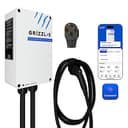
| Grizzl-E Classic Connect 40A | 40 A, adj. 16-40 A | Plug-in 14-50 | 25 ft published | UL Type 4, −30 °C to +50 °C | No Classic Connect row | 30 A |
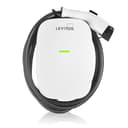
| Leviton EV320 | 32 A / 7.6 kW | Hardwired, 40 A breaker | 18 ft | NEMA Type 3R | Yes (model EV320) | 30 A |
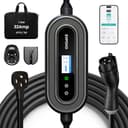
| EVPOVO Level 2 32A | 32 A / 7.68 kW, adj. 16-32 A | Plug-in 14-50 | 25 ft | Not published | No (ZA11 not listed) | 30 A |
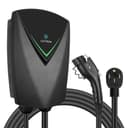
| Lectron Nexus 40A | 40 A / 9.6 kW, fixed | Plug-in 14-50 | 23 ft (22 ft on EPA’s record) | IP66 | Yes (LECHGNexusNEMA14-50J1772) | 30 A |
| ChargePoint Home Flex (14-50 plug) | 40 A / 9.6 kW | Plug-in 14-50 | 23 ft | NEMA 3R | Yes | 30 A |
Read the last column as the whole argument of the page. Five chargers, five different price brackets, one identical result in an Ariya’s charge port. What you are actually choosing between is cord length, enclosure rating, paperwork and whether you want an app — not speed.
Two of those columns deserve a word. Cord lengthdecides where the charger can live: the Leviton’s 18 feet is the shortest here and it is the one spec people regret, so measure from the mounting spot to the car’s charge port before you buy, around the car rather than through it. And the ENERGY STAR column is a rebate question, not a quality one: plenty of good chargers are not certified, but a utility rebate that requires certification will not take a product EPA does not list. Check your program first — the certified roundup is the shortlist if a rebate is on the table.
What we left out, and why
- Every 48-amp charger. They are the default recommendation across the internet and they are the wrong buy for this car. A 48-amp unit needs a 60-amp circuit to deliver amps an Ariya cannot accept. If a second EV changes that, the 48-amp field is in best 48-amp chargers.
- Native NACS chargers.The Ariya’s inlet is CCS1, so a Tesla-style charger would need an adapter permanently installed on the handle at the wall. That is a workable solution for a Tesla-first household and a needless failure point for everyone else. If you are in that position, the adapter roundup explains which direction you actually need.
- Dual-level travel cordsets.They are a genuinely good second purchase for an Ariya — a 30-amp car gets most of a dual-voltage cordset’s capability — but they belong in the trunk rather than on the wall. Best portable chargers is the page for that shortlist.
- The Battery Tender eCharge 32, which would otherwise have led this page. It is a 32-amp, ENERGY STAR certified, Level 1 and 2 unit and exactly the right shape for this car — and a live availability check on 19 October 2026 returned its Amazon listing as “Currently unavailable,” with no live listing for the 32-amp model (022-3017) under any other number. We do not feature a product you cannot buy today. If it comes back, it belongs at pick one.
- Level 1 as a plan.It works — the DOE’s Alternative Fuels Data Center puts Level 1 at a few miles of range per hour — and on a 91 kWh battery it is a multi-day proposition. Fine as a backstop, not as the charger you rely on.
The short answer
32 amps, a J1772 handle, and the longest cord you can get for the money. Pick one if you have (or can get) a 14-50 outlet and want one charger that fits this car now and the next one later; pick two if you want it hardwired and documented to the last standard; pick three if price is the binding constraint and you accept a thinner paper trail. Picks four and five are fixed 40-amp units on 50-amp circuits — worth it for the certification record or the app, never for speed, because in an Ariya they are 30 amps the same as everything else here.