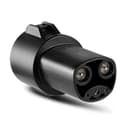
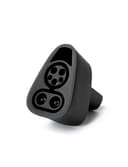
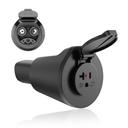
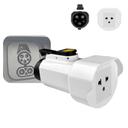
The five, side by side
Read from the same registry entries as the reviews above. The connector column is the one to read first, because it states the directioneach adapter converts. Where a cell says “Not published”, the seller did not publish that figure — which on an adapter is itself information, and on the two V2L entries it is most of what there is to know.
| Product | Connector | Max output | Max power | Warranty | Price |
|---|
| Lectron J1772 to Tesla Adapter | J1772 → NACS (Tesla) | 48 A | 11.5 kW | 1 year | |
|---|
| LENZ CCS1 to NACS Adapter | CCS1 → NACS (Tesla) | Not published | Not published | Not published | |
|---|
| EVDANCE Tesla to J1772 Adapter (80A) | NACS (Tesla) → J1772 | 80 A | Not published | Not published | |
|---|
| LZSTEC NACS V2L Adapter (20A / 2.4 kW) | NACS inlet → household outlet | 20 A | 2.4 kW | Not published | |
|---|
| EVqiaoyi J1772 Type 1 V2L Adapter (2022-2024 cars) | J1772 (Type 1) inlet → household outlet | Not published | Not published | Not published | |
|---|
Which of the three jobs do you need?
Job one: your car has a NACS port and you want to use ordinary stations
You need a J1772-to-NACSadapter — the Lectron here. Public Level 2 stations, workplace chargers, hotel chargers and nearly every home charger installed before 2024 hand you a J1772 plug that a NACS car physically cannot take. This is AC only and has nothing to do with Superchargers, which your car already uses natively. It is the most-used adapter in this whole category and the cheapest useful one.
Job two: your car has a J1772 port and you want to use Tesla’s AC hardware
You need a NACS-to-J1772adapter — the EVDANCE here, which publishes a maximum of 80 A at 250 V, far more headroom than any Level 2 circuit will ask for, and names Tesla Destination Charger compatibility. That covers hotel and restaurant Destination Chargers, a friend’s Wall Connector and a borrowed Mobile Connector. One honest caveat the cheap listings do not advertise: a Wall Connector can be configured by its owner to accept Tesla vehicles only, and no adapter overrides that. Our Tesla-to-J1772 roundup covers the category in full.
Job three: you want household power out of the car
That is V2L— vehicle-to-load — and it is the one job on this page where the adapter does not help you charge at all. It exposes a feature the car has: a few Hyundai, Kia and Genesis models can export AC power through the charge port, and a V2L adapter turns that into a household socket for a fridge during an outage or a kettle at a campsite. The adapter cannot add the feature to a car that lacks it. Critically, these come in two incompatible generations, which is covered below. Our V2L adapter roundup is the full field.
How we ranked these five
The Lectron J1772-to-Tesla leads because of how often it gets used.It publishes a 48-amp rating, covers any Level 2 circuit, carries a one-year warranty and comes from the best-established brand in the category. Its own spec note is admirably plain about what it is not: AC Level 2 only, no DC fast charging, and unrelated to the NACS-to-CCS adapters non-Tesla cars use at Superchargers. The honest con is mechanical rather than electrical — locking behaviour varies by station and some public units grip it loosely, which is exactly why adapter locks exist. Full figures in our review.
The LENZ CCS1-to-NACS is the reason this price band is worth a page of its own.It is the only DC adapter at this budget whose listing names an actual safety standard — UL 2252 — alongside a published 500 V rating, which covers the CCS stations a Tesla will realistically use. On a part carrying hundreds of volts, a named standard is worth far more than the price gap to the unbranded alternatives. Two conditions that are the buyer’s to meet: your Tesla has to support CCS charging in the first place (older cars may need Tesla’s retrofit), and not every CCS station handshakes cleanly with every adapter. It publishes no peak kW or amp figure, so the real ceiling is set by the station and the car. Our LENZ review has the detail.
The EVDANCE Tesla-to-J1772 is the pick running the other way, and the value buy of the two directions: an 80 A / 250 V published rating at a lower price than the brand-name equivalent. It publishes no kW figure and no warranty term, which is the trade. Our EVDANCE review sets out what the listing does and does not state.
The LZSTEC NACS V2L adapter is the best-specified V2L part in this band, and the one for newercars: the 2025-on Hyundai and 2026-on Kia models that wear a NACS inlet rather than a J1772 one. It is the only V2L listing we found that publishes a current and a power figure (“Up to 20A / 2.4kW”), vehicle-controlled locking with automatic release, and an 85 °C thermal limit. It publishes no outlet type, cable length, enclosure rating or warranty term, and it will not fit a 2022–2024 Ioniq 5 or EV6. Buy the generation that matches your car’s port, not the cheaper one.
The EVqiaoyi J1772 V2L is the budget pick, and it earns the slot on honesty.It is the cheapest V2L adapter we found with a brand named in the title, and the only one that states its fitment limit explicitly: 2022–2024 Hyundai Ioniq 5 and Ioniq 6 and Kia EV3/6/9 only. In a category where fitment is the thing buyers get wrong, that is worth more than it sounds. What it publishes beyond that is nothing — no amperage, wattage, outlet type, cable length, certification body or warranty — and the brand has no track record we can verify. We would still rather recommend the listing that tells you which cars it fits than a better-looking one that leaves the inlet generation to you.
What $100 does not buy
A NACS-to-CCS1 adapter for Supercharging a non-Tesla EV.The cheapest in our registry sits above this band and the interlocked, UL 2252-certified ones — the A2Z Typhoon Pro and the Lectron Vortex Plus, which publishes 500 A DC and 1,000 V DC — cost considerably more. A sub-$100 part claiming to do this job is misdescribing itself. A 2-in-1 adapter that covers both AC and DC with published ratings on both sides sits right at the top of this band rather than inside it, and the ones that do publish both are in our CCS-to-Tesla roundup. And adapter chains. One adapter between the station and the car is the limit; stacking a connector adapter onto an outlet adapter onto an extension is how connectors melt. The background is in are EV charging adapters safe.