Amp & Adapter

Best EV Chargers for Renters and Apartments

Charging without owning the wall — what you can install, unplug and take with you, and how to get real range from the outlets a rental actually has.

By Stephen V.Last updated How we rank

Almost every home-charging guide assumes you own the wall. That assumption quietly excludes about a third of drivers, and it produces advice that is useless if you cannot commission a new 240V circuit, drill into brickwork, or leave hardware behind when the lease ends.

This page starts from the opposite constraint: nothing here requires permanent modification to a property you do not own. Every pick either plugs into an existing outlet or, at most, hangs on a bracket you can unscrew and patch. The ranking is built around three questions that matter far more to a renter than amperage does: what outlet can you reach, can you take it with you, and how much range does it actually add overnight.

The honest headline is this: a great many renters do not need a 40A charger at all. If you drive an average distance and have access to any ordinary household socket near the car, a Level 1 charger adds enough range overnight to cover a typical day — and it requires no permission, no electrician and no conversation with a landlord. We have ranked accordingly, with the highest- capability options first for those who can use them, and the no-permission options given equal weight rather than treated as consolation prizes.

Everything below is read from the manufacturer’s or seller’s published figures on the date shown under each pick. We own no units and run no bench tests; unpublished figures read “Not published”.

How this is funded: we earn a commission if you buy through our links, at no extra cost to you. It never changes which product we recommend, and we’ll tell you plainly when we’d skip one. Full disclosure.

Quick picks

Ranked on published specs, install flexibility and buyer fit. Select a row to jump to the full write-up. We have not bench-tested these units — here is exactly what we do instead.

#ProductBest forPrice
1
Lectron 40A Portable Level 1/2 Charger

Lectron 40A Portable Level 1/2 Charger

The best all-round portable: a real 40A / 9.6 kW Level 2 charger on a NEMA 14-50 plug, with a Level 1 adapter for a standard outlet. For many people this is all the home charger they need, and it comes with you on trips.

Best overall for renters
$269.99 · View on Amazon

Price as of September 2, 2026. #ad How we’re funded

2
EVPOVO Level 2 Wall Charger (40A, 25 ft)

EVPOVO Level 2 Wall Charger (40A, 25 ft)

A wall-mounted 40A charger with a published 25 ft cable, at a price that normally buys a portable unit. Cable length is the spec most budget chargers quietly shorten, so a unit that publishes 25 ft at this price is worth a look — with the usual small-brand caveats.

Best if you have a 14-50 outlet
$243.19 · View on Amazon

$255.995% off

Price as of September 2, 2026. #ad How we’re funded

3
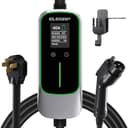
ELEGRP Level 2 EV Charger (40A, NEMA 14-50)

ELEGRP Level 2 EV Charger (40A, NEMA 14-50)

The cheapest way we found to get a genuinely ETL-certified 40A charger with a long cable. It is a plain plug-in unit with no app and no frills, which is exactly why it undercuts the name brands — buy it if the budget is the binding constraint and you already have a 14-50 outlet.

Best certified budget option
$209.99 · View on Amazon

Price as of September 2, 2026. #ad How we’re funded

4
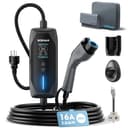
EVDANCE Level 1 & 2 Portable Charger (16A, 25 ft)

EVDANCE Level 1 & 2 Portable Charger (16A, 25 ft)

The genuinely useful dual-voltage unit: 12A from an ordinary household socket, 16A from a 240V NEMA 6-20, with a 25 ft cable and an ETL listing. It is not a fast charger and does not pretend to be — it is the one to keep in the trunk for wherever you end up parked.

Best no-permission option
$119.99 · View on Amazon

Price as of September 2, 2026. #ad How we’re funded

5
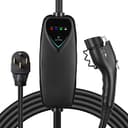
bokman Portable Level 1 & 2 Charger (16A)

bokman Portable Level 1 & 2 Charger (16A)

The dual-voltage answer at a Level 1 price: it runs from a standard 5-15 household outlet or a 6-20 240V outlet, which roughly doubles the charging rate wherever a 240V receptacle exists. That flexibility is what a travel charger is actually for.

Best dual-voltage travel unit
$99.99 · View on Amazon

$114.9913% off

Price as of September 2, 2026. #ad How we’re funded

The picks in full

#1Best overall for renters

Lectron 40A Portable Level 1/2 Charger

The best all-round portable: a real 40A / 9.6 kW Level 2 charger on a NEMA 14-50 plug, with a Level 1 adapter for a standard outlet. For many people this is all the home charger they need, and it comes with you on trips.

Strengths

  • True 40A Level 2 on a 14-50 outlet — same overnight speed as a wall unit
  • Includes a 120V adapter to fall back to any standard outlet
  • Packs in the trunk for road trips and destination charging

Trade-offs

  • Needs a 14-50 outlet installed to hit full speed at home
  • No wall bracket or scheduling — it's a cable, not a smart charger
ConnectorJ1772
Max output40 A
Max power9.6 kW
Cable length21 ft
InstallPlug-in (NEMA 14-50 + 5-15 adapter)
Outdoor ratingIP66 connector
Warranty1 year

Spec note. Adjustable amperage on some units lets you dial it down for a weaker outlet. On a standard 120V outlet it drops to Level 1 speed (a few miles of range per hour), which is the physics of the outlet, not the charger.

Specs read from the product listing, on July 19, 2026. “Not published” means the manufacturer does not state that figure.

#2Best if you have a 14-50 outlet

EVPOVO Level 2 Wall Charger (40A, 25 ft)

A wall-mounted 40A charger with a published 25 ft cable, at a price that normally buys a portable unit. Cable length is the spec most budget chargers quietly shorten, so a unit that publishes 25 ft at this price is worth a look — with the usual small-brand caveats.

Strengths

  • 25 ft cable is published up front — enough to reach a charge port on the far side of the car
  • 40A / 9.6 kW on a NEMA 14-50 plug, so no hardwiring is required
  • Wall-mounted design at a price closer to the portable units

Trade-offs

  • EVPOVO is a small brand with essentially no service track record
  • The listing does not name a certification body, an enclosure rating or a warranty
  • No app or scheduling — if your utility has time-of-use rates, check the car can schedule instead
ConnectorJ1772
Max output40 A
Max power9.6 kW
Cable length25 ft
InstallPlug-in (NEMA 14-50)
Outdoor ratingNot published
WarrantyNot published

Spec note. The listing publishes 40A, a J1772 connector, a NEMA 14-50 plug, wall-mounted construction and a 25 ft cable. It does not name a certification body, an enclosure rating or a warranty term, so those read as not published. Verify the certification on the listing page before buying — it is the one spec we would not trade away.

Specs read from the product listing, on August 11, 2026. “Not published” means the manufacturer does not state that figure.

#3Best certified budget option

ELEGRP Level 2 EV Charger (40A, NEMA 14-50)

The cheapest way we found to get a genuinely ETL-certified 40A charger with a long cable. It is a plain plug-in unit with no app and no frills, which is exactly why it undercuts the name brands — buy it if the budget is the binding constraint and you already have a 14-50 outlet.

Strengths

  • ETL certified at 40A — the safety listing is the one thing you should never cut
  • 25 ft cable is longer than several units costing considerably more
  • Plugs into a NEMA 14-50 outlet, so there is no electrician bill for the charger itself

Trade-offs

  • No app, no scheduling — if you need off-peak automation, look at the Emporia
  • ELEGRP is a fixtures brand rather than an EV specialist; long-term support is the open question
  • The listing does not publish an outdoor enclosure rating, so treat it as a garage unit
ConnectorJ1772
Max output40 A
Max power9.6 kW
Cable length25 ft
InstallPlug-in (NEMA 14-50)
Outdoor ratingNot published
WarrantyNot published

Spec note. The listing publishes 40A, 240V, an ETL certification, a NEMA 14-50 plug and a 25 ft cable. It does not publish a NEMA/IP enclosure rating or a warranty term, so both read as not published here. A 40A charger requires a 50A circuit under the 80% rule.

Specs read from the product listing, on August 11, 2026. “Not published” means the manufacturer does not state that figure.

#4Best no-permission option

EVDANCE Level 1 & 2 Portable Charger (16A, 25 ft)

The genuinely useful dual-voltage unit: 12A from an ordinary household socket, 16A from a 240V NEMA 6-20, with a 25 ft cable and an ETL listing. It is not a fast charger and does not pretend to be — it is the one to keep in the trunk for wherever you end up parked.

Strengths

  • ETL listed — a named testing lab, which several cheaper travel units cannot claim
  • Runs from a standard 120V socket or a 240V NEMA 6-20, roughly doubling the rate on the latter
  • 25 ft cable is unusually long for a travel unit, which matters when the outlet is nowhere near the car

Trade-offs

  • 16A maximum — this is a top-up charger, not a replacement for a 40A home install
  • The 240V mode needs a NEMA 6-20 outlet, which most houses do not have
  • No published enclosure rating or warranty term
ConnectorJ1772
Max output16 A
Max power3.8 kW
Cable length25 ft
InstallPlug-in (NEMA 5-15 or 6-20)
Outdoor ratingNot published
WarrantyNot published

Spec note. The listing publishes 12A at 120V and 16A at 240V, a 25 ft cable, an ETL listing and both NEMA 5-15 and 6-20 plug options, stated as compatible with all EVs and PHEVs. It does not publish an enclosure rating or a warranty term.

Specs read from the product listing, on August 11, 2026. “Not published” means the manufacturer does not state that figure.

#5Best dual-voltage travel unit

bokman Portable Level 1 & 2 Charger (16A)

The dual-voltage answer at a Level 1 price: it runs from a standard 5-15 household outlet or a 6-20 240V outlet, which roughly doubles the charging rate wherever a 240V receptacle exists. That flexibility is what a travel charger is actually for.

Strengths

  • Ships with both NEMA 5-15 (120V) and NEMA 6-20 (240V) plugs — one unit covers both
  • 16A rating is the practical maximum for this class of portable charger
  • 20 ft cable is longer than most units at this price

Trade-offs

  • The listing does not name a safety-certification body, unlike the Lectron
  • 16A is still a top-up rate, not a replacement for a Level 2 wall charger
  • Small brand with limited support history
ConnectorJ1772
Max output16 A
Max powerNot published
Cable length20 ft
InstallPlug-in (NEMA 6-20 or 5-15)
Outdoor ratingNot published
WarrantyNot published

Spec note. The listing publishes 16A, a 20 ft cable and both NEMA 6-20P and 5-15 plug options for Level 1 and Level 2 use. It does not publish a certification body, a kW figure or a warranty term.

Specs read from the product listing, on August 11, 2026. “Not published” means the manufacturer does not state that figure.

Start by identifying your outlet

Everything follows from this. Go and look at what is actually within cable reach of where the car parks, and match it to this list:

  • A standard household socket (NEMA 5-15).The most common case by far. This gives you Level 1 charging — roughly 3 to 5 miles of range per hour, or about 40 miles over a twelve-hour overnight. That covers an average day’s driving with room to spare.
  • A NEMA 14-50 (range or RV outlet).The jackpot. This is a 50A circuit, so a 40A charger runs at full output — the same as a proper home install. Common in garages, workshops and some parking structures.
  • A dryer outlet (NEMA 14-30 or 10-30).A 30A circuit, so you can draw 24A continuously. That is around 18 miles of range per hour, which is genuinely good. You will need a plug adapter and you must set the charger down to 24A yourself — see our NEMA adapter guide.
  • A NEMA 6-20 (240V, 20A).Found in workshops and some older laundry areas. Supports 16A, so around 12 miles of range per hour — roughly triple Level 1 from a socket that is often already there.

The types of EV chargers guide explains the levels in full, and how long charging takes works through the arithmetic for each.

The rule that decides everything: portable, not permanent

A hardwired charger is the wrong purchase for a renter under almost any circumstances. It requires an electrician, it requires the landlord’s written consent, it stays with the building, and you will have paid several hundred dollars to improve someone else’s property. A plug-in charger — wall-mounted or portable — costs the same or less, does the same job, and comes with you.

The Lectron 40A portable leads this list for exactly that reason. On a NEMA 14-50 it delivers a genuine 40A, the same as a wall-mounted unit, and it packs into a bag when the lease ends or when you go away for the weekend. It is the single most flexible piece of charging hardware a renter can own. Our full Lectron review goes deeper.

The EVPOVO and ELEGRPare for renters who have a 14-50 outlet and want something that looks and feels like a permanent installation without being one. Both are wall-mounted stations on a plug — you hang them on a bracket, plug them in, and unscrew the bracket when you leave. The EVPOVO publishes a 25 ft cable, which matters enormously in a shared garage where the outlet is rarely where you would have put it. The ELEGRP is the price floor with a real ETL certification.

The EVDANCE Level 1 & 2 is the no-permission answer, and the pick we would give most renters who are not sure what they can arrange. It runs from an ordinary 120V socket at 12A, or from a 240V NEMA 6-20 at 16A if one exists, and its 25 ft cable is unusually long for a travel unit — which is precisely what you need when the only socket is on the far wall. It is ETL listed, which several cheaper travel chargers are not.

The bokman covers the same ground for less, with a second plug that doubles the rate wherever 240V exists. It is the one to keep in the trunk.

Talking to a landlord or building manager

If you want more than an ordinary socket, the conversation goes better when you ask for something specific and small. Three requests, in ascending order of difficulty:

  1. Permission to use an existing outlet, with an offer to cover the electricity. This costs the building nothing and is usually granted.
  2. Permission to have an electrician add a dedicated 240V outlet at your expense, with the outlet remaining as an improvement to the property. Framed that way — a permanent upgrade they keep for free — this succeeds more often than people expect, particularly as EV-ready parking becomes a selling point.
  3. A shared charger for the building. Slow, political, and worth raising only if several residents want it.

Whatever is agreed, get it in writing, and have any new circuit installed by a licensed electrician under permit. Our installation guide covers the process and what it costs.

If you genuinely cannot charge where you live

Some situations have no home-charging answer, and it is more useful to say so than to pretend otherwise. Street parking with no reachable outlet, or a garage you have no access to, means your charging will happen at public stations, workplaces or on errands. That is a workable way to own an EV — it is simply a different cost structure, because public DC charging is substantially more expensive per kWh than home electricity. Our charging vs gas guide covers what that does to the savings case, and AC vs DC charging explains why the public rate is higher.

Extension cords: the honest answer

Do not run a Level 2 charger through a household extension cord. A charger pulling 40A continuously through a cord not rated for it is a genuine fire risk, and it is the single most common dangerous shortcut in renter charging. If you need reach, buy either a charger with a longer cable or a properly rated J1772 extension — our cables and extensions guide covers what “properly rated” means. For Level 1 from a household socket, a heavy-gauge outdoor-rated cord of the shortest length that works is the accepted approach, but read your charger’s manual first — some manufacturers prohibit it outright.

Frequently asked questions

Can I install an EV charger in a rental?

You can install a plug-in charger yourself — mount it on a bracket and plug it into an existing outlet. Anything requiring a new circuit needs the landlord's written permission and a licensed electrician, and the circuit stays with the property. For most renters a plug-in or portable unit is the right answer because it comes with you.

Is Level 1 charging enough for a renter?

For a great many people, yes. Level 1 from an ordinary household socket adds roughly 3 to 5 miles of range per hour, so about 40 miles over a twelve-hour overnight charge — more than the average daily drive. If you regularly cover more than that, or your car sits parked for only a few hours, you need Level 2.

Can I charge from a dryer outlet?

Yes, with the correct NEMA plug adapter, and with the charger dialed down to 24A because a dryer circuit is 30A and the continuous-load limit is 80%. The adapter will not enforce that limit for you — you have to set it on the charger. Only one of the dryer and the car can run at a time.

What happens to the charger when I move?

A plug-in or portable charger unplugs and comes with you, which is the whole argument for buying one. A hardwired charger is permanently attached to the building's wiring and stays behind, which is why we do not recommend one to renters.

Can I use an extension cord with an EV charger?

Not with a Level 2 charger — a 40A continuous draw through a household cord is a real fire risk. If you need reach, use a properly rated J1772 extension or buy a charger with a longer cable. For Level 1, a heavy-gauge outdoor-rated cord of the shortest workable length is the common approach, but check your charger's manual first because some manufacturers prohibit it.

Sources

Keep reading