Autel MaxiCharger vs Wallbox Pulsar Plus
Two premium smart chargers with opposite design philosophies — maximum output and enclosure versus the smallest box on the wall.
These two get cross-shopped because they sit at similar prices and both are properly engineered smart chargers. They are, however, built around opposite priorities, and once you see that, the decision usually makes itself.
The Autel MaxiCharger maximizes the physical side: the highest output here, the strongest enclosure, the longest cable. The Wallbox Pulsar Plusminimizes the physical side — it is by a wide margin the smallest 48A charger you can buy — and puts its engineering into power management instead, including the ability to split one circuit between two chargers.
The short answer: buy the Autel if the charger is going outside or you want the highest output a house can deliver. Buy the Wallbox if wall space is genuinely tight, or if you have two EVs and one circuit.
How this is funded: we earn a commission if you buy through our links, at no extra cost to you. It never changes which product we recommend, and we’ll tell you plainly when we’d skip one. Full disclosure.
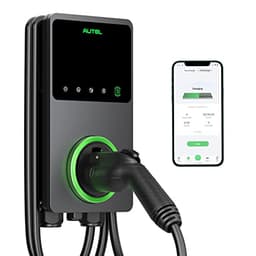 Autel MaxiCharger Home Autel MaxiCharger Home | 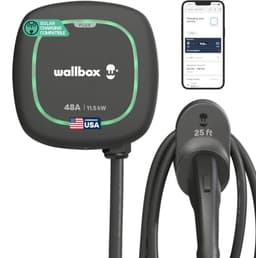 Wallbox Pulsar Plus Wallbox Pulsar Plus | |
|---|---|---|
| Connector | J1772 | J1772 |
| Max output | 50 A | 48 A |
| Max power | 12 kW | 11.5 kW |
| Cable length | 25 ft | 25 ft |
| Install | Hardwired (70A circuit for 50A); plug-in sold as separate 40A models | Hardwired (48A) or plug-in (40A) |
| Outdoor rating | IP65 / NEMA 4X (indoor/outdoor) | NEMA 3R (indoor/outdoor) |
| Warranty | 3 years | 3 years |
| Price |
Output: 50A versus 48A, which is not the real difference
On paper the Autel wins by two amps. Ignore that. Two amps is roughly two miles of range per hour, and neither figure is achievable unless your panel supports a 60A circuit and your car’s onboard AC charger can accept that much — many cannot. Both units land in the same practical place: as fast as a house gets.
The difference that matters is how you get there. The Autel is hardwired for its full 50A. The Wallbox is hardwired for 48A but also exists as a 40A plug-in variant. If you want a plug rather than a hardwire, that is a genuine fork — and it is worth reading our plug-in vs hardwired guide before assuming hardwiring is the better choice. A plug-in charger unplugs when you move and swaps out in five minutes if it fails.
Both, incidentally, are more charger than most homes need. Our 40A roundup makes the case that 40A on a 50A circuit is the amperage the majority of buyers should actually be shopping for, and that stepping up to 48A frequently costs more in circuit work than the charger itself. Get a load calculation before you shortlist on amperage.
Enclosure: the Autel’s clearest win
The Autel publishes NEMA 4X; the Wallbox publishes NEMA 3R. That is a real gap. NEMA 3R protects against falling rain, sleet and snow — entirely adequate under an eave or inside a garage. NEMA 4 adds windblown dust and splashing or hose-directed water, and the X adds corrosion resistance, which is the specification you want near salt air or where the charger gets washed down.
If the charger is going on an exposed exterior wall, this line alone may settle the decision. Our outdoor charger roundup decodes the ratings in full, and if you are protecting an already-rated charger from UV rather than water, our covers and enclosures guide covers the cheaper route.
Size: the Wallbox’s clearest win
The Pulsar Plus is remarkably small for a 48A charger — not marginally, but in a way you notice on the wall. In a single-car garage where the charger sits between a door frame and a shelf, or on a wall you look at from the kitchen window, that is not a vanity consideration. It is also easier to place well, which indirectly helps cable routing.
The trade is cable management. A smaller body means less room to dress the cable, so a wall hook or holster is more nearly mandatory here than on the bulkier Autel, which has a 25 ft cable and the physical mass to manage it.
Cable length
Both publish 25 ft, which is generous and effectively removes the most common regret in this category. Still walk the actual path before you commit to a mounting position — down the wall, across the floor, around the car to the port, plus slack. Cable length beats amperage for day-to-day satisfaction more often than any spec sheet suggests.
Power sharing: the feature only one of them has
This is the Wallbox’s genuine differentiator and the reason it wins outright for some households. Power Sharinglets two Pulsar Plus units split a single circuit, dynamically allocating current between them. If you have two EVs and a panel that cannot support two separate 60A circuits — a very common situation — that capability can be the difference between charging both cars at home and paying four figures for a service upgrade.
Power Boost is the related feature: the charger monitors the whole house and throttles itself when other loads spike, so it can live on a panel that a naive load calculation says is full. Our load management guide explains when this works and when it does not.
The Autel has connectivity — Wi-Fi, Bluetooth, Ethernet, scheduling, access control — but the two-charger circuit-splitting trick is Wallbox’s. If you need it, that ends the comparison.
The apps and the connectivity caveat
Both apps do scheduling, energy tracking and access control competently. Neither is a reason to buy. As we argue in our smart charger roundup, the only app features that genuinely justify their cost are off-peak scheduling (which most modern EVs do themselves, for free), load management, and access control if the charger is somewhere other people can reach.
The honest caveat on both: connectivity is a failure point a dumb charger does not have. Radios drop, firmware updates land, cloud accounts get redesigned. Both of these will charge without a network connection, which is the important question — but it is worth confirming for any connected charger before you buy.
Which should you buy?
Buy the Autel MaxiCharger if the charger is going on an exposed exterior wall, if you want the maximum output a residential panel can supply, or if you value physical robustness over footprint. The NEMA 4X enclosure is the strongest argument on this page.
Buy the Wallbox Pulsar Plus if wall space is tight, if you have or expect a second EV and want two chargers on one circuit, or if your panel is constrained enough that dynamic load management is the thing standing between you and home charging.
Buy neither if you have not yet had the load calculation done. Both are premium 48A-class chargers, and if the electrician comes back and says your panel can spare a 50A circuit but not a 60A, you will have paid for amps you cannot use. In that case the Emporia or the EVIQOdeliver the same nightly result for considerably less — see our main home charger roundup for the whole field.
And if the Wallbox is on your list because the garage is Tesla-adjacent rather than because of its size, the other comparison worth reading is Wallbox Pulsar Plus vs Tesla Wall Connector — same 48 amps on both sides, and the connector decides it.
Frequently asked questions
Is the Autel MaxiCharger's 50A actually faster than the Wallbox's 48A?
Barely, and probably not in your driveway. Two amps is about two miles of range per hour, and both figures require a 60A circuit plus a car whose onboard AC charger can accept that much — many cap lower. Treat the two as equivalent on speed and decide on enclosure, size and power sharing instead.
Which is better for outdoor installation?
The Autel. It publishes NEMA 4X, which covers windblown dust, hose-directed water and corrosion; the Wallbox publishes NEMA 3R, which covers falling rain, sleet and snow. Under an eave either is fine — on an exposed wall, or near salt air, choose the Autel.
Can I charge two EVs with these?
The Wallbox is built for it. Power Sharing lets two Pulsar Plus units split one circuit, allocating current between them dynamically — which can avoid a panel upgrade in a two-EV household. The Autel does not offer that two-unit circuit-splitting capability.
Do either of them need Wi-Fi to charge?
No. Both will charge with no network connection; you lose scheduling and data, not the ability to charge. That is worth verifying on any connected charger before buying, because it is not universally true of cheaper units.
Are these worth the money over a 40A charger?
Only if your panel can genuinely feed a 60A circuit. Both are 48A-class chargers, and a 48A install requires a 60A breaker that many older panels cannot spare. If the electrician says 50A is what you can have, a good 40A charger gives you the same full battery by morning for much less.
Sources
- U.S. DOE Alternative Fuels Data Center — Charging Electric Vehicles at Home — DOE guidance on Level 1 vs Level 2 home charging, 120V/240V service and installation (accessed July 19, 2026)
- EPA ENERGY STAR — Electric Vehicle Chargers — ENERGY STAR on certified EV chargers, safety certification and standby energy use (accessed July 19, 2026)
- EPA ENERGY STAR — Certified Electric Vehicle Chargers (AC Output) — The list of ENERGY STAR certified AC (Level 2) EV chargers (accessed July 19, 2026)
- U.S. DOE Alternative Fuels Data Center — Electric Vehicle Charging Stations — DOE overview of charging levels, power output and connector types (J1772, CCS, NACS) (accessed July 19, 2026)
Keep reading
Best smart home EV chargers
The honest test for whether connectivity is worth paying for, and the three features that pass it.
Read the smart guideBest outdoor home EV chargers
What the NEMA and IP ratings mean, and which chargers genuinely belong on an exterior wall.
Compare outdoor unitsCharging without a panel upgrade
Circuit sharing, load-managed chargers and what to do when the electrician says the panel is full.
Read the load guideBest 48A and 50A home chargers
The whole high-output field, with the three-part test for whether you actually need it.
See the 48A roundupAutel MaxiCharger Home review
The full review of the unit on the left of this comparison — 50A, a NEMA 4 enclosure and the panel headroom it assumes.
Read the Autel reviewWallbox Pulsar Plus review
The full review of the unit on the right — genuinely the smallest 48A charger you can buy, and who its app-led design suits.
Read the Wallbox review