The whole decision, in four numbers
Before you compare a single product, write these four down. The charger you should buy falls out of them, and no amount of spec-sheet reading changes the order.
1. The circuit your panel can actually spare. Not what you hope it can spare — what an electrician says after a load calculation. A 40A charger needs a 50A circuit; a 48A charger needs a 60A one. On a 100A service already feeding an electric range, a dryer and air conditioning, the difference between those two requests is frequently the difference between “yes, next Tuesday” and “you need a service upgrade first”.
2. What your car’s onboard charger accepts. Every EV converts AC to DC with an onboard charger that has its own current ceiling, and plenty of them stop at 32A or 40A. If yours does, a 48A wall unit delivers exactly what the car allows and not one amp more. You would have paid for a bigger breaker, thicker conductors and a hardwire bill to buy nothing at all.
3. How many hours the car is genuinely plugged in. The amperage argument only exists inside a short charging window. Across a normal overnight plug-in, both amperages finish the job long before you wake up.
4. What each route costs installed. Two written quotes — one for a 50A plug-in install, one for a 60A hardwired install — settle this question faster than any comparison table, this one included.
Notice what is not on that list: the number printed on the charger. It is the output of this decision, not an input to it.
What eight amps actually buys you
The arithmetic is simple and not in dispute. At 240V, 40A is 9.6 kW and 48A is 11.52 kW— about 20% more power.
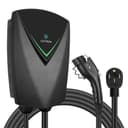
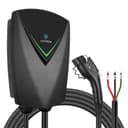
The cleanest real-world figure comes from a manufacturer that sells the same charger in both amperages. In its launch announcement of 28 July 2026, Lectron publishes up to 38 miles of range per hour for the 40A plug-in Nexus and up to 46 miles per hourfor the 48A hardwired version — identical cable, identical enclosure, identical certification set, eight miles an hour apart. Because both numbers come from one manufacturer describing one product line, that gap is a fair like-for-like reading of what the amperage is worth, which cross-brand marketing claims rarely are.
Two honest caveats on those figures. They are up tonumbers that assume an efficient car; the U.S. Department of Energy’s own generic figure for Level 2 charging is around 25 miles of range per hour, and a heavy SUV or a truck in winter will land nearer that than the marketing number. And they assume the car will accept the amperage in the first place, which brings us back to item two on the list above.
Now put the gap in the window it lives in. Over a ten-hour overnight charge, 40A adds roughly 380 miles and 48A roughly 460 — on those manufacturer figures, and both far beyond what almost anyone drives in a day. The eight miles an hour you bought were added while you were asleep, and the car was full either way. That is the crux of it: 48A is not faster in any way you will experience, unless one of three things is true.
The three cases where 48A genuinely pays
A short charging window. You arrive home late near empty and leave early. Four hours at 9.6 kW is roughly 150 miles of range; at 11.52 kW it is roughly 180. When the window is the constraint rather than the night, 20% more power is 20% more range in the battery at 7am.
Two EVs sharing one charger.Two cars alternating on one unit halves everyone’s window, so the extra power compounds. If that is your household, read our guide to charging two cars first — power sharing across one circuit is often a better answer than more amps.
A very large pack that regularly runs low. A truck with a 130 kWh battery taken from near-empty to full is a genuinely long job, and the one case on this page where the amperage shows up in daily life rather than in a spreadsheet.
The gate is your panel, not your budget
Electrical code treats EV charging as a continuousload — current drawn for hours without pause — and requires the circuit to be rated about 25% above that draw. Stated the other way round, a charger may use at most 80% of the circuit’s rating. So:
- 40A ÷ 0.8 = 50, so a 40A charger needs a 50A circuit.
- 48A ÷ 0.8 = 60, so a 48A charger needs a 60A circuit.
A 60A dedicated circuit is a substantial addition to a modest service, and it needs heavier conductors than a 50A one — a price gap that grows with every foot between the panel and the garage wall. If the load calculation comes back short, your options are a subpanel, a service upgrade, or load management, and the first two routinely cost more than every charger on this page put together. Our amps and circuits guide works through the full breaker table, and the load management guide covers the third route — which is how a 48A charger legitimately lives on a panel that could not otherwise feed it.
At 48A, the plug disappears
This is the consequence people discover after they have bought. A NEMA 14-50 receptacle — the outlet nearly every plug-in charger uses — is a 50A device, so the same 80% rule caps it at 40A continuous. There is no plug in common residential use rated to carry 48A for hours. Every genuine 48A charger is therefore hardwired, and if a listing advertises 48A on a plug, something in that claim is wrong.
Hardwiring changes three things beyond the bill. An electrician becomes mandatory rather than optional. The charger becomes part of the house — if you move, it stays, which matters more than buyers expect. And the receptacle, the component in a plug-in install most likely to overheat, is removed from the system altogether. That last one is a real engineering advantage of 48A, and the only one that has nothing to do with speed. Our plug-in vs hardwired guide takes the trade-off apart properly; if you are staying on a plug, buy an industrial-grade receptacle rather than the cheapest one on the shelf.
Your car is probably the real ceiling
Charging speed is set by the lowestof three numbers: the circuit, the charger, and the car’s onboard AC charger. Buyers optimize the second and ignore the third, which is how a 48A charger ends up feeding a car that draws 32A.
The number you need is in the owner’s manual, in the charging section, usually expressed in kW rather than amps: divide by 240 to get the amperage. An 11.5 kW onboard charger accepts 48A; a 7.7 kW one accepts 32A and will never do more, whatever you hang on the wall. It is model-and-year specific, so check yours rather than a forum post about a different trim. Our Chevy Bolt and Ioniq 5 pages work through two cars where this catches buyers out for opposite reasons, and our BMW pageis the clearest case of all — BMW builds its own home equipment around 9.6 kW, which is 40 amps.
If you have already bought the bigger charger and the sessions are slower than the number on the box, that is usually this and not a fault. Our guide to why an EV charges slowly at home walks the seven causes in the order worth checking.
One legitimate exception: if you expect to replace the car within a few years with something that does accept 48A, and the 60A circuit is available now, installing for the future car is reasonable. Buying 48A for a car that cannot use it and never will is not.
Where the money actually goes
Here is the fact that reframes the whole comparison. On the two matched pairs above, the 48A hardware premium is small to nonexistent — when we checked the live listings on 4 September 2026, one brand priced its 40A and 48A models identically, and the other separated them by less than a tenth of the cheaper unit’s price. (Live prices sit in the cards above; we do not quote a number in prose that could be stale by the time you read it.)
The install premium is the opposite. Heavier conductors, hardwire labor instead of a plug, a 60A breaker that needs space in the panel, and the permit and inspection any competent job includes — before you even reach the possibility of a subpanel. In practice the gap between a 50A plug-in install and a 60A hardwired one is usually larger than the gap between the chargers, and occasionally larger by an order of magnitude.
So the question is never “can I afford the 48A charger”. It is “can I afford the 48A circuit” — and only your electrician can answer it. Get both routes quoted on the same visit. Our installation guide covers what to ask for, and what the work typically costs.
Buy 48A only if all three are true
- An electrician has confirmed 60A of headroomwithout a panel or service upgrade — or you are willing to pay for load management instead.
- Your car’s onboard charger accepts 48A, or the car that replaces it will.
- Your charging window is genuinely short, two EVs share the unit, or the pack is very large.
Buy 40A if any of these is true
- The panel is tight, or the service is 100A and already busy.
- You rent, or expect to move — a plug-in charger comes off the wall and goes with you, and the renter’s case is built around exactly that.
- Your car caps AC charging at 32A or 40A.
- The car sits plugged in for eight hours or more most nights — which describes the large majority of home charging.
The hedge: buy a charger that can be both
If you cannot yet answer the panel question, do not guess at it. One of the picks above is designed to defer the decision.
The Emporia ships on a NEMA 14-50 plug and runs at 40A there, then converts to a hardwired 48A install later. You buy once and decide twice: live on the cheap install for a year, and step up only if the short-window problem turns out to be real. For most people arriving at this page undecided, that is the smartest path through it.
The ChargePoint Home Flex used to make the same argument from the other direction, with an amperage dial that ran from 16A to 50A. It is no longer on this page because ChargePoint now sells the hardwired and plug-in versions as separate models and, as of 20 September 2026, the hardwired one is not listed on Amazon; the Home Flex sold there is the NEMA 14-50 plug-in, a fixed 40A unit. Our Home Flex review explains the change. The principle stands: a charger you cannot down-configure becomes scrap if the panel says no.
What we would skip
Skip 48A the moment a quote includes a panel or service upgrade to support it; buy 40A, spend a fraction of the difference on a proper receptacle, and put the rest back in your pocket. Skip any fixed-amperage 48A unit before the circuit is confirmed in writing — fixed high amperage is the most fragile thing you can buy in this category. And skip the assumption that a bigger number on the box is a faster morning: on a car that caps at 40A, on a circuit that tops out at 50A, or across a night that runs eight hours, it is simply a more expensive way to arrive at the same full battery. If you have settled the question, our 40A roundup and 48A roundup go deeper on each tier.