The circuit is the real decision
Both of these are hardwired chargers at full output, which means the install cost is driven by the breaker and the wire run rather than by the box on the wall. Here the two makers ask different things of your panel:
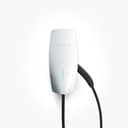
- Tesla:48 amps on a 60-amp double-pole breaker, commissioned down to 40, 32, 24, 16 or 12 amps if the panel cannot carry it.
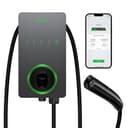
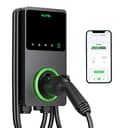
- Autel:50 amps with a 70-amp circuit per its own store page, adjustable down to 16 amps in the app — and its NACS listing publishes the same unit as adjustable from 6 to 50 amps on a 20- to 80-amp circuit depending on the setting.
In other words, both chargers can be dialed down to fit a modest panel, but only one of them reaches its headline number on a circuit that is common in US houses. If your service is 100 or 125 amps, or the panel is already full, the honest reading is that the Tesla’s 48 amps on 60 is the easier install and the Autel set to 40 amps on a 50-amp circuit is the cheaper one. Amps, circuits and the 125% rule walks through the arithmetic, and best for a 100-amp panel is the page to read if the service is your constraint.
And remember what the car does with all this. Two extra amps is about 480 watts, or roughly 2 miles of range per hour on a typical EV — and only on a car whose onboard charger can accept 50 amps in the first place, which most cannot. Our 40 amps vs 48 amps page is the long version of why that gap is smaller than the marketing implies.
Hardwired, and in Tesla’s case hardwired by rule
Neither of these is a plug-in charger. The difference is how firmly each maker says so. Tesla’s installation manual is explicit — “Do NOT install cord-and-plug type connections”— so there is no sanctioned way to put this unit on a NEMA 14-50 outlet. Autel’s 50-amp MaxiCharger is likewise hardwired, but Autel sells plug-in NEMA 14-50 and NEMA 6-50 versions as separate 40-amp models, so the install type is a choice you make at purchase.
That matters most to renters and to anyone who expects to move. A hardwired charger stays with the house; a plug-in one comes with you. NEMA 14-50 vs hardwired covers the trade-off in full, and best for renters is the right page if taking the charger with you is non-negotiable.
Connector: the one difference that is not negotiable
The Tesla Wall Connector has a NACS handle and nothing else. Its manual’s safety section states that “No adapters or conversion adapters are allowed to be used”, so a J1772 car is not this product’s job — that is what the Universal Wall Connector, with Tesla’s own adapter docked on the side of the unit, exists for. Our Wall Connector vs Universal comparison is the page for that decision.
Autel sells the same charger in both connectors, which is the quiet advantage in this matchup. A NACS Autel plugs into a Tesla, a Kia EV9, a Toyota bZ or a Cadillac LYRIQ; a J1772 Autel plugs into everything else, including a Nissan Ariyaor an ID.4. If the household’s next car might not wear the same plug as this one, that flexibility is worth more than two amps. If you need to bridge the two worlds instead, the J1772-to-Tesla adaptersdo it for a fraction of a charger’s price — though we would not design a nightly routine around an adapter.
What each maker publishes — and what it does not
| Published spec | Tesla Wall Connector (Gen 3) | Autel MaxiCharger AC Elite Home 50A |
|---|
| Maximum output | 48 A / 11.5 kW | 50 A / 12 kW |
| Adjustable range | 12-48 A, set at commissioning | 16-50 A in the app (6-50 A on the NACS listing) |
| Circuit for full output | 60 A double-pole breaker | 70 A (Autel’s own store page) |
| Install | Hardwired only — “Do NOT install cord-and-plug type connections” | Hardwired at 50 A; plug-in 14-50 / 6-50 sold as separate 40 A models |
| Connector | NACS only; no adapters permitted per the manual | J1772 or NACS, chosen at purchase |
| Cable | 24 ft on the listing; 22 ft on EPA’s ENERGY STAR record | 25 ft (7.5 m) |
| Enclosure | Approved for indoor or outdoor installation | IP65 / NEMA 4X |
| Operating temperature | Not published in the Gen 3 manual | −40 °F to 131 °F |
| Connectivity | Wi-Fi with over-the-air updates, managed in the Tesla app | Wi-Fi, Bluetooth, Ethernet, CAN, RS485 |
| Load management | Power sharing across up to six units | Adaptive Load Management and Dynamic Load Balancing; required sensor hardware not published |
| Certification | ENERGY STAR certified — EPA lists model 1457768 at 48 A / 11.52 kW | CSA certified and ENERGY STAR certified |
| Warranty | 48 months residential, 12 months commercial | 3 years |
| Weight | About 10 lb with the wirebox | About 15.4 lb with the in-body holster |
The temperature row is the most under-rated line in the table
Autel publishes an operating range of −40 °F to 131 °F behind an IP65 / NEMA 4X shell — the widest low-temperature figure of any charger in our registry. Tesla’s Gen 3 installation manual approves indoor or outdoor installation but publishes no ambient temperature range at all.
That is not evidence the Tesla fails in the cold; plenty of them work through Minnesota winters. It is evidence that if you need a figure — for an unheated detached garage, a north-facing exterior wall, or simply your own peace of mind — only one of these makers gives you one. That is the argument of best chargers for cold weather, and best outdoor chargers decodes the enclosure ratings themselves.
Load management, if you will ever charge two cars
Both makers publish a way to avoid upgrading your service when a second EV arrives, and they are different kinds of answer. Tesla’s is simple and closed: power sharing across up to six Wall Connectors, all in the Tesla app, which is excellent if every charger and every car is Tesla. Autel lists Adaptive Load Management, which shares capacity with the rest of the house, and Dynamic Load Balancing between chargers — but Autel does not publish what sensor hardware ALM needs, so you cannot cost the feature before you buy it. We flag that as a gap on every page where it comes up rather than guessing at it.
If two cars is the plan, how load management works and best chargers for two EVs are the pages that rank the whole field on exactly this question.
Who should buy which
- Buy the Tesla if every car in the household is a Tesla, you want charging scheduled in the app that is already on your phone, your panel can take a 60-amp circuit, and the longest warranty in the category matters to you. The fit-and-finish is the best in this comparison, and a NACS handle with nothing clipped onto it is genuinely nicer to live with.
- Buy the Autel NACSif your car has a NACS inlet but is not a Tesla — or is a Tesla today and might not be next time. Same native handle, more amps, a published temperature range, and a price bracket below Tesla’s.
- Buy the Autel J1772 if your car has a J1772 or CCS1 inlet. The Tesla Wall Connector is simply the wrong product for that car, and its own manual says so.
- Buy neitherif your car’s onboard charger is below about 40 amps and you have a NEMA 14-50 outlet already. A good plug-in 40-amp charger will charge it just as fully overnight for a fraction of the install cost — which is the case we make in best 40-amp chargers.
The short answer
Two well-built hardwired chargers, one meaningful specification apart. The Tesla gets to 48 amps on a circuit more houses have and carries a four-year residential warranty; the Autel goes two amps higher if your panel allows, publishes the cold-weather figure Tesla does not, comes in the connector your car actually has, and sits a price bracket below it. Unless the garage is Tesla-only, the Autel is the one we would buy — and if you want the fuller field rather than this pair, start at best home EV chargers or the comparison chart.