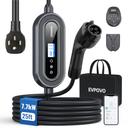
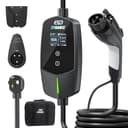
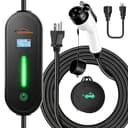
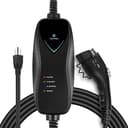
The five, side by side
Read from the same registry entries as the reviews above. The plug type in the install column is the single most important cell in this table — it is what caps the amps.
| Product | Max output | Max power | Cable | Install | Warranty | Price |
|---|
| EVPOVO Level 2 32A (NEMA 14-50) | 32 A | 7.7 kW | 25 ft | Plug-in (NEMA 14-50) | 3 years | |
|---|
| EVDANCE 40A Portable Level 2 Charger | 40 A | 9.6 kW | 25 ft | Plug-in (NEMA 14-50, adapters vary) | 1 year | |
|---|
| EVDANCE Level 1 & 2 Portable Charger (16A, 25 ft) | 16 A | 3.8 kW | 25 ft | Plug-in (NEMA 5-15 or 6-20) | Not published | |
|---|
| TopAutoGear Portable Level 1 & 2 Charger (16A) | 16 A | Not published | 17 ft | Plug-in (NEMA 6-20, with a 5-15 adapter) | Not published | |
|---|
| Lectron Level 1 EV Charger (15A, 110V) | 15 A | Not published | 16 ft | Plug-in (standard 110V outlet) | Not published | |
|---|
What $200 buys in a portable
It buys 32 amps.That is the headline, and it is recent. A 32-amp portable on a 14-50 outlet delivers about 7.7 kW — roughly 20 to 25 miles of range an hour — which is a full overnight charge for almost any EV and the same output as plenty of wall-mounted chargers costing three times as much. The only thing a wall unit does better at that amperage is look permanent.
It buys a 25 ft cable, which matters more than buyers expect. Three of the five picks publish 25 ft. On the road that is the difference between reaching an outlet on the far side of a motel parking space and not charging at all. Length is also the quiet reason to prefer a portable for a rental or a second home.
It buys a named certification — if you insist. Four of the five picks name a lab: ETL listings against UL 2594 and UL 2231 on the EVPOVO, and ETL on the EVDANCE dual-voltage, TopAutoGear and Lectron units. This is where the floor of the market gets thin: the cheapest 16-amp travel chargers frequently publish no certification body at all, and we will not recommend one of those as a budget pick no matter how low the price goes.
What it does not buyis a factory NACS handle (the native-Tesla portables in our registry start above this cap), a published outdoor enclosure rating on the body, or a warranty longer than three years — two picks here publish one year and two publish nothing at all. If a NACS plug is what you need, our Tesla portable roundup is the page, and the cheapest honest route from here is a 40-amp J1772 unit plus a J1772-to-NACS adapter from our under-$50 adapter page.
The outlet, not the charger, sets your speed
Tesla publishes the clearest table in the industry for its own Mobile Connector, and it generalises: the same cordset delivers 32 A / 7.6 kW on a NEMA 14-50 or 6-50, 24 A / 5.7 kW on a 14-30 or 10-30 dryer outlet, 16 A / 3.8 kW on a 6-20, and 12 A / 1.3 kW on an ordinary 5-15 household socket. Same charger, a sixfold difference. So before you compare products, find out what outlet you will actually plug into — our NEMA outlet types guide identifies them, and the NEMA adapter roundup covers the one-foot adapters that let a 14-50 charger use a dryer circuit, with the mandatory derating.
How we ranked these five
The EVPOVO 32A wins on a specification sheet that should cost more than it does.Thirty-two amps, 25 ft of cold-rated TPU cable, an adjustable output so it fits a 20-, 30- or 40-amp circuit, Wi-Fi through the Smart Life app or plain button control, an ETL listing naming UL 2594 and UL 2231, CCID20 and three years. Its honest limitations: no published enclosure rating on the body, and it needs the 14-50 outlet to be worth having.
The EVDANCE 40A is the most power inside the cap — just. Forty amps, 9.6 kW, a 25 ft cable and an IP67-rated connector, which is the spec that matters most on a unit that gets carried around and set down on wet ground. Two caveats, both material: it has priced within a couple of dollars of $200, so it may sit above the cap on the day you read this, and the configurations and included adapters vary by listing — check the plug type and stated amperage on the exact unit before buying. It is a pick on our main portable roundup too.
The EVDANCE Level 1 & 2 16A is the one to take somewhere you have not been.It publishes 12 A at 120 V and 16 A at 240 V with both NEMA 5-15 and 6-20 plug options, a 25 ft cable and an ETL listing — the combination that means you can charge from whatever is on the wall. It is also the right answer for a plug-in hybrid, whose onboard charger usually cannot use more anyway; see chargers for a PHEV.
The TopAutoGear is the budget pick because it is certified.At roughly a hundred dollars it publishes an ETL certification, 8–16 A adjustment across 110/240 V, a 17 ft cable, an LCD display and a NEMA 6-20 plug with a 5-15 adapter. It publishes no kW figure, no enclosure rating and no warranty term, which is the trade at this price. The bokman 16A, also a pick on our budget roundup, is a near-identical alternative with 20 ft of cable and no named certification, which is why it is not the pick here.
The Lectron Level 1 is on this page for one buyer: someone who wants a certified 120-volt-only spare from a brand with a track record, to leave in a trunk or at a second home. Be clear-eyed about it — it costs more than the dual-voltage units above it and does less, because 110 V at 15 A is roughly 1.6 kW. Our Level 1 roundup makes the case for that category honestly, including the fact that for under 40 miles of daily driving it genuinely is enough.
One thing to check before you buy any of them
What is in the box.Adapter sets are where portable listings are vaguest: some ship with several NEMA plug adapters, some with one, and some publish nothing about the contents at all. An adapter you assumed was included can turn a 7.7 kW purchase into a 1.3 kW one on arrival. Read the listing text rather than the photograph, and if the answer is not published, treat it as not included. Our road-trip kit page covers which adapters are worth carrying and in what order.
Two EVDANCE units sit inside this cap, and if that brand is what you are deciding about, EVDANCE alternatives compares its whole range against the rivals on warranty, enclosure rating and published amperage.