Amp & Adapter

Best NEMA Adapters for EV Chargers

The short cords that let a 14-50 charger use the dryer or welder outlet you already have — and the amp limit you must set yourself, because the adapter won't.

By Stephen V.Last updated How we rank

Most Level 2 chargers ship with a NEMA 14-50 plug. Most houses do not have a NEMA 14-50 outlet. What they very often dohave is a dryer outlet, and sometimes a welder outlet — both 240V, both already installed, both useless to a 14-50 plug without a $20 cord.

That is what these adapters are: a short, heavy cable with the plug your outlet takes on one end and a 14-50 receptacle on the other. They are among the highest leverage purchases in EV charging, because a dryer outlet plus an adapter turns roughly 50 miles of overnight range into roughly 200 — for the price of a takeaway, with no electrician involved.

But there is one rule, and getting it wrong is the dangerous part of this page. An adapter changes the plug. It does not change the circuit. If you plug a 40A charger into a 30A dryer circuit through an adapter and leave the charger set to 40A, you are asking a 30A circuit to carry a 40A continuous load. The adapter will not stop you. The charger will not stop you. You must set the charger down yourself.

Every charger worth owning has an amperage setting — a dial, a DIP switch or an app control. Find yours before you buy an adapter. The limits are in the table below and the arithmetic is in our amps and circuits guide.

Everything below is read from published listings on the date shown under each pick. We own no units and run no bench tests; unpublished figures read “Not published”.

How this is funded: we earn a commission if you buy through our links, at no extra cost to you. It never changes which product we recommend, and we’ll tell you plainly when we’d skip one. Full disclosure.

Quick picks

Ranked on published specs, install flexibility and buyer fit. Select a row to jump to the full write-up. We have not bench-tested these units — here is exactly what we do instead.

#ProductBest forPrice
1
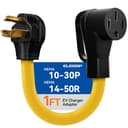
ELEGRP NEMA 10-30P to 14-50R Adapter (1 ft)

ELEGRP NEMA 10-30P to 14-50R Adapter (1 ft)

The one that unlocks the old three-prong dryer outlet in an older house — the most common 240V receptacle people already have and cannot use. Heavy 10-gauge STW cable, from a brand that makes electrical fixtures rather than a marketplace pop-up.

Best for an older dryer outlet
$23.99 · View on Amazon

Price as of September 2, 2026. #ad How we’re funded

2
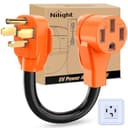
Nilight NEMA 14-30P to 14-50R Adapter

Nilight NEMA 14-30P to 14-50R Adapter

The modern-dryer version, and the one most people actually need. A 14-30 is the four-prong receptacle in essentially every house built or rewired in the last few decades, and this is a 10-gauge cord from an established automotive-electrical brand.

Best for a modern dryer outlet
$22.49 · View on Amazon

$24.9910% off

Price as of September 2, 2026. #ad How we’re funded

3
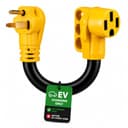
Elecan NEMA 6-50P to 14-50R Adapter (1 ft)

Elecan NEMA 6-50P to 14-50R Adapter (1 ft)

The welder-outlet adapter, and the only one on this list that keeps you at full 40A. A 6-50 sits on a 50A circuit, so unlike the dryer adapters you do not have to give anything up — and this one publishes 6 AWG conductors and an ETL listing.

Best for a welder outlet
$22.49 · View on Amazon

Price as of September 2, 2026. #ad How we’re funded

4
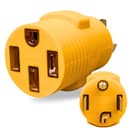
MECMO NEMA 14-30P to 14-50R Adapter (24A)

MECMO NEMA 14-30P to 14-50R Adapter (24A)

The cheapest four-prong dryer adapter we would recommend, and the only one here that prints the 24A ceiling on the listing rather than leaving you to work it out. That honesty is worth more than the couple of dollars it saves.

Cheapest, with the limit printed on it
$19.99 · View on Amazon

Price as of September 2, 2026. #ad How we’re funded

The picks in full

#1Best for an older dryer outlet

ELEGRP NEMA 10-30P to 14-50R Adapter (1 ft)

The one that unlocks the old three-prong dryer outlet in an older house — the most common 240V receptacle people already have and cannot use. Heavy 10-gauge STW cable, from a brand that makes electrical fixtures rather than a marketplace pop-up.

Strengths

  • Opens up the 10-30 dryer receptacle, which is otherwise useless to a 14-50 charger
  • 10 AWG STW cable — the gauge is published, which many competing adapters do not do
  • One foot long, so it hangs at the outlet instead of becoming a floor cable

Trade-offs

  • The circuit behind a 10-30 is 30A, so you MUST dial the charger down to 24A — the adapter cannot do it for you
  • 10-30 outlets have no ground conductor, only a bonded neutral; have an electrician confirm the outlet is sound first
  • No published warranty term
ConnectorNEMA 10-30P → NEMA 14-50R
Max output30 A
Max powerNot published
Cable length1 ft
InstallIn-line plug adapter
Outdoor ratingNot published
WarrantyNot published

Spec note. The listing publishes a NEMA 10-30P to 14-50R conversion, 30 amps, 10 AWG STW heavy-duty cable and a 1 ft length. It does not publish a certification body or warranty term. A 30A circuit permits a 24A continuous draw under the 80% rule — set the charger accordingly.

Specs read from the product listing, on August 11, 2026. “Not published” means the manufacturer does not state that figure.

#2Best for a modern dryer outlet

Nilight NEMA 14-30P to 14-50R Adapter

The modern-dryer version, and the one most people actually need. A 14-30 is the four-prong receptacle in essentially every house built or rewired in the last few decades, and this is a 10-gauge cord from an established automotive-electrical brand.

Strengths

  • 10-gauge conductor published in the listing — appropriate for a 30A circuit
  • 14-30 has a true ground, unlike the older 10-30 it replaced
  • Nilight is an established brand in automotive electrical rather than a one-listing seller

Trade-offs

  • Still a 30A circuit — the charger must be set to 24A maximum, which the adapter will not enforce
  • Sharing the dryer circuit means only one of the two can run at a time
  • No published warranty term or certification body
ConnectorNEMA 14-30P → NEMA 14-50R
Max output30 A
Max powerNot published
Cable lengthNot published
InstallIn-line plug adapter
Outdoor ratingNot published
WarrantyNot published

Spec note. The listing publishes a NEMA 14-30P to 14-50R conversion, 30 amp to 50 amp and a 10 gauge conductor. It does not publish a length, certification body or warranty term. A 30A circuit permits 24A continuous under the 80% rule.

Specs read from the product listing, on August 11, 2026. “Not published” means the manufacturer does not state that figure.

#3Best for a welder outlet

Elecan NEMA 6-50P to 14-50R Adapter (1 ft)

The welder-outlet adapter, and the only one on this list that keeps you at full 40A. A 6-50 sits on a 50A circuit, so unlike the dryer adapters you do not have to give anything up — and this one publishes 6 AWG conductors and an ETL listing.

Strengths

  • A 6-50 is a 50A circuit, so a 40A charger runs at full output with no dial-down
  • 6 AWG conductors and an ETL listing are both published — the strongest spec sheet here
  • Waterproof construction stated, which matters in a shop or an outdoor-adjacent bay

Trade-offs

  • 6-50 has no neutral; it works for EV charging but is not interchangeable with a 14-50 for other loads
  • Only useful if you already have a welder outlet — running a new one costs the same as running a 14-50
  • No published warranty term
ConnectorNEMA 6-50P → NEMA 14-50R
Max output50 A
Max powerNot published
Cable length1 ft
InstallIn-line plug adapter
Outdoor ratingNot published
WarrantyNot published

Spec note. The listing publishes a NEMA 6-50P to 14-50R conversion, 50 amps, 125V/250V, 6 AWG heavy-duty waterproof cable, an ETL reference and a 1 ft length. It does not publish a warranty term. On a 50A circuit a charger may draw 40A continuously under the 80% rule.

Specs read from the product listing, on August 11, 2026. “Not published” means the manufacturer does not state that figure.

#4Cheapest, with the limit printed on it

MECMO NEMA 14-30P to 14-50R Adapter (24A)

The cheapest four-prong dryer adapter we would recommend, and the only one here that prints the 24A ceiling on the listing rather than leaving you to work it out. That honesty is worth more than the couple of dollars it saves.

Strengths

  • The listing states a 24A max at 240V — the correct continuous limit for a 30A circuit
  • Cheapest 14-30 adapter here from a brand already established in EV accessories
  • Explicitly warns it is not for three-prong dryers or RV outlets, which prevents the common mis-purchase

Trade-offs

  • 24A ceiling is lower than the 30A-capable cords, so there is no headroom if you later move it
  • Does not publish a conductor gauge
  • No published warranty term
ConnectorNEMA 14-30P → NEMA 14-50R
Max output24 A
Max powerNot published
Cable lengthNot published
InstallIn-line plug adapter
Outdoor ratingNot published
WarrantyNot published

Spec note. The listing publishes a NEMA 14-30P to 14-50R conversion, a 30A four-prong dryer source and a 24A / 240V maximum draw, and states it is not for three-prong dryer or RV outlets. It does not publish a conductor gauge, length or warranty term.

Specs read from the product listing, on August 11, 2026. “Not published” means the manufacturer does not state that figure.

Identify your outlet first

Go and look at the receptacle before buying anything. The differences are obvious once you know what you are looking at, and buying the wrong adapter is the most common mistake here.

  • NEMA 10-30— three slots, two angled and one straight. The older three-prong dryer outlet, standard in houses wired before the mid-1990s. 30A circuit → set the charger to 24A.
  • NEMA 14-30— four slots. The modern four-prong dryer outlet that replaced the 10-30. 30A circuit → set the charger to 24A.
  • NEMA 6-50— three slots, two horizontal blades and a ground. The welder outlet, common in workshops and garages. 50A circuit → the charger can run at 40A.
  • NEMA 14-50— four slots, one L-shaped. The one your charger already fits. No adapter needed.

Note the asymmetry: the welder outlet is the good one. A 6-50 sits on a 50A circuit, so a 40A charger runs at full output with nothing given up. Both dryer outlets are 30A circuits, which caps you at 24A — still around 18 miles of range per hour, or roughly 200 miles overnight, which is genuinely excellent for a $20 cord.

The 10-30 grounding note

The older three-prong 10-30 has no separate ground conductor — it uses a bonded neutral, which is why the four-prong 14-30 replaced it. It is still a legal existing installation in many places and adapters for it are widely sold, but if your house has 10-30 outlets it also has wiring of that vintage. Have an electrician confirm the outlet and its circuit are sound before running a continuous EV load through it. This is a genuine caveat, not a formality.

The 80% rule, and why it exists

The National Electrical Code treats a load running three hours or more as a continuous load, and limits it to 80% of the circuit rating. EV charging is the textbook example: eight to twelve hours at full current, night after night.

The reason is heat. A circuit carrying its full rated current indefinitely runs warmer than the same circuit carrying it in bursts, and everything in the chain — conductor, breaker, plug, receptacle — is rated with that derating assumed. So:

  • 30A circuit → 24A continuous maximum
  • 50A circuit → 40A continuous maximum
  • 60A circuit → 48A continuous maximum

An overloaded circuit does not necessarily trip. A slightly-over-limit continuous draw can run for months while quietly cooking a connection, and the first symptom is often a discolored or warm outlet. That is why setting the charger correctly is your responsibility rather than something you can rely on the hardware to enforce.

How we ranked these four

The ELEGRP 10-30 adapter leadsbecause the old three-prong dryer outlet is the one most likely to be sitting unused in a house that also has an EV in the drive, and because ELEGRP publishes what matters: a 10 AWG STW cable and a one-foot length. Short is good — the adapter should hang at the outlet, not become a second floor cable.

The Nilight 14-30 is the modern-dryer equivalent, and the one most newer houses need. Ten-gauge conductor, published, from a brand established in automotive electrical rather than a single-listing seller. The 14-30 also has a true ground, which the 10-30 does not.

The Elecan 6-50 is the one that gives up nothing.It has the strongest spec sheet here — 6 AWG conductors and a published ETL listing — and because a welder outlet is a 50A circuit, your charger stays at 40A. If you have a workshop or a garage with a 6-50, this is the best charging situation on this page and most people do not realize they are in it.

The MECMO 14-30 is the cheapest we would recommend, and the only listing here that prints the 24A ceiling on the product itself rather than leaving you to derive it. That honesty is worth more than the couple of dollars it saves, because the amp limit is the thing people get wrong.

Practical notes before you order

Buy short.One foot is ideal. An adapter is not an extension cord and should not be used as one — a long adapter cable adds resistance and becomes a trip hazard. If you need reach, use a properly rated J1772 extension on the charger side; our cables and extensions guide covers that.

Do not stack adapters. Two adapters in series means two extra connections, each a resistance point and a place for heat. If you need an unusual conversion, buy the single cord that does it.

Do not use an RV adapter for EV charging. Several listings explicitly warn against this, and the warning is real: adapters sold for RV use are built for a different duty cycle and are not rated for a continuous EV load. Buy one sold for EV charging.

Check the outlet by hand after the first hour. On any new setup, and especially on an outlet that has not been used in years. Warm is worth investigating. Hot is a stop signal and a call to an electrician.

Remember the dryer still needs the circuit.Only one of the appliance and the car can run at a time, and unplugging the dryer weekly is a wear point on both plugs. If this becomes your permanent arrangement, having an electrician fit a proper 14-50 on its own circuit is worth costing out — our installation cost guide covers what that runs.

When to stop adapting and start installing

Adapters are excellent for travel, for renting, and for finding out whether home charging suits you before committing. As a permanent solution in a house you own they are a compromise: you are capped at 24A, sharing a circuit, and physically swapping plugs. If home charging has become part of your routine, a dedicated 50A circuit and a proper industrial-grade 14-50 receptacle gets you to 40A permanently and removes the daily friction. Our plug-in vs hardwired guide covers the options.

Frequently asked questions

Can I plug my EV charger into a dryer outlet?

Yes, with the correct NEMA adapter — and you must set the charger to 24A, because a dryer circuit is 30A and the continuous-load limit is 80%. The adapter does not enforce that limit and the charger will not know. Only one of the dryer and the car can run at a time.

Does a NEMA adapter reduce charging speed?

The adapter itself does not, but the circuit behind the outlet does. A 30A dryer circuit caps you at 24A rather than 40A, which is roughly 18 miles of range per hour instead of 30. A 6-50 welder outlet is on a 50A circuit, so there you keep the full 40A.

What is the difference between a 10-30 and a 14-30 outlet?

The 10-30 is the older three-prong dryer outlet with no separate ground conductor; the 14-30 is the four-prong replacement that added one. Both are 30A circuits with the same 24A charging limit. If your house has 10-30 outlets, have an electrician confirm the outlet and circuit are sound before running a continuous EV load through wiring of that age.

Can I use an RV adapter to charge my EV?

No. Adapters sold for RV use are built for a different duty cycle and are not rated for the continuous load of EV charging — several listings explicitly warn against it. Buy an adapter sold specifically for EV charging.

Can I stack two adapters together?

Don't. Each adapter adds two more connections, and every connection is a resistance point that generates heat under sustained current. If you need an unusual conversion, buy the single cord that makes it directly.

Sources

Keep reading