Amp & Adapter

Autel vs Emporia

Two hardwired chargers at almost the same price, both NEMA 4, both 25 ft. One gives you 50 amps of output; the other gives you the ability to install on a panel that cannot spare them.

By Stephen V.Last updated How we rank

If your electrical panel has the headroom, buy the Autel MaxiCharger: it is the cheaper of the two and it has the higher output. If your panel does not — and on a 100- or 125-amp service it frequently does not — buy the Emporia Pro, because its load management is the only thing on this page that changes what your house is capable of.

This is an unusually clean comparison, which is why it is worth writing. Both units are hardwired. Both publish a NEMA 4 outdoor-rated enclosure. Both ship a 25 ft cable. Both are J1772. They sit within about seventy dollars of each other. Nearly every spec that normally separates two chargers is a tie here.

So the decision comes down to two things that genuinely differ: the Autel is rated 50 amps against the Emporia’s 48, and the Emporia reads your panel and throttles the car while the Autel does not. One of those matters to almost nobody and the other decides the purchase for a lot of houses.

We own no units and we do not bench-test chargers — here is exactly what we do instead. Every figure below is read from each manufacturer’s published specification and the live listing, with the code points taken from an installer network’s published explanation of the NEC requirements.

How this is funded: we earn a commission if you buy through our links, at no extra cost to you. It never changes which product we recommend, and we’ll tell you plainly when we’d skip one. Full disclosure.

Quick picks

Ranked on published specs, install flexibility and buyer fit. Select a row to jump to the full write-up. We have not bench-tested these units — here is exactly what we do instead.

#ProductBest forPrice
1
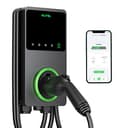
Autel MaxiCharger Home

Autel MaxiCharger Home

A polished 50A unit with Wi-Fi, Bluetooth and a clean app, built to a higher hardware standard than most. The one to look at if you want ChargePoint-grade features and outdoor toughness but want to compare on price.

Buy this if your panel has the headroom
$529.00 · View on Amazon

$599.0012% off

Price as of October 5, 2026. #ad How we’re funded

2
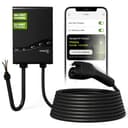
Emporia Pro (48A, hardwired, J1772)

Emporia Pro (48A, hardwired, J1772)

Not a faster charger than the Emporia Classic — Emporia's own comparison puts both at 48A — but a charger you can install where 48A would not otherwise fit. The premium buys PowerSmart load management and the Vue 3 panel monitor it depends on, which throttles charging to whatever headroom your service has left. On a 100A panel that is the difference between charging fast and rewiring the house; on a roomy 200A panel it is a feature you are paying for and will not use.

Buy this if the panel is the problem
$599.00 · View on Amazon

Price as of October 5, 2026. #ad How we’re funded

The picks in full

#1Buy this if your panel has the headroom

Autel MaxiCharger Home

A polished 50A unit with Wi-Fi, Bluetooth and a clean app, built to a higher hardware standard than most. The one to look at if you want ChargePoint-grade features and outdoor toughness but want to compare on price.

Strengths

  • Up to 50A / 12 kW, dial-adjustable to smaller circuits
  • Wi-Fi + Bluetooth, scheduling and access control
  • Solid outdoor build, NEMA 4 rating

Trade-offs

  • Full 50A needs a 60A circuit and hardwiring
  • App occasionally needs a reconnect — connectivity adds a failure point a dumb charger doesn't have
ConnectorJ1772
Max output50 A
Max power12 kW
Cable length25 ft
InstallHardwired; plug-in sold as separate 40A models
Outdoor ratingNEMA 4 (outdoor)
Warranty3 years

Spec note. Autel sells this as the MaxiCharger AC Elite Home 50A. The 50A unit is hardwired — the plug-in NEMA 14-50 and NEMA 6-50 versions are separate 40A models, so the install type is chosen at purchase rather than configured on the wall. The listing we link is the hardwired 50A. Long 25 ft cable reaches across a two-car garage.

Specs read from the product listing, on September 23, 2026. “Not published” means the manufacturer does not state that figure.

#2Buy this if the panel is the problem

Emporia Pro (48A, hardwired, J1772)

Not a faster charger than the Emporia Classic — Emporia's own comparison puts both at 48A — but a charger you can install where 48A would not otherwise fit. The premium buys PowerSmart load management and the Vue 3 panel monitor it depends on, which throttles charging to whatever headroom your service has left. On a 100A panel that is the difference between charging fast and rewiring the house; on a roomy 200A panel it is a feature you are paying for and will not use.

Strengths

  • PowerSmart load management is bundled, not an upsell — the Vue 3 panel monitor it needs is in the box
  • 48A / 11.5 kW hardwired, or 40A on a NEMA 14-50 outlet, from the same unit
  • NEMA 4 rated for indoor or outdoor installation, with a 25 ft cable
  • Rear-entry hardwire option the Classic does not offer, which hides the conduit
  • Solar excess-charging and whole-home energy monitoring in the same app, with no subscription
  • 3-year warranty, and Emporia publishes UL Listed, NEMA rated and ENERGY STAR certification

Trade-offs

  • No faster than the cheaper Emporia Classic — both are 48A, so if you do not need load management you are paying for nothing
  • PowerSmart depends on the Vue 3 sending load data to Emporia's cloud, so the throttling that protects your panel is a connected service, not local hardware
  • The Vue 3 clamps onto your service mains, so an electrician still has to open the panel — 'no panel upgrade' does not mean 'no panel work'
  • Emporia's own “$3,000-$8,000 panel upgrade” saving is the manufacturer's marketing figure, not an independent estimate
  • Emporia does not publish the Pro's ENERGY STAR model number, which rebate forms usually ask for
ConnectorJ1772
Max output48 A
Max power11.5 kW
Cable length25 ft
InstallHardwired (48A); a NEMA 14-50 plug-in SKU runs at 40A
Outdoor ratingNEMA 4 (outdoor)
Warranty3 years

Spec note. Emporia publishes: up to 48A hardwired on a 60A circuit, up to 40A on a NEMA 14-50 outlet (50A circuit), a 25 ft cable, a NEMA 4 indoor/outdoor rating, a rear-entry hardwire option, a 3-year warranty, and UL Listed / NEMA Rated / ENERGY STAR Certified marks. Its own Classic-vs-Pro table lists BOTH models at up to 48A, 25 ft and 3 years — the Pro's differences are PowerSmart load management, the bundled Vue 3 energy monitor, solar and peak-demand features, the square case and rear entry. EPA's ENERGY STAR certified-EVSE database holds one Emporia Corp. family record (EMEVSE1, 48A, 25 ft output cord, 6 AWG, network capability 'Yes', qualified May 2022) covering fifteen further model numbers; Emporia does not publish which one the Pro carries, so confirm the model number with Emporia before filing a rebate that requires it.

Specs read from the product listing, on September 2, 2026. “Not published” means the manufacturer does not state that figure.

The specifications, side by side

Every figure in this table is the manufacturer’s own published number or the live listing’s. Where something is not published, the row says so rather than being filled in.

SpecificationAutel MaxiCharger HomeEmporia Pro
Maximum output50A / 12 kW48A / 11.5 kW hardwired; 40A on the plug-in SKU
Circuit needed at full outputTypically 60A or more — confirm with your electrician60A
InstallHardwired; plug-in sold as separate 40A modelsHardwired (48A); a NEMA 14-50 plug-in SKU runs at 40A
ConnectorJ1772J1772
Cable25 ft25 ft
EnclosureNEMA 4, outdoor ratedNEMA 4, outdoor rated
Whole-home load managementNoYes — panel sensor throttles the car
Energy monitoringCharging sessions via the Autel appWhole-home monitoring via the Emporia app

The 50A versus 48A difference is not the story

It looks like the headline and it is almost irrelevant. 50 amps is 12 kW; 48 amps is 11.5 kW. That is a 4% difference in charging rate, which on an overnight charge you are asleep for amounts to a few minutes.

More to the point, almost no car can use either number fully. The onboard charger inside the vehicle is the real ceiling, and the common ratings are 7.2, 9.6, 11 and 11.5 kW. A car rated at 11 kW draws 11 kW from both of these chargers. The extra 2 amps on the Autel is capacity you are paying nothing extra for and will probably never see.

Where the Autel’s 50A rating does cost you something is the circuit. A higher continuous rating means a correspondingly larger breaker and conductor under the 125% continuous-load rule, and that is an electrician’s question about your particular panel rather than a number we should assert for you. Ask before you buy, because on a constrained service it can be the difference between a straightforward install and a service upgrade. Our amps and circuits guide covers how that calculation works.

Load management is the story

The Emporia Pro puts a sensor on your panel’s main feed and watches the whole house. When the dryer, the oven and the air conditioner run together, it reduces the car’s draw to keep the total under your service rating. When the house goes quiet after midnight, it gives the car everything it has.

That is worth real money in exactly one situation, and nothing at all in the other.

If your service has 60 amps genuinely spare— a gas-heated house with a 200-amp panel, say — load management is managing headroom you already have. You are paying a premium for software that will never need to intervene. Buy the Autel, which is cheaper and faster on paper.

If your service does not, load management is the cheapest way to get a 48A charger installed at all. The alternative is a 32A charger, which is slower, or a service upgrade, which is a four-figure job involving a new panel and usually the utility. Against either of those, the Emporia’s premium is small. Our load management guide explains the mechanism, and our roundup for 100-amp panels is the page if that is your situation.

One honest caveat on the Emporia side: load management depends on the sensor being installed correctly on the main feed, which means the electrician is working inside your panel, and on the charger’s software continuing to work. A charger with no software to fail is a legitimate thing to prefer.

Both are hardwired, and that is a feature

Neither of these is a charger you unplug and take with you, and for a permanent installation that is the better electrical answer. A hardwired charger avoids the GFCI conflict behind most nuisance tripping: NEC 210.8(A) requires GFCI protection for 125- to 250-volt garage receptacles and NEC 625.54 requires it for receptacles installed for EV charging, but a hardwired unit is not subject to that receptacle requirement — and since the charger has its own ground-fault protection, stacking an external GFCI on top is where the false trips come from.

It also removes the receptacle, which is the component that overheats. An ordinary NEMA 14-50 outlet is built for the intermittent loads of ranges and RVs rather than 40 amps held for eight hours a night.

If you rent, or expect to move within a few years, neither of these is the right purchase and the comparison is moot — our roundup for renters covers removable options. Both brands do sell 40A plug-in versions, and on both of them the plug-in variant drops to 40 amps, so you give up the output either way.

The short answer

Ask your electrician one question before you choose: how many amps can my service actually spare? If the answer is 60 or more, buy the Autel MaxiCharger — it is cheaper, it is rated higher, and the load management you are not paying for would have had nothing to do. If the answer is less than 60, buy the Emporia Pro, because it is the only one of the two that can be installed at all without electrical work costing more than the charger.

Our Autel MaxiCharger review and Emporia Pro review cover each unit in full, and Autel versus Wallbox Pulsar Plus is the other comparison the Autel sits in. One buying note: both brands sell direct as well as on Amazon, and the prices are not always the same — we earn a commission on the links here and nothing on the direct ones, and we would still rather you paid less.
Frequently asked questions

Is the Autel MaxiCharger or the Emporia Pro better?

They are close enough that your electrical panel decides it. Both are hardwired, both publish NEMA 4 enclosures, both ship 25 ft cables and both are J1772. The Autel is cheaper and rated 50A against the Emporia's 48A. The Emporia adds whole-home load management, which is what lets a 48A charger run on a service that could not otherwise feed a 60A circuit. Headroom to spare: buy the Autel. No headroom: buy the Emporia.

Does 50 amps charge meaningfully faster than 48?

No. 50A is 12 kW and 48A is 11.5 kW, a 4% difference that amounts to minutes on an overnight charge. It is also capacity most cars cannot use, because the vehicle's onboard charger is the real ceiling and common ratings top out around 11 to 11.5 kW. Treat the 50A rating as a specification detail rather than a reason to choose.

Do I need load management?

Only if your service cannot spare the circuit the charger needs. Have an electrician do a load calculation first. With 60 amps genuinely free you are paying for software that will never intervene. With less than that, load management is cheaper than both a 32A charger's lost speed and a full service upgrade.

Can I get either of these as a plug-in charger?

Both brands sell plug-in versions, and on both of them the plug-in variant runs at 40A rather than the hardwired 48 or 50. So the plug-in route costs you output whichever brand you choose. If removability matters more than speed — because you rent, or expect to move — that is a reasonable trade, but go in knowing you are buying a 40A charger.

Which is better for outdoor installation?

Neither has an advantage on paper: both publish a NEMA 4 outdoor rating, which covers rain, splashing water and hose-directed water. At that point the decision returns to output versus load management. If you want a cast metal enclosure instead of a plastic one, our Emporia versus Grizzl-E comparison covers that trade-off.

Sources

Keep reading