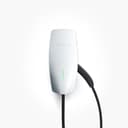
What “Universal” actually means here
It is worth being precise, because the naming causes confusion. Tesla has sold more than one wall charger. The Universalunit is the one with the integrated J1772 adapter — a NACS handle that a Tesla plugs into directly, with a J1772 adapter that stows on the unit and fits over the handle for non-Tesla cars.
The distinction matters when you shop: a Tesla-only Wall Connector will not charge a J1772 car without you supplying an adapter yourself, which is exactly the problem the Universal version exists to solve. Check which one a listing is describing before you buy.
Who this actually solves a problem for
- Two-car households with one Tesla. The clearest case. One charger, one circuit, both cars served properly.
- Anyone who expects their next car to change standards. The industry is midway through the NACS transition and a charger outlives a car. A dual-standard unit is genuinely future-proof in a way a single-connector one is not.
- Households with guests who charge. Rentals, family, a friend who visits with a different badge on the hood.
If every car you own and expect to own uses the same connector, you are paying for a capability you will never use, and our main home charger roundup has better value.
Output, and the circuit it quietly assumes
The unit is rated up to 48A, which is roughly 11.5 kW. Under the 80% continuous-load rule that requires a 60A circuit, and the unit is hardwired— there is no plug-in configuration to fall back on.
Read that as the real precondition of this purchase, not a footnote. Sixty amps is where residential panels start running out of spare capacity. If your electrician says a 50A circuit is what you can have, this charger will still work — it can be commissioned to a lower output — but you are paying a premium for output you cannot use, and you have lost the plug-in flexibility a 40A unit would have given you. Our amps and circuits guide has the breaker table, and our load management guide covers what to do when the panel is the obstacle.
Is 48A worth having?
Honestly: for most drivers, no. At 40A you replace roughly 300 miles of range across a ten-hour night; at 48A, roughly 380. Both are full by morning unless you have a large battery, arrive near empty and leave early.
And a ceiling sits above the charger regardless — your car’s onboard AC charger rating. If it caps below 11.5 kW, no wall charger on earth delivers more. Look it up in your owner’s manual before paying for amps. Our 40A roundup is the case for stopping lower.
Hardwired only: what you give up
This is the honest cost of the design and it deserves more than a line in a cons list.
- It stays with the house. A plug-in charger unplugs and moves with you. This one is part of the building.
- Replacement is an appointment. If a plug-in charger fails you swap it in five minutes. A hardwired failure means an electrician.
- The install is less commodity. A NEMA 14-50 receptacle is an ordinary job most electricians quote quickly; a hardwire termination to a specific charger is a slightly more involved one.
Against that, hardwiring removes the receptacle — a genuine failure point on continuous EV load, and the component most likely to go wrong in a cheap plug-in install. Our plug-in vs hardwired guide weighs it properly, and we compare this exact decision for this exact unit in Tesla Wall Connector vs a NEMA 14-50 outlet.
Connectivity and the app
Wi-Fi, scheduling and integration with the Tesla app. If you already live in that app for the car, having the charger in the same place is genuinely tidy — fewer accounts, one interface.
The test we apply to every connected charger applies here too: can your car already schedule its own charging?Most modern EVs can, from the car, which removes the usual headline reason to pay for connectivity. What a car cannot do is manage household electrical load or measure the circuit — those are the features that justify a smart charger on their own. Our smart charger roundup sets out the test in full.
One thing worth verifying for any connected unit before purchase: that it charges with no network connection. Losing scheduling in an outage is an inconvenience; losing the ability to charge is not acceptable, and it is not universally true of cheaper connected chargers.
Build, enclosure and cable
The unit is outdoor-rated and the housing is well-made by the standards of this category. The cable length published in the spec table above is generous and matters more than most buyers expect — measure from where the junction box will go to where your charge port sits when the car is parked the way you actually park it, then add slack.
Two low-cost additions that extend the life of any outdoor install more than a better charger would: a holster to keep the connector off the ground and out of the grit, and shade or a coveragainst UV — which is what actually ages outdoor charging hardware, not rain.
Who should buy something else
Single-standard households. If every car uses J1772, a good 40A plug-in charger does the same job for less and comes off the wall when you move.
Anyone without a confirmed 60A circuit. Get the load calculation first. If the answer is 50A, buy a 40A charger and spend the difference on a proper industrial receptacle.
Renters and anyone likely to move soon. Hardwired hardware stays behind. Our renters roundup covers what to buy when you do not own the wall.
Tesla-only households on a budget. The integrated J1772 adapter is the premium you are paying, and you will not use it. Our NACS charger roundup covers the factory-NACS field without it.
The verdict
A genuinely distinctive product in a category where most units are interchangeable. The dual-connector handle solves a real, daily, physical annoyance that no competitor addresses, and if you have a Tesla and something else on the same driveway it is the tidiest hardware answer available — assuming you have a confirmed 60A circuit and have accepted that it is a permanent fixture.
The practical problem is buying one at a sensible price. As of 16 September 2026 the Amazon offer comes from a third-party seller rather than Tesla, so price Tesla’s own shop first. The cheaper route is the standard Wall Connector, the same hardware with a NACS-only handle, plus a NACS-to-J1772 adapter for the second car — but Tesla’s manual for that unit cautions against using adapters. Our side-by-side comparison of the two weighs exactly that trade.