Amp & Adapter

EVIQO Level 2 EV Charger Review

A wall-mounted 40A charger on a plug, from a young brand at a serious price — what the listing publishes, what it doesn't, and who should buy the 48A sibling instead.

By Stephen V.Last updated How we rank

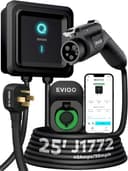
The EVIQO occupies a gap that is smaller than it should be. Most 40A chargers are either premium units whose real capability is 48A hardwired — so you are paying for headroom the plug prevents you from using — or portable bricks with a wall bracket bolted on as an afterthought. The EVIQO is a purpose-built wall station that runs on a NEMA 14-50 plug, and that combination is the one most home buyers actually want.

We have already covered EVIQO’s native-NACS version in our Tesla home charger roundup. This is the J1772 model, for everything that is not a Tesla — and for Tesla owners who would rather buy a J1772 charger and an adapter than commit to one connector.

One thing to be clear about up front: this listing publishes less than ChargePoint or Emporia do. It states its amperage, its connector and its plug type; it does not state a cable length, an enclosure rating or a warranty term in a form we can verify. Those read “Not published” in the table below rather than being filled in with a plausible number. We own no units and have run no bench tests — everything here is read from the published listing on the date shown under the pick.

How this is funded: we earn a commission if you buy through our links, at no extra cost to you. It never changes which product we recommend, and we’ll tell you plainly when we’d skip one. Full disclosure.

Quick picks

Ranked on published specs, install flexibility and buyer fit. Select a row to jump to the full write-up. We have not bench-tested these units — here is exactly what we do instead.

#ProductBest forPrice
1
EVIQO Level 2 J1772 Charger (40A, Plug-in)

EVIQO Level 2 J1772 Charger (40A, Plug-in)

The J1772 sibling of the NACS unit we already rate, and the same argument applies: 40A on a NEMA 14-50 plug is the install almost everyone should be doing, and this is a wall-mounted charger rather than a portable pretending to be one. Buy it if you want a permanent box without an electrician's hardwire bill.

Our pick — best overall 40A
$395.98 · View on Amazon

$469.9916% off

Price as of September 2, 2026. #ad How we’re funded

The picks in full

#1Our pick — best overall 40A

EVIQO Level 2 J1772 Charger (40A, Plug-in)

The J1772 sibling of the NACS unit we already rate, and the same argument applies: 40A on a NEMA 14-50 plug is the install almost everyone should be doing, and this is a wall-mounted charger rather than a portable pretending to be one. Buy it if you want a permanent box without an electrician's hardwire bill.

Strengths

  • 40A / 9.6 kW is the amperage sweet spot — a full overnight charge for any car on the road
  • Plugs into a NEMA 14-50 outlet, so there is no hardwiring and it comes with you if you move
  • Purpose-built wall-mounted station, not a portable unit hung on a bracket

Trade-offs

  • 40A is the ceiling — there is no upgrade path to 48A the way the Emporia has
  • EVIQO is a young brand; long-term firmware and support are the open question
  • The listing does not publish an enclosure rating or warranty term
ConnectorJ1772
Max output40 A
Max power9.6 kW
Cable lengthNot published
InstallPlug-in (NEMA 14-50)
Outdoor ratingNot published
WarrantyNot published

Spec note. The listing publishes 40A, 240V, a J1772 connector and a NEMA 14-50 plug on a wall-mounted station. It does not publish a cable length, enclosure rating or warranty term in the title, so those read as not published here. A 40A charger requires a 50A circuit under the 80% continuous-load rule.

Specs read from the product listing, on August 11, 2026. “Not published” means the manufacturer does not state that figure.

Who it’s for

The EVIQO suits the buyer who has decided two things: that 40A is enough, and that they do not want to pay an electrician to hardwire anything. That is a much larger group than the market serves well. Forty amps delivers roughly 9.6 kW, which is about 30 miles of range per hour — over 300 miles across an overnight charge. Unless you arrive home near empty and need a full battery before dawn, that is simply “full by morning”. Our 40A roundup makes the full case for this amperage.

It also suits anyone installing into a rental or a house they might leave. A plug-in charger unplugs. A hardwired one is a permanent improvement to a building. Our renter charging guide covers that decision in more depth.

Who should buy something else

If you want an upgrade path, buy the Emporia.This is the EVIQO’s clearest weakness. It is a 40A unit and it stays a 40A unit. The Emporia ships configured for a NEMA 14-50 plug at 40A and can be converted to a hardwired 48A install later — so if you are not yet sure what circuit you will end up with, that flexibility is worth real money. Our Emporia review covers it.

If your panel is uncertain at the low end, buy the ChargePoint. The Home Flex configures down to 16A, which means it can live on a small branch circuit in an old house. A fixed-40A charger on a 30A circuit is a charger you cannot legally run at rated output. See the Home Flex review.

If you have confirmed 60A headroom, look at the EVIQO 48A instead. EVIQO sells a hardwired 48A sibling at a modest premium. It is the same argument as this unit — a lot of charger for the money from a young brand — with the extra amperage and the electrician’s bill that comes with it.

What the specifications actually mean

40A on a NEMA 14-50.This is the important line. A 40A continuous draw requires a 50A circuit under the National Electrical Code’s 80% rule, and a 50A circuit is exactly what a NEMA 14-50 receptacle sits on. That means no compromise: unlike a 48A charger throttled to 40A by its plug, this unit is running at its designed output. Our amps and circuits guide explains the rule.

Wall-mounted, not portable. The practical difference is cable management and how it lives on the wall. A portable unit hung on a bracket has its plug cord dangling and its body clamped in a cradle; a purpose-built station is designed to sit flush with the cable routed properly. On a charger you will look at every day for a decade, that matters more than the spec sheet suggests.

J1772 connector.The standard AC connector for every non-Tesla EV sold in North America, and one a Tesla can use with a cheap adapter — see our J1772-to-Tesla adapter roundup. If you own only Teslas and always will, EVIQO’s native NACS version avoids the adapter entirely. If your household has, or might have, a mixed fleet, the J1772 unit plus a $40 adapter is the more flexible purchase. Our connectors guide untangles the whole picture.

What the listing does not tell you

Three gaps are worth naming, because they are the questions we would ask before buying:

  • Cable length is not published in the title.This is the single most common regret in the category. A cable that will not reach a charge port on the far side of the car makes the whole install useless. Measure the actual path — down the wall, across the floor, around the vehicle — and confirm the length on the listing page before ordering.
  • No enclosure rating is published here.EVIQO’s NACS model publishes IP66 / NEMA 4, but we will not transfer a rating between SKUs. If this charger is going on an exterior wall, confirm the rating first — our outdoor charger roundup explains what the numbers mean.
  • No warranty term is published. On a young brand this is the spec we would most want to see, because warranty length is a manufacturer betting its own money on its failure rate.

The brand question

EVIQO is new. That is not an accusation — the products are certified, the listings are detailed, and the pricing is genuinely competitive. But a charger is a ten-year purchase mounted to a wall, and the thing you are really buying from ChargePoint or Wallbox is the likelihood that someone answers the phone in 2032. A young brand cannot yet demonstrate that, and no amount of specification substitutes for it.

How much that matters depends on the unit. For a simple non-connected charger, failure means buying another box, and a plug-in unit makes that a five-minute swap rather than a service call — which is a genuine argument for the plug-in form factor here. The risk is much higher on chargers that depend on a cloud account to function; if the company folds, those can become expensive wall ornaments. Verify that any connected charger will start a session with no network before you buy it.

Certification is the line we will not cross

Whatever else you weigh, do not buy a Level 2 charger that will not name its certification body in plain text. UL and ETL listings mean an independent lab tested a device that draws its full rated current continuously for hours, unattended, on the wall of your house. The EPA’s ENERGY STAR program publishes a searchable list of certified EV chargers, and checking a model against it takes under a minute. That is the cheapest insurance in this entire purchase.
Frequently asked questions

Is the EVIQO 40A charger fast enough?

For nearly everyone, yes. 40A delivers about 9.6 kW, or roughly 30 miles of range per hour — over 300 miles across an overnight charge. The exceptions are very large batteries on short charging windows, or two EVs sharing one charger, which is where 48A starts to matter.

Can the EVIQO J1772 charger be hardwired for more amps?

No. This is a fixed 40A plug-in unit and there is no upgrade path. If you want the option of 48A later, the Emporia ships on a plug at 40A and converts to hardwired 48A, and EVIQO sells a separate hardwired 48A model. Buying for a future you have not confirmed is the more common mistake, though — 40A is enough for most homes.

Can I use the EVIQO J1772 charger with a Tesla?

Yes, with a J1772-to-NACS adapter, which costs around $40 and is the single most useful accessory a Tesla owner can buy. If your household will only ever have Teslas, EVIQO's native NACS version avoids the adapter. If the fleet is or might be mixed, the J1772 unit plus an adapter is the more flexible purchase.

What circuit does the EVIQO 40A need?

A 50A circuit with a NEMA 14-50 receptacle. EV charging is a continuous load, so the code limits the draw to 80% of the circuit rating, and 80% of 50A is 40A. Use an industrial-grade receptacle — cheap 14-50 outlets are a documented failure point under sustained EV load.

Is the EVIQO rated for outdoor installation?

The listing we read does not publish an enclosure rating for this J1772 model, so we will not claim one — EVIQO's separate NACS model publishes IP66 / NEMA 4, but ratings do not transfer between SKUs. If the charger is going on an exterior wall, confirm the rating on the listing page first.

Sources

Keep reading