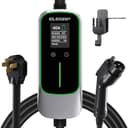
The one thing it does not compromise
It is ETL certified. This is the line we will not cross on a charger recommendation, and it is why this unit is here while most things at this price are not.
An ETL listing means Intertek — an independent, nationally recognized testing laboratory — tested the device against the applicable safety standard. UL listing means the same from Underwriters Laboratories. Either is acceptable. What is notacceptable is a listing that says only “certified”, or names a mark that is a self-declaration rather than a lab test, or says nothing at all.
The reason this matters more here than on almost any other consumer purchase is the duty cycle. A Level 2 charger draws its full rated current, continuously, for eight to twelve hours, unattended, usually in an attached garage, several nights a week, for a decade. Very few household devices work that hard. The EPA’s ENERGY STAR program publishes a searchable list of certified EV chargers, and cross-checking a model against it takes under a minute. Do that before buying anything, including this.
Where the money was saved
No app, no Wi-Fi, no scheduling.This is the largest single saving and, for most buyers, the least consequential. The main thing a charger app buys you is scheduling to off-peak electricity rates — and most modern EVs can schedule charging from the car’s own screen, for free, in a way that works at any charger you plug into. Check your car first. If it can set a departure time or charging window, a charger app is a duplicate feature. Our smart charger roundup works through what connectivity is genuinely worth.
No published enclosure rating.The listing does not state a NEMA or IP rating, so we treat this as an indoor / garage charger. If your charger is going on an exterior wall, this is the specification that should move you to a different unit — our outdoor charger roundup covers what those ratings actually mean and which units genuinely hold them.
No published warranty term. Worth naming plainly, because a warranty length is a manufacturer betting its own money on its failure rate. The practical mitigation here is the form factor: a plug-in charger that fails is a five-minute swap, not a service call. That is a real argument for plug-in units at the budget end, and it is covered in our plug-in vs hardwired guide.
Brand depth.ELEGRP makes electrical fixtures competently and has a real corporate existence, but it does not have ChargePoint’s decade of EV-specific service history. On a non-connected charger this matters much less than it would on a cloud-dependent one — there is no account to lose access to and no server that has to stay up for your car to charge.
What it does not skimp on: the cable
A 25 ft cable at this price is genuinely notable, and it is the second reason this unit is worth your attention. Cable length is the most under-rated specification in the category and the source of the most common regret. Buyers fixate on amperage — a difference of eight miles of range per hour they will never notice — and then discover that a 16 ft cord cannot reach a charge port on the opposite side of the car from where the outlet is.
Before buying any charger, walk the actual cable path: down the wall, across the floor, around the vehicle to the port, plus slack so the cable is not under tension. Add a couple of feet. If the answer is more than the charger’s cable, either move the charger, buy a longer-cabled unit, or add a properly rated extension — our cables and extensions guide covers doing that safely.
One caveat on budget cables
Cheaper cables are stiffer, and stiffness gets dramatically worse below freezing. In a cold garage in January, a budget cable can be genuinely hard to coil, and forcing a stiff cable is how jackets crack. If you live somewhere with real winters, our cold weather charging guide covers what actually changes — and a wall hook or holster costing a few dollars keeps the cable off a cold concrete floor, which helps more than people expect.
Who should buy it, and who should not
Buy it if the budget is the binding constraint, you already have or are getting a NEMA 14-50 outlet, the charger is going in a garage rather than on an exterior wall, and either your car handles its own charge scheduling or your utility has no time-of-use rates. That is a large and entirely reasonable set of people, and they should not feel they are settling.
Buy something else ifany of the following are true. If the charger is going outside, buy a unit with a published outdoor rating. If your panel is uncertain and you might end up on a smaller circuit, buy a charger that configures down — the Grizzl-E Classic Connect adjusts from 16A to 40A (the plug-in ChargePoint Home Flex on Amazon as of 20 September 2026 does not go below 32A). If you might want 48A later, buy the Emporia, which converts from a 40A plug to a 48A hardwired install. And if your utility has genuine off-peak pricing and your car cannot schedule itself, the app on a smarter charger will pay for the price difference.
Do not forget the outlet
If you are saving money on the charger, do not then save money on the receptacle. A continuous 40A EV load is far harder on a NEMA 14-50 outlet than the oven the cheap ones were designed for, and overheated and melted receptacles are a well-documented failure mode in home EV installs. An industrial-grade 14-50 costs very little more than a bargain one and is the single best few dollars in the whole project — see our NEMA 14-50 outlet guide.