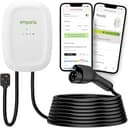
Who it’s for
The Emporia suits the buyer who has not yet had the conversation with an electrician. That is a much larger group than the industry admits. You do not know whether your panel will take a 60A circuit, you do not know what the run to the garage will cost, and you would rather not commit to a charger before you know. Buying the Emporia lets you start on a NEMA 14-50 outlet at 40A — the cheaper, simpler install — and step up to 48A hardwired if and when it turns out to be worth it.
It also suits anyone who wants energy data without paying premium prices for it. Emporia’s wider product line is home energy monitoring, and the charger slots into that ecosystem, which is a more coherent story than most charger apps manage.
Amperage and the circuit it demands
Out of the box on its plug, this is a 40A charger, which needs a 50A circuit under the 80% continuous-load rule and delivers roughly 38 miles of range per hour by published figures — over 300 miles across an overnight charge. Hardwired at 48A it needs a 60A circuit and delivers roughly 46 miles per hour.
Read that gap carefully before paying for the bigger install. It is about 20% more power, and both numbers comfortably exceed normal daily driving. The 48A configuration earns its keep in two situations: a genuinely short charging window, or two EVs sharing one charger. Otherwise the 40A plug-in setup is not a compromise, it is the correct answer. Our amps and circuits guide has the full breaker table, and our 48A charger roundup works through whether you need this tier at all.
The vehicle limit nobody checks
Your car’s onboard AC charger caps what it can accept, and plenty of EVs stop at 32A or 40A regardless of the wall unit. If yours does, the 48A conversion buys you nothing at all. Check the owner’s manual for the specific model year before you pay an electrician to run heavier wire.
Build and outdoor rating
The Emporia carries a NEMA 4enclosure rating, which is a real outdoor rating rather than a marketing claim — protection against windblown dust and splashing or hose-directed water, a step above the NEMA 3R found on several competitors. That makes it legitimately suitable for an exterior wall, not just a garage. It is one of the picks in our outdoor charger roundup for exactly that reason.
If you are mounting outdoors, the usual caveats apply regardless of the rating: a drip loop so water runs off rather than in, a weatherproof in-use cover if you are plugging into an outdoor receptacle, and an awareness that any EVSE cable stiffens considerably below freezing.
The app, honestly assessed
Emporia’s scheduling and energy tracking are useful if your utility has time-of-use pricing — shifting a full charge from peak to off-peak is the single largest recurring saving available to a home charger owner, and it is entirely a software feature. Our cost-to-charge guide shows how much that shift is actually worth at your rate.
But be honest about duplication. Most modern EVs schedule charging from the car’s own screen, for free, with no account and nothing to reconnect to Wi-Fi. If your car does that well, the app is a second way to do something you already have. Connectivity is also the most common source of charger complaints across every brand in this category — a feature that can drop offline is a feature that can annoy you. If none of it appeals, the Grizzl-E Classic does the core job with no connectivity at all.
What we’d change
The conversion from plug-in to hardwired is a genuine strength, but it is an electrician’s job rather than a switch you flip — budget for a second visit if you take that path, and factor it into whether starting at 40A really is cheaper for you overall. We would also like a longer published warranty; three years is competitive rather than generous in a category where the units are expected to last a decade on a wall.
The alternatives
If you want the most mature app, the ChargePoint Home Flex has the longest software track record — though the model on Amazon as of 20 September 2026 is the 40A plug-in, not the 16–50A hardwired unit; the two are compared directly in our Emporia vs ChargePoint comparison. If you want the least charger for the least money and no app at all, the Grizzl-E is the value answer, and the cheapest certified units are in our budget roundup. And if you drive a Tesla, Emporia sells the same unit with a factory NACS connector — see our Tesla charger roundup.
Emporia also sells a step-up model, the Pro, and it is worth knowing what it is before you assume it is faster: it is not. Emporia’s own comparison puts both at 48A with the same 25 ft cable and the same 3-year warranty. The premium buys PowerSmart load management and the panel monitor that runs it, which can fit a 48A charger onto a service that cannot spare a 60A circuit. Our Emporia Pro review works through who that is genuinely worth it for — and why most people with a roomy 200A panel should stay on this page.