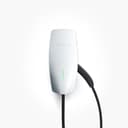
The specifications, side by side
Every figure in this table is the manufacturer’s own published number, the live listing’s, or EPA’s certification record. Where something is not published, the row says so rather than being filled in.
| Specification | Wallbox Pulsar Plus | Tesla Wall Connector |
|---|
| Maximum output | 48A / 11.5 kW | 48A / 11.5 kW |
| Connector | J1772 | NACS (Tesla) |
| Install at full output | Hardwired on 60A; a 40A plug-in variant exists | Hardwired on 60A only — Tesla’s manual does not permit a cord-and-plug connection |
| Cable | 25 ft | 24 ft published; 22 ft on the ENERGY STAR record |
| Enclosure | NEMA 3R (indoor/outdoor) | Approved for indoor or outdoor installation |
| Warranty | 3 years | 4 years residential (48 months from invoice) |
| Circuit sharing between two units | Yes — Power Sharing, plus Power Boost | Yes — load management across Tesla units |
| ENERGY STAR | Not confirmed in EPA’s dataset by us | Yes — model 1457768, 48A / 11.52 kW, qualified 18 September 2023 |
| Physical footprint | The smallest 48A housing in its class | 13.6 × 6.1 × 4.3 in, about 10 lb with wirebox |
The connector is the decision
Everything else on this page is a footnote to this section.
The Tesla Wall Connector ends in a NACS handle. A Tesla plugs into it with nothing dangling off the connector, which is genuinely nicer to live with every night than an adapter joint at the car. Any other EV — a Ford, a Hyundai, a BMW, a Chevy — needs an adapter to use it, and Tesla’s own Gen 3 installation manual states in its safety section that no adapters or conversion adapters are allowed to be used. Tesla also excludes damage from the “use of non-genuine Tesla accessories or parts” from its charging-equipment warranty.
You can read that strictly or loosely, but you cannot read it as encouragement. If your household is mixed, or might become mixed, Tesla sells a unit designed for exactly that — the Universal Wall Connector, which docks Tesla’s own J1772 adapter on the side of the box, released by a button on the adapter. That is a supported arrangement rather than a workaround, and we compare the two in Wall Connector vs Universal Wall Connector.
The Pulsar Plus ends in J1772, which is the North American Level 2 standard. Every non-Tesla EV plugs straight in, and a Tesla plugs in through the J1772 adapter Tesla supplies with the car. That is one adapter, at the car end, on a cable you are already handling — and it is the arrangement millions of Teslas use at public Level 2 stations every day. Our J1772 to Tesla adapters page covers the spares if the original has wandered off.
Price, and what the gap buys
The Wallbox is the cheaper unit, and the gap is not small. What the Tesla premium buys, concretely: the native handle, an extra year of warranty, a certification record you can look up in EPA’s database under model 1457768, and integration into the app you already have open for the car. What it does not buy is more power — both units are 48 amps.
For a two-Tesla household that premium is defensible, because scheduling, load management and charge history all live in one place. For a single Tesla where the charger is just a cable on a wall, it is a lot of money for a plug shape.
Power Sharing, the Wallbox’s real advantage
If two EVs will eventually share one circuit, the Pulsar Plus has the cleaner answer. Power Sharing lets two Pulsar Plus units split a single circuit between them, so a second car does not mean a second 60-amp run. Power Boost adds whole-home awareness, so the charger backs off when the house is drawing hard.
Tesla has load management across its own units too, so this is an advantage rather than a monopoly — but the Wallbox gets you there with J1772 handles, which means the two cars sharing the circuit do not both have to be Teslas. Our two-EV page works through the options, including the single-charger routes.
The install is the same bill, with one exception
Both units are hardwired on a 60-amp circuit for 48-amp output, so the electrician’s quote is broadly the same: a 60A double-pole breaker, the run to the garage wall, and the box mounted. Our installation cost guide covers what that typically involves.
The exception is the fallback. The Pulsar Plus has a 40A plug-in variant, so if your panel turns out not to have 60 amps spare, there is a version of this purchase that plugs into a NEMA 14-50 and runs at 40 amps. The Tesla Wall Connector has no such route — its manual explicitly rules out a cord-and-plug install — so if the load calculation comes back tight, you are shopping again. Worth knowing before the electrician visits rather than after. Our 100-amp panel page is the right read if you suspect that is you.
The cable, and the figure that differs
Wallbox publishes 25 ft. Tesla publishes 24 ft — and EPA’s ENERGY STAR record for model 1457768 says 22 ft. We do not know which measurement convention produced each number, so we report both rather than picking one.
If reach is tight, plan around 22 ft for the Tesla and measure the real path: down the wall, along the floor, around the car to the side the port is on, up to the port, plus three feet of slack. Teslas take the cable at the rear left, which is often the far side from a wall-mounted charger. Our long-cable roundup covers the units that buy you more reach if neither of these is enough.
The short answer
Tesla-only garage, hardwiring anyway, want the tidiest possible nightly routine: the Tesla Wall Connector earns its premium. Anything else — a non-Tesla EV, a mixed household, a panel you are not sure about, two cars that will share a circuit, or simply a preference for keeping several hundred dollars — the Wallbox Pulsar Plus is the better buy and gives up nothing electrically.
One buying note. Both brands sell direct as well as on Amazon and the prices are not always the same. We earn a commission on the links here and nothing on the direct ones, and we would still rather you paid less — check both.