The parking problem, which is the real story
Superchargers were laid out for Tesla vehicles, whose charge port sits at the rear left. Stalls are arranged so a Tesla reverses in and the short cable reaches that corner. A BMW’s port is on the right side, which puts it on the wrong side of the car relative to the post.
In practice, BMW owners commonly end up pulling in nose-first at an angle, reversing into an adjacent bay, or straddling two stalls to get the cable to reach. At a quiet site this is a mild inconvenience. At a busy one during a holiday weekend it is genuinely awkward, and occupying two stalls when people are queuing is the kind of thing that makes you unpopular. Newer Supercharger installations have addressed cable reach, but coverage is uneven and you cannot assume it at an arbitrary site.
Plan for it rather than discovering it: check the site in the Tesla app before committing to it as your charging stop, and have a CCS alternative in mind. The DOE’s Alternative Fuels Data Center station finder is useful for seeing what else is nearby.
Adapter weight on the port
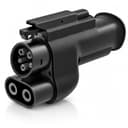
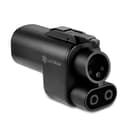
An adapter adds length and mass to the end of an already heavy DC connector, and all of it levers on your charge port. On a car where you may already be plugging in at an odd angle because of the reach issue, that leverage gets worse. Support the connector with a hand while seating it, and rest the assembly rather than letting it hang for a forty-minute session.
How to verify compatibility before you buy
1. Look at your charge port.If your BMW has a native NACS port, you plug straight into a Supercharger and do not need this adapter — you may instead want the opposite direction for CCS stations.
2. Check BMW’s own adapter route.Where an automaker supplies or endorses an adapter for its vehicles, that is the one to use: it has been validated against your car’s charging hardware and it keeps warranty questions simple. Third-party units are for owners without that option, or who want a spare in the trunk.
3. Confirm enrollment and the specific site.Non-Tesla Supercharger access is account-based and granted site by site. The Tesla app and BMW’s own app are the authorities on which locations will serve you.
4. Then choose the adapter, prioritizing a listing that names UL 2252, the safety standard for EV coupler adapters. This is the highest-current part an EV owner handles, and our main NACS-to-CCS roundup ranks the category on certification ahead of price for that reason.
What to expect from the session
Superchargers were engineered around Tesla’s pack voltage, and non-Tesla vehicles do not always match it cleanly. Combined with the normal DC taper — every EV slows steeply past roughly 50–60% state of charge to protect the battery — a Supercharger session may deliver less than the peak figures on either the car’s spec sheet or the stall.
That is expected behavior rather than a fault, and no adapter changes it: an adapter is a passive connector translator, not a converter. The value of Supercharger access for a BMW is coverage— a large, reliable, well-maintained network in places where CCS options are thin or out of order. Our AC vs DC charging guide explains the taper and the architecture question in full.
Most of your charging still happens at home
Worth remembering while shopping for a DC adapter: for nearly every owner, the overwhelming majority of charging is done overnight on a Level 2 charger at home, and public DC fast charging is a road-trip tool. If your home setup is not sorted yet, that is where the money makes the biggest difference to daily life — our home charger roundup covers the Level 2 units worth buying, the BMW charger page narrows it to the amperage BMW itself builds its own equipment around, and the amps and circuits guide explains how to size one to your panel.
One safety note that belongs with any adapter purchase: our guide to whether EV adapters are safe covers why a well-made one cannot override the car’s own handshake, and the four things that genuinely do go wrong.
What we would skip
Skip any adapter that publishes no voltage rating and names no standard. Skip buying before checking the port, the account and the site. And skip planning a road trip entirely around Superchargers on a right-port car without confirming cable reach at the specific sites you intend to use.