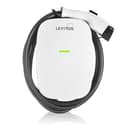
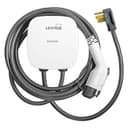
What Leviton publishes
Start here, because it is the EV320’s real distinction. Most chargers in this price range publish an amperage, a cable length and a vague certification claim. Leviton publishes a specification sheet, and it is a long one. Read from leviton.com/products/ev320:
- 32 A, 208/240 VAC, “7.6kW Output”, on a 40 A breaker.
- “18 ft. (5.5 m)” cable, hardwired only — Leviton’s spec sheet puts that in capitals.
- Plastic (PC+PBT) enclosure, NEMA Type 3R, rated -30 °C to 50 °C.
- A “20 mA CCID per UL 2231”— the charge-circuit interrupting device, the part that is supposed to notice a ground fault and open the circuit.
- “Optional access control; station comes with RFID disabled”.
- “Energy Star Certified” and a “2-Year Limited” warranty.
- A standards line reading: UL 2594, UL 2231-1, UL 2231-2, UL 2251, UL 62, UL 991, UL 1998, NFPA 70 Article 625, UL 840, CSA Std. C22.2#280, OCPP 1.6 Compliant, cETLus.
That standards line is the longest we have recorded for any charger on this site, and it is worth knowing what the entries do. UL 2594 is the standard for electric vehicle supply equipment itself. UL 2231-1 and -2cover personnel protection systems — the CCID above. UL 2251 is the plug, receptacle and coupler standard. UL 991 and UL 1998 are tests for safety-related control systems and for the software inside them, which is a level of disclosure most brands do not bother with. Our certification guide explains which of these marks actually mean a lab tested the thing.
One more: EPA’s ENERGY STAR certified-EVSE dataset lists model EV320 by model number, qualified 2022-10-24, with an 18 ft cord on the record. That matters more than a logo on a box. A charger “ENERGY STAR certified” in a bullet point and a charger that appears in EPA’s own machine-readable dataset under its own model number are different standards of evidence, and the EV320 clears the higher one — see our ENERGY STAR roundup, which is built from that dataset.
OCPP 1.6 on a charger with no radio
The oddest line in that specification list is “OCPP 1.6 Compliant”. OCPP is the Open Charge Point Protocol — the open standard a charger uses to talk to a management backend, the thing commercial and fleet operators run their sites on. It is unusual on a residential unit and distinctly unusual on one Leviton also tells you has no Wi-Fi.
Leviton does not publish, on that page, how an EV320 is meant to reach an OCPP backend without a radio. We are not going to invent a mechanism. What we can say is what the line is useful for: if the charger is ever commissioned into a managed environment — a small fleet, a workplace bay, a multi-unit building — being an OCPP 1.6 device means it speaks the standard rather than a proprietary cloud. For a single household it is a line on a sheet that will never affect you, and it should not be part of your purchase reasoning.
The RFID line is similar and more immediately practical. The station ships with RFID disabled, and access control is optional. On a home charger in a locked garage that is exactly the right default. On a shared driveway, a duplex or a small apartment building, a card-tap to start a session is a real feature, and the EV320 is one of the few consumer-priced units that has it — worth knowing if you are the landlord in our rental-property guide.
The three specs that cost it the recommendation
18 feet of cable
This is the EV320’s most consequential weakness and it has nothing to do with electricity. 18 feet is the shortest cable in our 32-amp roundup, and roughly the shortest in the category — 25 feet is the going rate, and Leviton’s own EV40P ships 25.
Eighteen feet routes from the wall, down, across the garage floor and up to a charge port. It does that comfortably if the charger is on the right wall and the car parks nose-in with the port on the near side. It does not do it if you ever park the other car in that bay, if the port is on the far corner, or if you back in. Measure the actual path — wall to port, following the route the cable will take, not the straight line — before you buy an 18-foot charger. Our long-cable roundup exists because this is the single most common regret in the category, and it gets worse in winter when the cable stiffens: see chargers for cold weather, where the EV320 does well on every criterion except this one.
A two-year warranty
Leviton publishes “2-Year Limited”. In a category where three years is normal and five years is available — Enphase publishes five on the IQ 40, Grizzl-E offers a three- or five-year choice — two years is short for a permanently installed appliance that you are paying an electrician to attach to your house. The labor to replace a hardwired charger is not trivial, and the warranty is what decides whether you pay it in year three.
This is not a quality judgment. Leviton is a century-old wiring-devices manufacturer and we have no evidence these units fail. It is a risk-allocation judgment, and on paper Leviton has allocated more of it to you than its rivals have.
32 amps, at a price where 40 is available
32 amps on a 40-amp circuit is a perfectly sensible amount of charging — about 7.6 kW, which fully refills nearly any EV overnight, and our 32-amp roundup is built on the argument that it is the right purchase for a panel that cannot spare a 50-amp circuit. The problem is purely positional: the EV320 sits at the top of the 32-amp price range, close to or above units that deliver 40 or 48 amps. If your panel genuinely cannot take more than a 40-amp circuit, the amperage is not a flaw at all. If it can, you are paying a premium to receive less power.
Hardwired only, which is genuinely a feature
The EV320 cannot be plugged in. Leviton is emphatic about it, and in a cold or wet climate that constraint is worth something.
A plug-in charger sits behind a NEMA 14-50 receptacle, and NEC 625.54 requires GFCI protection for receptacles installed for EV charging, with NEC 210.8(A) requiring it for 125- to 250-volt garage receptacles generally. A charger’s own ground-fault protection — the 20 mA CCID Leviton publishes — can conflict with an external GFCI breaker, and the result is the nuisance tripping you will find in every owner forum. A hardwired charger is not subject to the 625.54 receptacle requirement at all. It also removes a connection that carries 32 amps continuously for hours every night, which is the part of a plug-in install that wears.
The cost is permanence and an electrician. The charger stays with the house when you move, and you cannot take it to a second property. Our plug-in versus hardwired guide works through the trade-off, and installation cost covers what the hardwire adds if there is no circuit yet.
The Leviton line, and which one you actually want
Leviton sells several closely related Level 2 chargers and the naming does not make the differences obvious. What we found live on Amazon when we checked:
| Model | Output | Install | Cable | Wi-Fi |
|---|
| EV320 (this review) | 32A / 7.6 kW | Hardwired | 18 ft | No |
| EV32W | 32A / 7.6 kW | Hardwired | 18 ft | Yes, My Leviton app |
| EV40P (pick two) | 40A / 9.6 kW | NEMA 14-50 plug | 25 ft | Yes, My Leviton app |
| EV48W | 48A / 11.6 kW | Hardwired | 18 ft | Yes, My Leviton app |
Two things fall out of that table. First, the EV40P is the odd one out in the best way: it is the only one with a 25-foot cable and the only plug-in, and it was the cheapest of the four when we looked. Second, every hardwired Leviton ships 18 feet of cable regardless of amperage, so going up the range does not buy you reach.
We have registered the EV40P as pick two and we link it. We have notgiven the EV32W or the EV48W product cards, for one reason: both showed very thin stock when we checked — the EV32W at three units and the EV48W at one. We do not build buy links around listings that may be gone by the time you click. If you want the Wi-Fi 32-amp or the 48-amp hardwired Leviton, search the model number directly and check availability yourself. For a 48-amp charger with deeper supply, our 48-amp roundup is the better starting point.
Who should buy the EV320
- You want a hardwired charger with no radio in it. No account, no app, no firmware, nothing to lose Wi-Fi at 2 a.m. Schedule charging in the car, which knows its own state of charge anyway. Our no-Wi-Fi roundup makes the case at length; the EV320 is the best-documented unit on it.
- Your panel can spare a 40-amp circuit and not a 50.Then 32 amps is the correct purchase and the amperage objection above does not apply to you — see chargers for a 100-amp panel.
- Documentation and certification are what you are buying. For a permit, an inspector, a rebate that needs an ENERGY STAR model number or a landlord who wants a paper trail, this is the easiest charger on the site to justify.
- You want optional RFID access control on a shared driveway or a small multi-unit property, and you want it switched off by default.
Who should not
- Anyone with a NEMA 14-50 outlet already in place. Buy the EV40P: more amps, more cable, an app, no electrician.
- Anyone whose cable run is longer than about fifteen feet of real path. Eighteen feet of cable disappears faster than people expect.
- Anyone who weights warranty heavily. Two years is the shortest term among chargers we would otherwise recommend.
- Anyone who needs load management to fit a charger onto a tight service. Leviton publishes no such feature here; the Emporia Pro ships the panel monitor that does it, and our load-management guide explains when it is the thing that makes the project possible.
The short answer
The EV320 is the most thoroughly documented 32-amp charger we have registered, from a manufacturer with a century of electrical devices behind it, and it is the right buy if you specifically want a hardwired unit with no radio on a 40-amp circuit. For everyone else, Leviton already sells the better answer in the EV40P — more current, a longer cable, an app, a plug — and it was cheaper when we checked. Buying it instead is not settling. It is reading the catalog.
One buying note. Leviton sells direct as well as through Amazon and the prices are not always the same; Leviton’s own store listed the EV320 above the Amazon price when we last compared. We earn a commission on the links here and nothing on the direct ones, and we would still rather you paid less. Check both.